
Navigation
Install the app
How to install the app on iOS
Follow along with the video below to see how to install our site as a web app on your home screen.
Note: This feature may not be available in some browsers.
More options
You are using an out of date browser. It may not display this or other websites correctly.
You should upgrade or use an alternative browser.
You should upgrade or use an alternative browser.
Mark Chisholm Tie in Technique
- Thread starter TC
- Start date

- Location
- Bloomington, Indiana
[ QUOTE ]
By choking your line with a karabiner, you can take up slack and lean into the line to the left or right.
[/ QUOTE ]
Left or right, but only one direction, depending on which way the line is choked, for any particular setup. The clomber cannot lean both left and right with the same choked line.
[ QUOTE ]
...allows you to put it tothe left or right of the stem and lean gainst it like Mahk was talking about.
[/ QUOTE ]
I didn't say anything about leaning against an adjustable friction saver.
[ QUOTE ]
Oh, I see. I thought Mahk meant the AMT adjustable FC.
[/ QUOTE ]
Actually I was talking about a spliced, rope, adjustable friction saver. If a small ring (such as the ring from the top of a throwbag) rather than a screw link is used for retrieval, an adjustable friction saver is easy to retrieve regardless of the makeup of the stem (knots, stubs, ivy etc.) But, it does not bite as well as a choked line on the stem. But, a choked line only bites in one direction.
Personal preference.
By choking your line with a karabiner, you can take up slack and lean into the line to the left or right.
[/ QUOTE ]
Left or right, but only one direction, depending on which way the line is choked, for any particular setup. The clomber cannot lean both left and right with the same choked line.
[ QUOTE ]
...allows you to put it tothe left or right of the stem and lean gainst it like Mahk was talking about.
[/ QUOTE ]
I didn't say anything about leaning against an adjustable friction saver.
[ QUOTE ]
Oh, I see. I thought Mahk meant the AMT adjustable FC.
[/ QUOTE ]
Actually I was talking about a spliced, rope, adjustable friction saver. If a small ring (such as the ring from the top of a throwbag) rather than a screw link is used for retrieval, an adjustable friction saver is easy to retrieve regardless of the makeup of the stem (knots, stubs, ivy etc.) But, it does not bite as well as a choked line on the stem. But, a choked line only bites in one direction.
Personal preference.
Laz, your right the comment was merely academic, I've tried a distel w/ SRT just for feel but I wouldn't trust two on it and climbing DRT the way I tie my hitch, like the rest of us, is "tuned" (rope, hitch and wraps) for what I like and that's not going to work the same SRT.
Sticking to the topic and given a choked line and lanyard attached to the rescuee, a pair of spikes, a lanyard, and a climbing line for the rescuer, of the million possible ways how might most of you do the rescue? Laz, I like the muenter, would you lower both you and the rescuee on the same line?
Oh, say the rescuee's choked line isn't damaged.
Sticking to the topic and given a choked line and lanyard attached to the rescuee, a pair of spikes, a lanyard, and a climbing line for the rescuer, of the million possible ways how might most of you do the rescue? Laz, I like the muenter, would you lower both you and the rescuee on the same line?
Oh, say the rescuee's choked line isn't damaged.

I didn't mean you could lean left or right at the same time, Mahk. But I can see how it reads that way. You generally only stand one side of a spar, so set the line the way you want it, though its no trouble re-set it if needed.
I'm not clear at all about what system you use, especially for retrieval from a spar
 . There are so many variations.
Perhaps you could post a pic for me?

I'm not clear at all about what system you use, especially for retrieval from a spar
Perhaps you could post a pic for me?

Just read this all again and can see where the confusion came in.
Mahks system is a version of the AMT FC (same principle anyway).
I found that any conventional retrieval of a friction saver with a throwline where ivy is concerned, is running a large risk of it getting stuck. Also large branches/stems, because of the extra friction. But I think I remember Mahk saying he used it choked when blocking down?
Any pictures if thats the case Mahk?
Mahks system is a version of the AMT FC (same principle anyway).
I found that any conventional retrieval of a friction saver with a throwline where ivy is concerned, is running a large risk of it getting stuck. Also large branches/stems, because of the extra friction. But I think I remember Mahk saying he used it choked when blocking down?
Any pictures if thats the case Mahk?
- Location
- Bloomington, Indiana
[ QUOTE ]
Mahks system is a version of the AMT FC (same principle anyway).
[/ QUOTE ]
Actually, the (official) name is the AMT Friction Saver Prusik. And, yes the system I have been talking about is a variation of that. The one I use is made of rope, the AMT version uses a standard webbing Friction Saver.
[ QUOTE ]
I found that any conventional retrieval of a friction saver with a throwline where ivy is concerned, is running a large risk of it getting stuck. Also large branches/stems, because of the extra friction.
[/ QUOTE ]
I haven't mentioned conventional retrieval with a throwline. Just a small (c. 5 inch) loop of string and a small ring (such as the ring from an old throw weight).
[ QUOTE ]
But I think I remember Mahk saying he used it choked when blocking down?
[/ QUOTE ]
Yes, that was the topic in the post that started the thread:
grover wrote:
[ QUOTE ]
What are you using for this situation - VERTICAL SECTION LOWERING WOOD INTO A BLOCK?
[/ QUOTE ]
[ QUOTE ]
Any pictures if thats the case Mahk?
[/ QUOTE ]
See the attachment. This is the same photo that I put in my first post of this thread, but this photo is the best one I have (taken by Tom D.). I will try to make a mockup in the next few (maybe more) days.
I don't want to create more confusion, but I wanted to mention that the Rope Guide (or a Rope Guide type setup) allows the climber to lean into the system (like the SRT setups); and allows easy up and down movement and easy retrieval without a preset retrieval line (like the adjustable friction saver).
Mahks system is a version of the AMT FC (same principle anyway).
[/ QUOTE ]
Actually, the (official) name is the AMT Friction Saver Prusik. And, yes the system I have been talking about is a variation of that. The one I use is made of rope, the AMT version uses a standard webbing Friction Saver.
[ QUOTE ]
I found that any conventional retrieval of a friction saver with a throwline where ivy is concerned, is running a large risk of it getting stuck. Also large branches/stems, because of the extra friction.
[/ QUOTE ]
I haven't mentioned conventional retrieval with a throwline. Just a small (c. 5 inch) loop of string and a small ring (such as the ring from an old throw weight).
[ QUOTE ]
But I think I remember Mahk saying he used it choked when blocking down?
[/ QUOTE ]
Yes, that was the topic in the post that started the thread:
grover wrote:
[ QUOTE ]
What are you using for this situation - VERTICAL SECTION LOWERING WOOD INTO A BLOCK?
[/ QUOTE ]
[ QUOTE ]
Any pictures if thats the case Mahk?
[/ QUOTE ]
See the attachment. This is the same photo that I put in my first post of this thread, but this photo is the best one I have (taken by Tom D.). I will try to make a mockup in the next few (maybe more) days.
I don't want to create more confusion, but I wanted to mention that the Rope Guide (or a Rope Guide type setup) allows the climber to lean into the system (like the SRT setups); and allows easy up and down movement and easy retrieval without a preset retrieval line (like the adjustable friction saver).
Attachments

The photo shows a standard set up of the AMT FC WP thingy ma wotsit. I thought you meant you choked it through a ring?
I'd like to see photos of how you retrieve it; what you think and I think are standard, probably isn't the same; the way I see it, either you can use a pre-installed retrieval line that will interfere with work, or tie it on after. If its tied on after, when retrieving it has to double up round the stem, increasing friction and chance of stalling(shoulder shrug).
IMO (seems people get crucified for this recently)As a tie in point on a spar (working a storm damaged tree for eg.), the AMT FC WP (rope or webbing)is a good solution.
For blocking down wood, I find the choked line much simpler and more effective, including rope guide versons (you don't need to reascend when blocking down).
If I need to re-ascend a pole on a single line, I can use various SRT techiques, inc. a version of the RAD SRT technique. This is much more energy efficient than bodythrusting with a French Prusik, especially with aid from a ground person. Depends how high or awkward the pole.
Or just spike up with a croll and tibloc, or rocker as back up.
Another consideration, is a Factor 1 fall on a short doubled line, compared to a much lower force on a single line (ever gaffed out?).
I'd like to see photos of how you retrieve it; what you think and I think are standard, probably isn't the same; the way I see it, either you can use a pre-installed retrieval line that will interfere with work, or tie it on after. If its tied on after, when retrieving it has to double up round the stem, increasing friction and chance of stalling(shoulder shrug).
IMO (seems people get crucified for this recently)As a tie in point on a spar (working a storm damaged tree for eg.), the AMT FC WP (rope or webbing)is a good solution.
For blocking down wood, I find the choked line much simpler and more effective, including rope guide versons (you don't need to reascend when blocking down).
If I need to re-ascend a pole on a single line, I can use various SRT techiques, inc. a version of the RAD SRT technique. This is much more energy efficient than bodythrusting with a French Prusik, especially with aid from a ground person. Depends how high or awkward the pole.
Or just spike up with a croll and tibloc, or rocker as back up.
Another consideration, is a Factor 1 fall on a short doubled line, compared to a much lower force on a single line (ever gaffed out?).
- Location
- Bloomington, Indiana
[ QUOTE ]
The photo shows a standard set up of the AMT FC WP thingy ma wotsit. I thought you meant you choked it through a ring?
[/ QUOTE ]
The photo shows an adjustable, rope, friction saver that I spliced. The AMT Friction Saver Prusik uses a standard Friction Saver made out of webbing.
'Choked' is confusing because both an adjustable friction saver (AFS) and the many SRT setups are choked on the stem, but they are choked in different ways.
[ QUOTE ]
I'd like to see photos of how you retrieve it; what you think and I think are standard, probably isn't the same; the way I see it, either you can use a pre-installed retrieval line that will interfere with work, or tie it on after. If its tied on after, when retrieving it has to double up round the stem, increasing friction and chance of stalling(shoulder shrug).
[/ QUOTE ]
Photos below. The 'string' is just a short (c. 5 inch) loop of string, not a long length. Photos below.
[ QUOTE ]
For blocking down wood, I find the choked line much simpler and more effective, including rope guide versons (you don't need to reascend when blocking down).
[/ QUOTE ]
Just to be clear, by 'choked line' here you mean SRT?
When I block down wood I sit on the climbing line when I make the notch and set up the rigging. The AFS allows minor up and down adjustments of the climbing line. I find this particularly helpful on big wood.
[ QUOTE ]
If I need to re-ascend a pole on a single line, I can use various SRT techiques, inc. a version of the RAD SRT technique. This is much more energy efficient than bodythrusting with a French Prusik, especially with aid from a ground person. Depends how high or awkward the pole.
Or just spike up with a croll and tibloc, or rocker as back up.
[/ QUOTE ]
I agree, to re-ascend a spar any of the SRT techniques would work well (the Croll doesn't meet ANSI strength requirements. I don't know about the Tibloc and the Rocker.) I think a RADS system would be more gear than needed, but I have seen it done.
Using an AFS, however, is just as efficient. The climber spikes up the pole while a ground worker tends slack, just as when the climbing line is doubled over a branch.
[ QUOTE ]
Another consideration, is a Factor 1 fall on a short doubled line, compared to a much lower force on a single line (ever gaffed out?).
[/ QUOTE ]
Hmmm...I think that there would be less force on the climber if they were on a doubled line because there would be more rope in the system to absorb and dissipate the force from the fall.
The photo shows a standard set up of the AMT FC WP thingy ma wotsit. I thought you meant you choked it through a ring?
[/ QUOTE ]
The photo shows an adjustable, rope, friction saver that I spliced. The AMT Friction Saver Prusik uses a standard Friction Saver made out of webbing.
'Choked' is confusing because both an adjustable friction saver (AFS) and the many SRT setups are choked on the stem, but they are choked in different ways.
[ QUOTE ]
I'd like to see photos of how you retrieve it; what you think and I think are standard, probably isn't the same; the way I see it, either you can use a pre-installed retrieval line that will interfere with work, or tie it on after. If its tied on after, when retrieving it has to double up round the stem, increasing friction and chance of stalling(shoulder shrug).
[/ QUOTE ]
Photos below. The 'string' is just a short (c. 5 inch) loop of string, not a long length. Photos below.
[ QUOTE ]
For blocking down wood, I find the choked line much simpler and more effective, including rope guide versons (you don't need to reascend when blocking down).
[/ QUOTE ]
Just to be clear, by 'choked line' here you mean SRT?
When I block down wood I sit on the climbing line when I make the notch and set up the rigging. The AFS allows minor up and down adjustments of the climbing line. I find this particularly helpful on big wood.
[ QUOTE ]
If I need to re-ascend a pole on a single line, I can use various SRT techiques, inc. a version of the RAD SRT technique. This is much more energy efficient than bodythrusting with a French Prusik, especially with aid from a ground person. Depends how high or awkward the pole.
Or just spike up with a croll and tibloc, or rocker as back up.
[/ QUOTE ]
I agree, to re-ascend a spar any of the SRT techniques would work well (the Croll doesn't meet ANSI strength requirements. I don't know about the Tibloc and the Rocker.) I think a RADS system would be more gear than needed, but I have seen it done.
Using an AFS, however, is just as efficient. The climber spikes up the pole while a ground worker tends slack, just as when the climbing line is doubled over a branch.
[ QUOTE ]
Another consideration, is a Factor 1 fall on a short doubled line, compared to a much lower force on a single line (ever gaffed out?).
[/ QUOTE ]
Hmmm...I think that there would be less force on the climber if they were on a doubled line because there would be more rope in the system to absorb and dissipate the force from the fall.
- Location
- Bloomington, Indiana
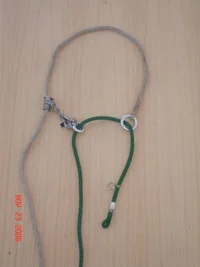
This is long (does anyone look at these?!?), but here goes.
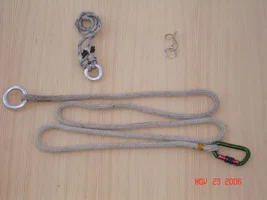
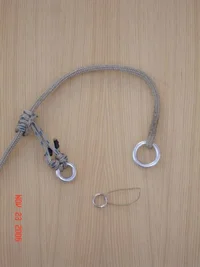
The kit:
--rope (here Safety Blue) with large friction saver ring spliced on one end. The green carabiner on the other end just serves as a stopper on the end.
--split tail cord (here Stay Set) tied to a small friction saver ring.
--small ring from an old throw weight. To avoid confusion with the other rings, I will call this ring the 'retrieval ring' or RR.
--small (about 4-5 inch) loop of string (here Zing-It) spliced to the RR.
--climbing line (not shown here, but in later photos).
The kit:
--rope (here Safety Blue) with large friction saver ring spliced on one end. The green carabiner on the other end just serves as a stopper on the end.
--split tail cord (here Stay Set) tied to a small friction saver ring.
--small ring from an old throw weight. To avoid confusion with the other rings, I will call this ring the 'retrieval ring' or RR.
--small (about 4-5 inch) loop of string (here Zing-It) spliced to the RR.
--climbing line (not shown here, but in later photos).
Attachments
- Location
- Bloomington, Indiana
- Location
- Bloomington, Indiana

- Location
- Bloomington, Indiana
- Location
- Bloomington, Indiana
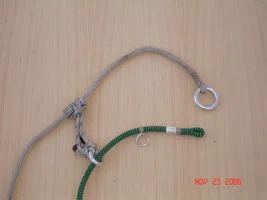
Pull the RR up tight to the small ring of the AFS. This will all remain attched through the remainder of the job, i.e. there is no need to take the RR off between each setup.
((At the risk of confusing people I will add that a climber would follow these same steps to install the AFS in order to climb the entire tree. Once the canopy was removed and the climber wanted to work the spar, they would pull the end of the climbing line out of the big ring and then follow the steps outlined below and in the following photos.))
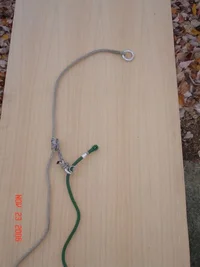
Adjust the prusik so that there is enough line between the small ring and the big ring so that the big ring will go around the stem and the small ring will stay at the side of the climber. Toss the big ring of the AFS around the stem.
((At the risk of confusing people I will add that a climber would follow these same steps to install the AFS in order to climb the entire tree. Once the canopy was removed and the climber wanted to work the spar, they would pull the end of the climbing line out of the big ring and then follow the steps outlined below and in the following photos.))
Adjust the prusik so that there is enough line between the small ring and the big ring so that the big ring will go around the stem and the small ring will stay at the side of the climber. Toss the big ring of the AFS around the stem.
Attachments
[ QUOTE ]
Photos below. The 'string' is just a short (c. 5 inch) loop of string, not a long length. Photos below.
I expect the photo is on its way - it sounds like what I use. I assume you don't use a throwline though?
[ QUOTE ]
Another consideration, is a Factor 1 fall on a short doubled line, compared to a much lower force on a single line (ever gaffed out?).
[/ QUOTE ]
Hmmm...I think that there would be less force on the climber if they were on a doubled line because there would be more rope in the system to absorb and dissipate the the force from the fall.
[/ QUOTE ]
Thats a common mis-conception; that would only be the case if the end of your line was tied to the tree (as in rigging or a doubled back SRT ascent), but not when both ends are tied to you. This is one of the areas where many arborists really don't understand they are at risk; a low stretch line doubled will give unacceptably high forces from as little as 50cm of fall (I tested this in a doubled system 3 times and came up with between 1000 and 1200Kg anchor forces from a 100kg dummy). This is because a doubled line in this situation has half the stretch for the same load than a single line anchored.
Its the same reason a single or half rope shouldn't be used as twin ropes in mountaineering (except where its better than decking out from stretch when low to the ground).
RE: The Croll - This is a good example of how the ANSI strength requirement is hampering progress in efficient, ergonomic ascent techniques. Such equipment is fit for purpose. Tree work has high demands on such equipment, but nothing compared to caving; I've rarely seen a croll at caving training areas or in kit bags that hasn't had all the anodising scraped off! They lock them to their harness and it gets dragged through whatever they drag themselves through (not my cup of tea).
Photos below. The 'string' is just a short (c. 5 inch) loop of string, not a long length. Photos below.
I expect the photo is on its way - it sounds like what I use. I assume you don't use a throwline though?
[ QUOTE ]
Another consideration, is a Factor 1 fall on a short doubled line, compared to a much lower force on a single line (ever gaffed out?).
[/ QUOTE ]
Hmmm...I think that there would be less force on the climber if they were on a doubled line because there would be more rope in the system to absorb and dissipate the the force from the fall.
[/ QUOTE ]
Thats a common mis-conception; that would only be the case if the end of your line was tied to the tree (as in rigging or a doubled back SRT ascent), but not when both ends are tied to you. This is one of the areas where many arborists really don't understand they are at risk; a low stretch line doubled will give unacceptably high forces from as little as 50cm of fall (I tested this in a doubled system 3 times and came up with between 1000 and 1200Kg anchor forces from a 100kg dummy). This is because a doubled line in this situation has half the stretch for the same load than a single line anchored.
Its the same reason a single or half rope shouldn't be used as twin ropes in mountaineering (except where its better than decking out from stretch when low to the ground).
RE: The Croll - This is a good example of how the ANSI strength requirement is hampering progress in efficient, ergonomic ascent techniques. Such equipment is fit for purpose. Tree work has high demands on such equipment, but nothing compared to caving; I've rarely seen a croll at caving training areas or in kit bags that hasn't had all the anodising scraped off! They lock them to their harness and it gets dragged through whatever they drag themselves through (not my cup of tea).
- Location
- Bloomington, Indiana

- Location
- Bloomington, Indiana
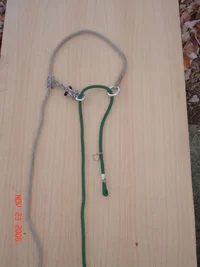
Adjust the setup so that there is about 2 - 6 inches between the small ring and the big ring.
This is the setup.
<u>NOTE</u>
The friction hitch will be on the left side of the climbing line (the same side as the small ring). The eye end of the climbing line will be attached to a carbiner on the saddle.
This is the setup.
<u>NOTE</u>
The friction hitch will be on the left side of the climbing line (the same side as the small ring). The eye end of the climbing line will be attached to a carbiner on the saddle.
Attachments
- Location
- Bloomington, Indiana
- Location
- Bloomington, Indiana


