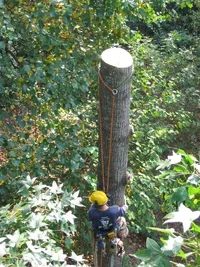
Mark Chisholm Tie in Technique

  • Thread starter Thread starter TC
  • Start date Start date

TC

Participating member
Is anyone out there using the TIE IN TECHNIQUE Mark Chisholm describes on the Article page?

What are you using for this situation - VERTICAL SECTION LOWERING WOOD INTO A BLOCK?

Where is your flipline and where is your climbing line?
Are you attached to front D rings or side D rings or both?

Are you cinching up main climbing line with running bowline and using a figure8 or descending device with back up friction hitch?

Above or below block?

The reason I ask is cause i've seen a few different variations on this technique and i would like to know if anyone has a different approach.

Thanks
smile.gif
 
hey grover check out the thread in the general discussion section entitled "steel core or no" (something like that), it has some discussion about what you're asking.

personally, I take my lifeline and choke it with the biner above the block, but I don't do a lot of rigging so others here would be much better to consult. good luck!

jp
grin.gif
 
Hey Grover. That article still holds most of my beliefs, but I have learned other solutions too. The main thing to do is have an escape route ready at all times that will allow you to rappel or also be easily used by a rescuer, God forbid that would ever need to be used.
 
Hey Mark, what are you using just now in this situation?

I'm using flipline above, and lifeline about 1 ft below block.

I used to use whoopie slings but they slid down the stem under weight trapping the flipline, now i use cowhitch, doesnt move as much.

I get a bit paranoid having both lines above block - just feels weird!

I tried using cinched up lifeline(running bow) with figure 8 backed up with friction hitch, but it seems to create a lot of slack - can't seem to get it tight up to stem.
any ideas?
 
[ QUOTE ]
I tried using cinched up lifeline(running bow) with figure 8 backed up with friction hitch, but it seems to create a lot of slack - can't seem to get it tight up to stem.
any ideas?

[/ QUOTE ]

I like this--adjustable friction saver. Allows the climber to move up or down with ease and can be retrieved from any point on the spar.
 

Attachments

  • 61312-img_1725_cropped_to_29%.webp
    61312-img_1725_cropped_to_29%.webp
    134 KB · Views: 495
Dependant upon how long i'll be working from the position and the dia. of the stem i may tie in with the rope guide. But most of the time, I like the tie in with friction hitch/ running bow. I prefer to skip the fig 8 b/c it just adds one more thing to have to attach/detach/haul around....I don't find a problem repelling on the single line...I think as long as your're using tech cord and wearing gloves the heat/friction will not be an issue.
With this system i don't find it difficult to keep every thing close and tiddy to the tree...if i'm trying to take additional slack out then i may slide the bowline around one side of the stem slightly..

And oh yeah tie in both above the block..
 
I've been using my Trango Cinch to tie into my choked off lifeline. It works really sweet for this application. Easy to install, smooth rappell, takes up slack easily (with enough rope below it sometimes even self tails), locks off automatically. You can also cinch it right up to the stem, which is nice.
 
[ QUOTE ]
adjustable friction saver. Allows the climber to move up or down with ease and can be retrieved from any point on the spar.

[/ QUOTE ]

Mahk, I think i've seen this before in Treeworker or something, can't remember.

Is it like a friction hitch tied round the cambium saver at one side and is it safe - no slipping of friction hitch etc?

Do you have any images or any web pages where i can see this set up?
Thanks
 
[ QUOTE ]
Do you have any images or any web pages where i can see this set up?

[/ QUOTE ]

The one that Wespur has is a webbing Friction saver. Here is one that is made of rope (also see the attachment in my earlier post). The setup is the same, big ring on one end, small ring on an adjustable friction hitch (although there are variations of this).

Instead of using a screw link for retrieval (as in the attachment), however, I now use a small metal ring--the ring from an old throw weight works well. The ring is girth-hitched to a small loop of string (throwline, starter cord, shoe lace) and the string is then girth-hitched to the climbing line.

I find this system is easy to retrieve, even if the tree has ivy, big stubs, flaky bark etc., and easy to set up. The adjustable friction saver is used as the tie-in while dismantling the tree, and is then used choked to the stem for blocking down the wood.
 

Attachments

  • 61423-DSC02501_resized_25%.webp
    61423-DSC02501_resized_25%.webp
    74.8 KB · Views: 488
I find it a bit of a fiddle to set up, and it doesn't offer much support because of the slack.

By choking your line with a karabiner, you can take up slack and lean into the line to the left or right. Its very quick and easy.

It is useful for a false crotch when working a tree from DdRT that doesn't have a useful fork/storm damaged top. I prefer it to the rope guide.
cool.gif
 
Get the art rope guide pulley and attach it to your cambium saver, the best 60$ you'll spend. It is less bulky then the rope guide itself and allows you to put it tothe left or right of the stem and lean gainst it like Mahk was talking about. The thing is really, really nice for that application. It allows you to tie in anywhere with a frictionless system. Way less time consuming then tieing a bowline with a long tail, I hate that, and half the time I dont make the tail long enough.

I agree with the tieing in above to block, but I also like to have my flip line and climbing line in slightly different places. One of the ideas of having two tie in points is in case I slip and cut my line, if they are in the same spot, its very possible I will nail them both. This has led me many times to put my lanyard above and my rope guide below as I am not supporting my wieght on it.
 
[ QUOTE ]
Get the art rope guide pulley and attach it to your cambium saver, the best 60$ you'll spend. It is less bulky then the rope guide itself and allows you to put it tothe left or right of the stem and lean gainst it like Mahk was talking about. The thing is really, really nice for that application. It allows you to tie in anywhere with a frictionless system. Way less time consuming then tieing a bowline with a long tail, I hate that, and half the time I dont make the tail long enough.

I agree with the tieing in above to block, but I also like to have my flip line and climbing line in slightly different places. One of the ideas of having two tie in points is in case I slip and cut my line, if they are in the same spot, its very possible I will nail them both. This has led me many times to put my lanyard above and my rope guide below as I am not supporting my wieght on it.

[/ QUOTE ]

Oh, I see. I thought Mahk meant the AMT adjustable FC.
 
Just a note on rapelling a single line vs. DRT on a friction hitch. Yes, theoretical load on the hitch is 2X when tied into a single line vs. DRT but only half the length of rope has to travel through the hitch to drop the same distance. I don't know what that really means but I would guess as far as heat build-up the differences might cancel out.
 
Its academic Clay. The hitch will slide out of control = crash and burn whether it burns through or not on a single line (check comp aerial rescue accident in awakenings). Either that, or it jams up. Its a simple matter to stick a krab under the hitch with a meunter. Works very sweetly, even one hand pull on hitch, slide through meunter etc.

I prefer the choked line to the adjustable choked FC; easy to set up regardless of tree girth. Just whip it round and clip it up. Krab choked in the end rather than runn. bowlin.

Also, easy to set up and retrieve when descending from a pole, with control. i.e. just slides down the pole, rather than a ringed false crotch flying free - especially if it has that chunk of a rope guide on it. A good way to damage an expensive piece of it!
cool.gif
 

New threads New posts

Back
Top Bottom