Looking for feedback on how to make these thoughts clearer. I have seen limited or no mention of this idea in some pretty comprehensive documents. At the ANSI Z meeting, the person in charge was highly concerned that we were seeing a significant increase of major accidents by tree parts failing when rigging loads were applied. Most of the companies I have stopped to watch almost inevitably will be loading as in picture 4 (typical rigging situation)or worse. Looking at every crawler crane - they are super careful about the vectors yet we tend not to be (from what I have seen).

Navigation
Install the app
How to install the app on iOS
Follow along with the video below to see how to install our site as a web app on your home screen.
Note: This feature may not be available in some browsers.
More options
You are using an out of date browser. It may not display this or other websites correctly.
You should upgrade or use an alternative browser.
You should upgrade or use an alternative browser.
Loading the tree
- Thread starter fireaxe
- Start date


- Location
- Penticton, British Columbia
Basically it seems to me that you are suggesting that our rigging practices should attempt to utilise the strengths of tree structure, rather than working against it.
Which would indicate a need for the working arbo to have at least a working understanding of biomechanics and physics. I'm for it...
Which would indicate a need for the working arbo to have at least a working understanding of biomechanics and physics. I'm for it...
Exactly.
An item that I failed to incorporate into the slides is one of the dampening effects of all the tree's parts. If you have ever notched the top of a tree on a rope, you know exactly what an un-dampened load feels like. Leave as many lower branches on as is feasible - work from the top down. You will be amazed at how little "rocking your world" will occur. Talk about an idea that is 180 degrees from the way we are taught... Thank you Mr Kevin James.
I bring these things up because I rope almost every branch on almost every tree removal. I do not like the out of control at all. I know we all get into this for the drama, but screw that, I want to live to retirement!
An item that I failed to incorporate into the slides is one of the dampening effects of all the tree's parts. If you have ever notched the top of a tree on a rope, you know exactly what an un-dampened load feels like. Leave as many lower branches on as is feasible - work from the top down. You will be amazed at how little "rocking your world" will occur. Talk about an idea that is 180 degrees from the way we are taught... Thank you Mr Kevin James.
I bring these things up because I rope almost every branch on almost every tree removal. I do not like the out of control at all. I know we all get into this for the drama, but screw that, I want to live to retirement!

- Location
- Orange, MA
I redirect multiple times if needed at all times to always be compressing stems,rather than attempt to rip them off!

- Location
- North Idaho
I think your message comes across fairly clearly in your illustration. However, I have some issues with the wording. In the first picture, green doesn't really represent what must be overcome to stay standing. Gravity (and other additional forces) is what must be overcome to stay standing. In the second picture, I don't think you're talking about torsion loads (although, depending on the rigging, I know they do act on the tree). I think you're talking about bending loads.
- Location
- Penticton, British Columbia
[ QUOTE ]
Leave as many lower branches on as is feasible - work from the top down. You will be amazed at how little "rocking your world" will occur. Talk about an idea that is 180 degrees from the way we are taught... Thank you Mr Kevin James.
I bring these things up because I rope almost every branch on almost every tree removal. I do not like the out of control at all. I know we all get into this for the drama, but screw that, I want to live to retirement!
[/ QUOTE ]
Sounds like you work in some tight quarters.
I think the idea to leave some branches to avoid 'untuned' dynamic loading is fairly commonplace in our industry, however.
I don't believe that it is necessary to safely remove a tree though. It is a technique that certainly has its place in my toolbox, especially when removing trees with defects, or tall skinny conifers. But, I would say I employ that method maybe 10% of the time. For the most part I work on conifers, though. Taking the time to climb up, lower a top, then climb back down and lower the limbs, then climb back up to chunk or lower wood out is unnecessary for the majority of the work I do IME.
Another way to avoid the problems you illuminate is to utilise speedlines, whether controlled or not. A great way to disperse the loading from rigging, and one has the benefit of being able to disperse the load by running the line through multiple unions, much the same as an SRT system. And of course, being able to anchor the line in the opposite direction of the path of the rigging again affords the rigger an additional option for supporting the tree during the rigging operation. Generally, if I have to lower a limb, it is done with a speedline so that the work ends up closer to the processor.
Good thread BTW.
Leave as many lower branches on as is feasible - work from the top down. You will be amazed at how little "rocking your world" will occur. Talk about an idea that is 180 degrees from the way we are taught... Thank you Mr Kevin James.
I bring these things up because I rope almost every branch on almost every tree removal. I do not like the out of control at all. I know we all get into this for the drama, but screw that, I want to live to retirement!
[/ QUOTE ]
Sounds like you work in some tight quarters.
I think the idea to leave some branches to avoid 'untuned' dynamic loading is fairly commonplace in our industry, however.
I don't believe that it is necessary to safely remove a tree though. It is a technique that certainly has its place in my toolbox, especially when removing trees with defects, or tall skinny conifers. But, I would say I employ that method maybe 10% of the time. For the most part I work on conifers, though. Taking the time to climb up, lower a top, then climb back down and lower the limbs, then climb back up to chunk or lower wood out is unnecessary for the majority of the work I do IME.
Another way to avoid the problems you illuminate is to utilise speedlines, whether controlled or not. A great way to disperse the loading from rigging, and one has the benefit of being able to disperse the load by running the line through multiple unions, much the same as an SRT system. And of course, being able to anchor the line in the opposite direction of the path of the rigging again affords the rigger an additional option for supporting the tree during the rigging operation. Generally, if I have to lower a limb, it is done with a speedline so that the work ends up closer to the processor.
Good thread BTW.
There are definitely a ton of variables - literally. In all cases the force has to be supported. In all cases unless the tree is cabled or propped, the load has to be supported down the stem, unless invisible strings are holding up the tree - j/k.
I had a brief conversation with someone who felt that one should be cautious about loading due to the difference of fiber in a tree. When the wind blows and bends the stem - no matter what - the idea of delineating compression/tension wood go out the window. In a rigging situation, you typically can't apply tension, our only option is compression unless you are going to install additional supporting factors. When you start pulling sideways on branches or stems or trees, bad things can occur.
I came onto a job one day when my crew was hanging a little VA pine from another. The small tree was not heavy. The tree that they were hanging it on was a bit larger but bent. So if you can picture them standing under the lean, hanging this small pine. Everybody is starting to get the picture that the effective force on the supporting pine was twice what the small pine weighted. When you take that then add the two vectors together - uhhh - that ain't gonna be good. Go over to the side opposite and the problem goes away (mostly). Forces applied DOWN the stem.
I don't really have much of a physics background, my background is biology. I would love to do some of the research that is needed in this area, but I have to feed my 2 beautiful kids. Maybe once they get out, I will do some if my rigging holds up .
.
I had a brief conversation with someone who felt that one should be cautious about loading due to the difference of fiber in a tree. When the wind blows and bends the stem - no matter what - the idea of delineating compression/tension wood go out the window. In a rigging situation, you typically can't apply tension, our only option is compression unless you are going to install additional supporting factors. When you start pulling sideways on branches or stems or trees, bad things can occur.
I came onto a job one day when my crew was hanging a little VA pine from another. The small tree was not heavy. The tree that they were hanging it on was a bit larger but bent. So if you can picture them standing under the lean, hanging this small pine. Everybody is starting to get the picture that the effective force on the supporting pine was twice what the small pine weighted. When you take that then add the two vectors together - uhhh - that ain't gonna be good. Go over to the side opposite and the problem goes away (mostly). Forces applied DOWN the stem.
I don't really have much of a physics background, my background is biology. I would love to do some of the research that is needed in this area, but I have to feed my 2 beautiful kids. Maybe once they get out, I will do some if my rigging holds up
.
- Location
- Hawaii
[ QUOTE ]
I don't believe that it is necessary to safely remove a tree though. It is a technique that certainly has its place in my toolbox, especially when removing trees with defects, or tall skinny conifers. But, I would say I employ that method maybe 10% of the time. For the most part I work on conifers, though. Taking the time to climb up, lower a top, then climb back down and lower the limbs, then climb back up to chunk or lower wood out is unnecessary for the majority of the work I do IME.
[/ QUOTE ]
Exactly. It may be a useful technique in trees with significant defects as mentioned where there is no access for a crane or bucket truck and must be climbed.
We use the fishing pole rigging technique pretty often to spread the load out across the stem and often back to the trunk when/where possible. There's a lot of info about your question in the practical rigging pub and Beranek's Fundamentals book as well. I agree, good thread.
jp

I don't believe that it is necessary to safely remove a tree though. It is a technique that certainly has its place in my toolbox, especially when removing trees with defects, or tall skinny conifers. But, I would say I employ that method maybe 10% of the time. For the most part I work on conifers, though. Taking the time to climb up, lower a top, then climb back down and lower the limbs, then climb back up to chunk or lower wood out is unnecessary for the majority of the work I do IME.
[/ QUOTE ]
Exactly. It may be a useful technique in trees with significant defects as mentioned where there is no access for a crane or bucket truck and must be climbed.
We use the fishing pole rigging technique pretty often to spread the load out across the stem and often back to the trunk when/where possible. There's a lot of info about your question in the practical rigging pub and Beranek's Fundamentals book as well. I agree, good thread.
jp

RopeShield
Carpal tunnel level member
- Location
- Ontario, Canada
Please.
Can some one point me to the study of the dampening effects of the crown when rigging?
I understand what is happening but wwood like to learn more to see if it can be tweaked or used more to our advantage.
I am thinking as a counter balance with questionable root platform, or other defecencies.
I did 4 nasty poplars recently all with questionable roots and wounds, one was like a wiggly tooth. I remove everything as I climb with the intent to remove the weight/levering potential before I get to the top.
Really want to be more thoughful of this crown dampening effect and apply with as much science as possible.
I most always consider any additional or uneccessary limb weight below at or above the rigging point as adding to the leveraging of the rig point and adding to cycles to failure.
What is the big game changer? It is about maximizing or minimizing leverages?
Thank you

Can some one point me to the study of the dampening effects of the crown when rigging?
I understand what is happening but wwood like to learn more to see if it can be tweaked or used more to our advantage.
I am thinking as a counter balance with questionable root platform, or other defecencies.
I did 4 nasty poplars recently all with questionable roots and wounds, one was like a wiggly tooth. I remove everything as I climb with the intent to remove the weight/levering potential before I get to the top.
Really want to be more thoughful of this crown dampening effect and apply with as much science as possible.
I most always consider any additional or uneccessary limb weight below at or above the rigging point as adding to the leveraging of the rig point and adding to cycles to failure.
What is the big game changer? It is about maximizing or minimizing leverages?
Thank you
- Location
- Penticton, British Columbia
When one is concerned with the structural integrity of the trunk of a given tree or simply in avoiding going for a ride, it is prudent to leave as many limbs on the tree as is possible prior to rigging to allow a more natural oscillation, and thus diffusion of the forces acting on the tree. This may allow the rigger to avoid placing undue or new stresses on areas of the trunk of a tree which have not been loaded as such...ever.
The removal of a significant proportion of limbs completely changes the way in which a tree moves, and if we are concerned it is best to allow a tree to move more naturally during work operations.
Which, strangely enough seems to fit with the gist of fireaxe's post, which was to perform rigging operations in harmony and with a sound (or working) knowledge of biomechanics and physics.
The removal of a significant proportion of limbs completely changes the way in which a tree moves, and if we are concerned it is best to allow a tree to move more naturally during work operations.
Which, strangely enough seems to fit with the gist of fireaxe's post, which was to perform rigging operations in harmony and with a sound (or working) knowledge of biomechanics and physics.

Norm_Hall
New member
- Location
- Wauconda, (Chicago),IL,USA
[ QUOTE ]
I redirect multiple times if needed at all times to always be compressing stems,rather than attempt to rip them off!
[/ QUOTE ]
Me too! Take advantage of the trees structure.
I 'back tie' alot as well. Sometimes, it's a better solution.
I redirect multiple times if needed at all times to always be compressing stems,rather than attempt to rip them off!
[/ QUOTE ]
Me too! Take advantage of the trees structure.
I 'back tie' alot as well. Sometimes, it's a better solution.

SingleJack
Participating member
- Location
- W MD
[ QUOTE ]
[ QUOTE ]
I redirect multiple times if needed at all times to always be compressing stems,rather than attempt to rip them off!
[/ QUOTE ]
Me too! Take advantage of the trees structure.
I 'back tie' alot as well. Sometimes, it's a better solution.
[/ QUOTE ]
"back tie"? Would you add a little detail, please? ... wanna make sure it's understood correctly ... thx
[ QUOTE ]
I redirect multiple times if needed at all times to always be compressing stems,rather than attempt to rip them off!
[/ QUOTE ]
Me too! Take advantage of the trees structure.
I 'back tie' alot as well. Sometimes, it's a better solution.
[/ QUOTE ]
"back tie"? Would you add a little detail, please? ... wanna make sure it's understood correctly ... thx
Norm_Hall
New member
- Location
- Wauconda, (Chicago),IL,USA
[ QUOTE ]
[ QUOTE ]
[ QUOTE ]
I redirect multiple times if needed at all times to always be compressing stems,rather than attempt to rip them off!
[/ QUOTE ]
Me too! Take advantage of the trees structure.
I 'back tie' alot as well. Sometimes, it's a better solution.
[/ QUOTE ]
"back tie"? Would you add a little detail, please? ... wanna make sure it's understood correctly ... thx
[/ QUOTE ]
Back tie the lowering branch to another more vertical or more substantial branch to help share the load.
[ QUOTE ]
[ QUOTE ]
I redirect multiple times if needed at all times to always be compressing stems,rather than attempt to rip them off!
[/ QUOTE ]
Me too! Take advantage of the trees structure.
I 'back tie' alot as well. Sometimes, it's a better solution.
[/ QUOTE ]
"back tie"? Would you add a little detail, please? ... wanna make sure it's understood correctly ... thx
[/ QUOTE ]
Back tie the lowering branch to another more vertical or more substantial branch to help share the load.

Fairfield
Participating member
- Location
- Bucks County pa USA
Not to get too far off topic but along the same lines. I have noticed climbers use two crotches ( two diffrent leads) for thier climbing line. Doing so to have the strength from both thinking the one alone isnt strong enough. Unfortunitly this makes a death triangle. I know the thought for some guys to setup a self equlizing anchor for the climbing line or in some cases the rigging line takes to long, but when worried about your anchor point why not.

treehumper
Carpal tunnel level member
- Location
- Ridgefield, NJ
John Ball I believe had some visual aids that demonstrated the difference in forces exerted on the stem when topping out a conifer with and without lower limbs. It clearly showed the dampening effect. It was a presentation sponsored by Vermeer in Brampton, ON. Quite impressive.
Having studied vectors for a physics class in college I apply the concepts as much as possible during rigging. Multiple re-directs that will set up more of a compression force on the limbs than side loads etc...
There's a whole workshop in vector and phaser analysis that would be hugely beneficial to arborists. Hmmmmm, maybe ISA or TCIA can get on this!
Having studied vectors for a physics class in college I apply the concepts as much as possible during rigging. Multiple re-directs that will set up more of a compression force on the limbs than side loads etc...
There's a whole workshop in vector and phaser analysis that would be hugely beneficial to arborists. Hmmmmm, maybe ISA or TCIA can get on this!
- Location
- Southern RI
The crane in the picture shows a Gantry style which is intended to support the boom.
When I am working on dropping the top I use a specific notch configuration so as to not have the bending moment occur at the same time as the hinge wood breaks.
Also my ground people are told to let it run until the brush hits the ground then put the brakes on and the drop is smooth. wear heavy gloves and stay focused.
If you work together everyday I think that is more important in controlling rigging forces than you might think.
When I am working on dropping the top I use a specific notch configuration so as to not have the bending moment occur at the same time as the hinge wood breaks.
Also my ground people are told to let it run until the brush hits the ground then put the brakes on and the drop is smooth. wear heavy gloves and stay focused.
If you work together everyday I think that is more important in controlling rigging forces than you might think.

TC
Participating member
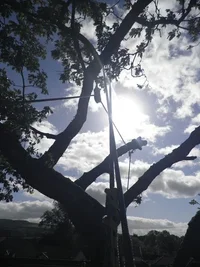
I nearly always use two blocks when rigging a tree down - not only to help dissipate the forces throughout the crown but it also gives you more options for lowering.
Lower a few branches down one side then switch to the other end of the rigging line a lower a few branches down the other side of the tree. This way your not putting too much pressure on one side of the root plate....your keeping the tree almost perfecty balanced as the crown is dismantled.
If I'm keeping the loads light I'll just re-direct through a suitable natural crotch instead of a 3rd pulley.


Lower a few branches down one side then switch to the other end of the rigging line a lower a few branches down the other side of the tree. This way your not putting too much pressure on one side of the root plate....your keeping the tree almost perfecty balanced as the crown is dismantled.
If I'm keeping the loads light I'll just re-direct through a suitable natural crotch instead of a 3rd pulley.
Attachments
TC
Participating member


boreality
New member
- Location
- boreal forest
This is the most fascinating part of tree removal. Whoever takes on the research is going to have a blast literally, bustin trees in half. Because you wouldn't learn anything until you've achieved failure.
[ QUOTE ]
I nearly always use two blocks when rigging a tree down - not only to help dissipate the forces throughout the crown but it also gives you more options for lowering.
Lower a few branches down one side then switch to the other end of the rigging line a lower a few branches down the other side of the tree. This way your not putting too much pressure on one side of the root plate....your keeping the tree almost perfecty balanced as the crown is dismantled.
If I'm keeping the loads light I'll just re-direct through a suitable natural crotch instead of a 3rd pulley.
[/ QUOTE ]
this technique sounds like it has the potential to cause cofusion for the groundie and kinda complicate what looks to be normal removal. i've found keeping the work simple makes for a smoother and more efficient job. use the more complicated techniques where it's needed.
I nearly always use two blocks when rigging a tree down - not only to help dissipate the forces throughout the crown but it also gives you more options for lowering.
Lower a few branches down one side then switch to the other end of the rigging line a lower a few branches down the other side of the tree. This way your not putting too much pressure on one side of the root plate....your keeping the tree almost perfecty balanced as the crown is dismantled.
If I'm keeping the loads light I'll just re-direct through a suitable natural crotch instead of a 3rd pulley.
[/ QUOTE ]
this technique sounds like it has the potential to cause cofusion for the groundie and kinda complicate what looks to be normal removal. i've found keeping the work simple makes for a smoother and more efficient job. use the more complicated techniques where it's needed.
New threads New posts
-
test
-

-
KBNest -Midline Attachable SRS Canopy Anchor.
- Started by TreeSteward
- Replies: 1
-

-
-

-


