Limb caught on lanyard

Today I was cutting down a 60 foot hackberry. Spiking it, everything was going smooth, just cut a section of the top out, lowering it on a rope, when a small fork caught the overhand stopper knot I have at the tail of my lanyard. The limb only weighed around 200 pounds and was not in free fall when it came up short on my lanyard. I keep a knot at the end of my lanyard to keep myself from slipping off the end of the rope. Just wondering if any of you have a good idea on how to have a stopper that won’t catch a small fork. I use a micro pulley with a VT prussic for my lanyard which is half inch line.
 
A sewn eye on the end might work like a stopper.

Easier solution would be adjust your body position or move the tail of your lanyard behind your back if it’s gonna be in the line of fire. A biner or link or little loop of 550 cord or throw line will work.

Glad that didn’t get nasty man :)
 
I use a double over hand stopper knot for some of my lanyards too, and have sewn terminations on others. I just try to be cognizant of where and how a piece will fall after it's cut and what is hanging off my harness that it might snag on the way down. Like Jonny said, move yourself or the tail of your lanyard accordingly.
 
I keep a scaffold knot on a biner and clip the tail to my saddle most of the time. It only hangs loose when I’m in a wide-spreading canopy and I’m using all the slack consistently.
 
To me it’s about rope management. Manage a dangling knot, or manage a small loop. Both need to be considered when working. Sure, I have to move the loop sometimes. Are we trying to come up with something that never needs managed? Sometimes we try to fix the tool rather than fix our habits. Just pay attention to your work zone and manage tools, position, and plan accordingly.
 
I’ve done the same. It sucked me in tight to the trunk, and it was loaded so hard I couldn’t unclip. I had to haul up the tail with everything I had to free it. Nearly cut the tail off..
 
I came in a little hot. Sorry for that. My setup does make a loop, but it’s usually small. If it needs moved, there’s no headache. The loop by nature hangs half the length of a dangling lanyard tail, so it’s a smaller target.
 
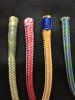
It doesn’t take too much expansion of the rope diameter to stop a friction hitch, bury the cover, or something in the end. Whipping, melting, shrink tube can be added on the outside.
4CFA196A-0C64-48AA-A9CD-40D19130FD56.jpeg
 
I came in a little hot. Sorry for that. My setup does make a loop, but it’s usually small. If it needs moved, there’s no headache. The loop by nature hangs half the length of a dangling lanyard tail, so it’s a smaller target.

Same here. I use a long lanyard, 25' and don't let it hang. Daisy chain the unused portion and clip it to the side of my harness, out of the way.

When using a heavy flip line, I personally don't care for stopper knots. If the one I am using has a knot or thimble I take great care of where it is and that it is out of the way of things that might snag it.
 
My current set up for lanyard is a variation of this video below.


It puts the lanyard as loops on my side and behind, but are close in and, as mentioned above, are small targets. Being so generally close in to my saddle allows my positioning to act as the primary means of controlling the lanyard tail position. Plus it allows me to alternate lanyard to pass crotches, which I like.

I am also running one of @Brocky 's stitch hitches as one of my lanyard adjustor hitches. Provides good onehand adjustment, and also allows for choking with a munters and running as a short SRT which can at times work something like @moss 's choking lanyard. (The munters is instead of having another prussic floating on my line, like the video above.)
 
I wonder if a figure 8 stopper knot might be a little less prone to getting caught in branch unions than double overhand.
 
It doesn’t take too much expansion of the rope diameter to stop a friction hitch, bury the cover, or something in the end. Whipping, melting, shrink tube can be added on the outside.
View attachment 67390
Personally I splice both ends unless reusing a termination from a nicked climbing line. This way I can swap ends and even out the wear.
 

New threads New posts

Back
Top Bottom