
I hate bulky knots on lanyards. Wesspur makes custom ones for me. I prefer 10.5mm static rope. Two sewn splices with double locking snap. Endelrid. 10ft long. Use 8mm HRC 19" hitchcord handsplices in a VT ( 2/2 ) between a pinto. Loads and unloads flawlessly. Static ropes hardly pick and are easily thrown. No wishy washy nonsense. I usually buy two at a time. I own 6 lanyards presently at diffrrent wear. Have sappy ones. All are setup with a tuefelberger thimble prussic for SRT usage.

Navigation
Install the app
How to install the app on iOS
Follow along with the video below to see how to install our site as a web app on your home screen.
Note: This feature may not be available in some browsers.
More options
You are using an out of date browser. It may not display this or other websites correctly.
You should upgrade or use an alternative browser.
You should upgrade or use an alternative browser.
Let's talk lanyards
- Thread starter Scratch
- Start date

Scratch
Participating member
- Location
- Hudson, WI
I "think" things are starting to click a little bit. Correct me if I'm wrong...
The friction hitch I see people using, let's say the Distel for example. I see people using two fingers to release it and they gently slide down a tree on a single line, but I must be seeing that with something like a Hitch Hiker or Rope Wrench also right? @Jehinten mentioned earlier on this thread about needing something to cause friction to help share the load. That's where either a Hitch Hiker, Rope Wrench, doubled line, or a simple wrap around a tree will help right?
In my hitch testing, I wasn't doing that. I was just tying a hitch on a single rope hanging down, clipping into it, and expecting to slowly descend using two fingers. I NEED to have some OTHER form of friction as well correct? Am I understanding that correctly?
The friction hitch I see people using, let's say the Distel for example. I see people using two fingers to release it and they gently slide down a tree on a single line, but I must be seeing that with something like a Hitch Hiker or Rope Wrench also right? @Jehinten mentioned earlier on this thread about needing something to cause friction to help share the load. That's where either a Hitch Hiker, Rope Wrench, doubled line, or a simple wrap around a tree will help right?
In my hitch testing, I wasn't doing that. I was just tying a hitch on a single rope hanging down, clipping into it, and expecting to slowly descend using two fingers. I NEED to have some OTHER form of friction as well correct? Am I understanding that correctly?

Yes, you got it now. You really can't expect to descend a single line with just a friction hitch. The lanyards you're seeing choked are likely being used for positioning not ascending/ descending. Have you tried yours yet without choking it?
I use my hitchhiker on climbing line as a second lanyard when spur climbing, it's a great lanyard adjuster.
I use my hitchhiker on climbing line as a second lanyard when spur climbing, it's a great lanyard adjuster.
Last edited:

Sounds like you need some instruction in person and not by internet.
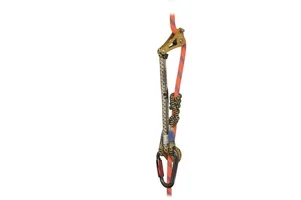
If you were seeing people descend vertically on a hitch similar to this, then you were witnessing climbing on a hitch SRT with added friction (Rope Wrench):
If you saw something like this, you were seeing DdRT climbing which doesn't require a device to add friction:
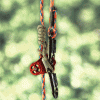
Lanyard use could be in either mode, but almost never vertically with full weight on the hitch SRT style. If you are having difficulty otherwise, it's probably because your rope or hitch cord is too dynamic (stretchy). Until you learn more and get experience, quit wasting time and effort and buy a premade lanyard kit from one of the arborist suppliers.
If you were seeing people descend vertically on a hitch similar to this, then you were witnessing climbing on a hitch SRT with added friction (Rope Wrench):
If you saw something like this, you were seeing DdRT climbing which doesn't require a device to add friction:
Lanyard use could be in either mode, but almost never vertically with full weight on the hitch SRT style. If you are having difficulty otherwise, it's probably because your rope or hitch cord is too dynamic (stretchy). Until you learn more and get experience, quit wasting time and effort and buy a premade lanyard kit from one of the arborist suppliers.

Scratch
Participating member
- Location
- Hudson, WI
I guess I meant by using the friction of a tree like in DRT or splitting your weight with a lanyard, or doubling your rope like in DRT, Maybe I'm not using the right terminology...You can also use a figure 8, tubular belay device, or a Munster's hitch on a carabiner to generate friction for descending. Using a footlock on the rope will also work.
Not sure what you mean by a simple wrap around the tree?
I've now re tied my 8mm cord into a Distel, around my 1/2" lanyard, and it does release easily with two fingers like I see so often, when the weight of my fat butt is spread out between the two ends of the lanyard, it seems to be working as it should.
Ive also tried the Michoacan, VT, and Knut as well. I like the Distel the best, but it seems they are all extremely similar.
Thanks again everyone for not flaming a newbie out and helping me understand.
Last edited:
Scratch
Participating member
- Location
- Hudson, WI
Another quick question... Is DRT the same as DdRT? One is just a more technically correct term.... Like if you say "double rope technique" that could imply the use of two separate rope, so to be more clear, the technique should be called "doubled" rope technique to imply one rope, double over? Hence the second d?
Am I correct?
Am I correct?
Last edited:
Unfortunately, you are getting into the hobby at a time when techniques have been evolving rapidly and so has the terminology.Another quick question... Is DRT the same as DdRT? One is just a more technically correct term.... Like if you say "double rope technique" that could imply the use of two separate rope, so to be more clear, the technique should be called "doubled" rope technique to imply one rope, double over? Hence the second d?
Am I correct?
DdRT is Doubled Rope Technique; like you said, one rope doubled over, with both ends essentially anchored at the climber. There's been a move to relabel it as MRS - Moving Rope System, since the rope moves as you move.
The abbreviation DdRT sometimes gets shortened to DRT when talking informally or when the context is understood, but DRT properly would stand for Double Rope Technique, as in two ropes used together, each in Single Rope Technique. (And SRT is being called SRS - Stationary Rope System).
Confusing, isn't it? Changing the lingo to MRS should clear things up.
I think actual DRT is climbing a doubled rope much like one would climb a single line. I've seen it in secured footlock and not much else.
Isn't using two different ropes " twin rope" ?
I think actual DRT is climbing a doubled rope much like one would climb a single line. I've seen it in secured footlock and not much else.
Isn't using two different ropes " twin rope" ?

- Location
- Retired in Minneapolis
DRT climbing, as it's been used here, would be like half-roping in rock climbing, where each rope can go through different anchor points. Twin rope would be using two ropes in an SRT style, both through the same multicender - like in rock climbing, where twin ropes go through every anchor point. <-- That probably confused things more.Confusing, isn't it? Changing the lingo to MRS should clear things up.
I think actual DRT is climbing a doubled rope much like one would climb a single line. I've seen it in secured footlock and not much else.
Isn't using two different ropes " twin rope" ?
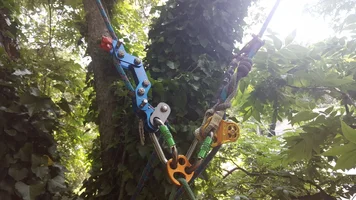
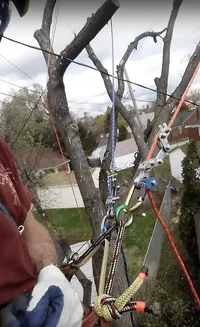
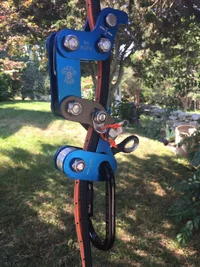

moss
Been here much more than a while
- Location
- Carlisle, Massachusetts, U.S.
I "think" things are starting to click a little bit. Correct me if I'm wrong...
The friction hitch I see people using, let's say the Distel for example. I see people using two fingers to release it and they gently slide down a tree on a single line, but I must be seeing that with something like a Hitch Hiker or Rope Wrench also right? @Jehinten mentioned earlier on this thread about needing something to cause friction to help share the load. That's where either a Hitch Hiker, Rope Wrench, doubled line, or a simple wrap around a tree will help right?
In my hitch testing, I wasn't doing that. I was just tying a hitch on a single rope hanging down, clipping into it, and expecting to slowly descend using two fingers. I NEED to have some OTHER form of friction as well correct? Am I understanding that correctly?
For my short lanyard (15') I use it in SRT mode more frequently than doubled. Depends on the tree the goal of the climb, work or rec etc. I don't use any added friction or bend in the rope beyond the basic hitch. I can just grab the rope above the hitch and take some load off (human rope wrench) or take load off by standing on the tree or share load with my main rope, either way you can get the hitch to move enough for the purposes of a positioning lanyard.
-AJ
New threads New posts
-
test
-

-
 Alternatives to standard asphalt around roots
- Started by southsoundtree
- Replies: 9
-
-

-

-
