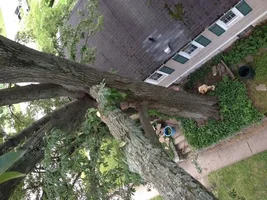
Leaning Red Oak with Fungus

What's the residual risk? Liability for Arborist?

  • High, and very high

    Votes: 0 0.0%
  • Moderate, and high

    Votes: 0 0.0%
  • Moderate, and low

    Votes: 3 60.0%
  • Low, and moderate

    Votes: 0 0.0%
  • Low, and low

    Votes: 2 40.0%

  • Total voters
    5

guymayor

Branched out member
Location
East US, Earth
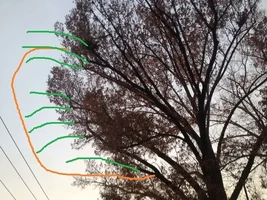
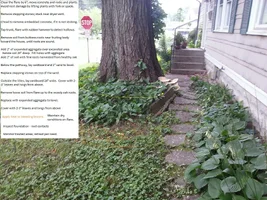
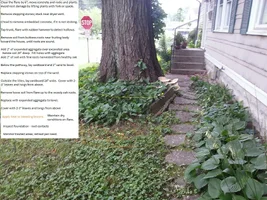
spinning off TreeTop's insurance thread, I just got pics of a shingle oak we treated last August. Specs were conservative in both pruning and soil treatment imo.

 

Attachments

  • 20140723_083321_resized.webp
    20140723_083321_resized.webp
    308.2 KB · Views: 43
  • flare care alfano2.webp
    flare care alfano2.webp
    281.3 KB · Views: 41
  • 20140723_083321_resized.webp
    20140723_083321_resized.webp
    308.2 KB · Views: 42
  • photo 4 (2).webp
    photo 4 (2).webp
    90.3 KB · Views: 44
  • madeiraoak.zip
    madeiraoak.zip
    868.3 KB · Views: 16
Yes, 2014, briefly mentioned here then: http://www.treebuzz.com/forum/threads/slim-flux-on-willow-oak.28336/page-2#post-396098
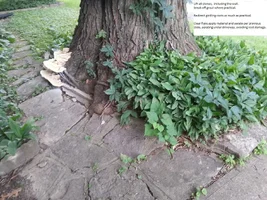
The fungus was/is Bodnarziewia berkelyii. conks weighed 29 pounds. In my one other encounter with it, in Q alba, it was misbehaving, but slowly.

Tom, the item of value I focus on is the tree itself; a concept that U(I?)SA has not not yet integrated into TRAQ, which is one reason why I often use other assessment criteria.
If you look at the pics you'll see a house, roads, and wires. Preserving the house and occupants and surroundings was of course the primary objective, but preserving the tree was a close second.
Or was that question rhetorical? lol!

O and in the survey, the timeframe is 3 years for residual risk, another aspect omitted from the target/defect-oriented TRAQ system.
 
So, the decay is on the house side, as is the majority of the canopy, as it appears to me. When you ask about 'risk,' do you not mean 'risk of the tree causing damage to something?' Or 'risk of losing the tree?' Unfortunately, IME, in this biz, 'risk' means 'risk of the tree damaging something or someone,' and the value of the tree, although important, is not seen as 'risk,' but 'potential loss.' It looks to me like if the tree failed it would go away from the property, and I can't assess those potential risks without more info. Canopy reduction would mitigate risk of failure, though. Was that performed?

Until I am clear on your terminology I cannot complete the survey. I WOULD say that the liability to the arborist is mitigated by BMP's, so I'm going 'low' on that one, despite the potential for lawyers to cast a wide net of liability.

-Tom
 
"Unfortunately, IME, in this biz, 'risk' means 'risk of the tree damaging something or someone,' and the value of the tree, although important, is not seen as 'risk,' but 'potential loss.' "

I agree this is most unfortunate. The way the dominant interests in this Biz frame things, the tree has no value, not even as a 'something', as property--unless you zoom in on two sentences on page 25 of the BMP. Sprawl was toward road away from house due to utility pruning (which was very well done!), and a big red oak behind the house.

Yes it was pruned in august; <15% off top and S side, <4" cuts, 3'-12' lengths removed, cuts made to upright laterals. Typical retrenchment specs. This took the risk from moderate/low to low/very low ime. Unfortunately the matrices are all skewed toward the negative; tables with 5 columns would have allowed for neutrality.
shingle paint reduced.webp
 
spinning off TreeTop's insurance thread, I just got pics of a shingle oak we treated last August. Specs were conservative in both pruning and soil treatment imo.
Guy you give detailed descriptions to all your clients with pics?
Do you know do you know an edible mushroom when you see it?
 
I give detailed descriptions with pics on most jobs to both owner and climber (even when that's me--I forget sometimes!) They keep expectations very clear, don't take long by reusing templates, and are nice to have on file.

I do know some edible mushrooms when I see them, but try to look them up anyway: http://arboristapps.co.uk/

I tried the Bod.b. in an omelet and it was...not very good. :(

I wonder how this tree rates a Moderate residual risk even after all that load reduction. ??
 
It wasn't the Bod.b from the pics on this tree I hope .
Thanks for the app suggestion. I really just started with smart phones and computer s for that matter . They're just not my thing ,but I'm learning I must because that's what I'm up against .:pcmala:
 
To me, a low risk tree has fewer/no obvious defects. Given the lack of structural roots on the opposite side of the fulcrum (there's a foundation there), combined with the fruiting bodies, this constitutes a moderate risk to me.

-Tom
 
To me, a low risk tree has fewer/no obvious defects. Given the lack of structural roots on the opposite side of the fulcrum (there's a foundation there), combined with the fruiting bodies, this constitutes a moderate risk to me.

-Tom

Tom, what effect does load and lever arm reduction have on this assessment/rating?
Is that rating consistent with the way TRAQ was taught? (I'm assuming you did the training)
What if we had taken off <18' sections with <4" cuts, 20% of crown?

Might you reconsider this assumption about lack of roots after probing and sounding and finding functional roots spreading out from the buttress?
The house is 6' away; we see lots of trees closer than that, right?

Sorry to pester you but I'm trying to get a handle on how TRAQ plays out in the field. It changed very little on paper since 1994's guidance.
 
Guy, I have not completed the TRAQ course. I would say my assessment would change if after inspection I found viable structural roots on the house/holding side of the tree. Maybe an air spade inspection would be in order. It's tough to say whether or not more aggressive reduction pruning would be in order, I think I would need to see the tree to weigh the pros and cons.

Tom
 
Fair enough Tom. Wish I had my Mud Knife on that one to move the soil; i had to do the digging while my helper got to have the fun job climbing. It's rare to sell air excavation for diagnostics only; $30 tile probes are good for finding roots.
 

New threads New posts

Back
Top Bottom