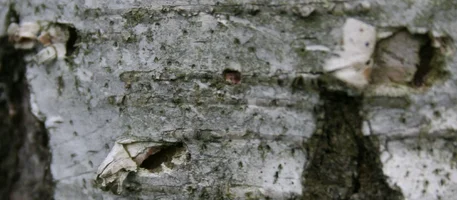
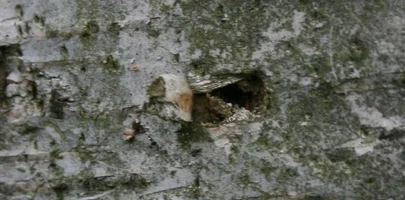
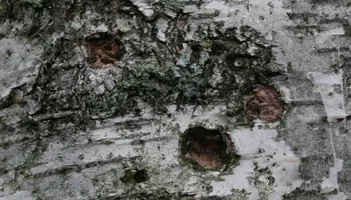
Leaf drop on Gray (White?) Birch

Looked at a customer's tree in Marlborough, MA today.

<u>Tree:</u>
Gray (or White) Birch Tree
Splits into two (2) main trunks at the ground
Each trunk 12-14” DBH
Tree is planted 6-10’ off front of house.

<u>Owner relays following facts:</u>
House built in mid-1980’s
Current owner has lived there for 9 years.
No changes in lawn care; no heavy equipment; no construction nearby. Rain this year appears normal.

Prior to this year, the leaves have come in full every spring for past 9 years and the tree has appeared healthy throughout the growing season into the fall.

<u>Reason for concern:</u>
This spring, no leaves came in on one trunk. Leaves came in on the second trunk, but have since died and fallen off (not a leaf remains).

<u>My observations:</u>

The first trunk had an excessive amount of dead branches throughout; few or no buds appeared on the finest branches that remain; branches seemed very brittle.

The second trunk appeared normal (as though it were fall); branches did seem a little dry, but there are buds present.

Any idea what caused this?
 
IF you don't know what to look for then you should not be offering to look at customers trees that have health problems. You are not making yourself look professional and are certainly not providing a professional service.

Start by learning some identification skills and get a book or two on trees and shrubs of the American north east. Then you need to learn about disease and insects, plant and soil water relations, soil chemistry and microbiology, traditional pest control methodology, intergrated pest management and then maybe the hardest, abiotic causes of tree decline.

Without anymore clues bronze birch borer is the immediate go-to answer but there are loads of possible explainations to be considered. You need to rule out the commonly occuring problems with birches then move on to other things. The one that I always check for on trees that suddenly die is chemical washing off a new roof. That is where knowledge and experience come into play.
 
mrtree,

Yes, I admit that I don't know everything there is to know about trees. In light of that, I told the customer that I was not certain about the cause (since I eliminated everything I thought it might be) and that if I were unable to determine the problem I would refer him to a trustworthy company that would be able to care for the tree. I suppose I could of just said, "It's dead; I'll cut it down for you."

But with respect to your second and third paragraph, thank you; that information is actually helpful. Do you recommend any particular titles?

I'll ask about the roof; that's a possibility.

Anyone,

With respect to inspecting the tree for Bronze Birch Borer, the article posted above states that "an examination of the main branches and trunk at top of the tree needs to be made." I hate to ask stupid questions (even though I do quite well at it), but must I climb to the top of the tree to make this examination? By "top," what is meant? 10' from the highest twig? 20'? I cannot access the tree via bucket because of the customer's property layout and the tree is quite full; I want to avoid damaging it.

thanks!
 
binoculars
grin.gif

Randomsuzpics024.jpg
 
If you are serious about learning, get a copy of Trees of the Northern United States and Canada by John Laird Farrar. Contact ISA and get a copy of the ISA certified arborist study guide. This very simplistic guide will give you a brief introduction to various topics and the selected references can then be used for more in depth study.
 
Oh I am that bad and far worse.

The Diseases of Trees and Shrubs and Insects that Feed on Trees and Shrubs are both excellent books but very difficult to use until you have some basic background knowledge to start from.

Think how difficult yellow leaves are to diagnose. Is it a yellow hybrid, too much or too little water, soil pH and fertility problem, lack of uptake due to damage roots, microorganisms etc.

If you set out to see what a "normal" tree is like, then you can begin to pick out abnormal trees and then start to understand reasons behind the abnormality.

One of the best little books (but has no relavence to this specific birch) is Wood Decay Fungi Common to Urban Living Trees in the Northeast and Central United States. You can learn some biology, taxonomy, identification and the effects of the pathogen. If there was more of these sorts of books we as an industry would be far better off.
 
Whitinsville,

I understand you are a student, and this is a great way to learn, "out in the field". I would, however, hook up with some follow tree people in your area, and do some walk arounds' to different trees. The ISA store has some good books/DVD's/vhs, also,there are alot of resources here on the BUZZ and we are willing to help.
Some pictures of the Birch in question, may help us to better help you.
Pics of entire tree, trunk, bark, branches, leaves, shots from different angles.

I sure mrtree didn't realize you are just learning.
cool.gif
 
[ QUOTE ]
Oh I am that bad and far worse.


[/ QUOTE ]Nah, yer a mellow fellow, once ya get to know ya!
cool.gif
[ QUOTE ]


The Diseases of Trees and Shrubs and Insects that Feed on Trees and Shrubs are both excellent books but very difficult to use until you have some basic background knowledge to start from.


[/ QUOTE ]A slight exaggeration, perhaps. You can go a long way with a sample in your hand and flipping through the pictures. A good way to get basic info, too.


[ QUOTE ]
One of the best little books is Wood Decay Fungi Common to Urban Living Trees in the Northeast and Central United States. You can learn some biology, taxonomy, identification and the effects of the pathogen. If there was more of these sorts of books we as an industry would be far better off.


[/ QUOTE ]Are you Luley's new marketing man, or are you authoring the next one
grin.gif
? He is contemplating a wider series of books. I agree the format is practical.

Yes a digital camera is a vital diagnostic tool--gets you lots of free advice, some of which may be worth more than the cost!
santa.gif
 
Are you Luley's new marketing man, or are you authoring the next one ? He is contemplating a wider series of books. I agree the format is practical.

No just like his little book. Would consider writing one on lichens of trees though. Have been talking with others about a risk assessment book that would include Elasto-inclino pull test, resitograph, tomograph etc.
 
[ QUOTE ]
one on lichens of trees

[/ QUOTE ]I remember reading a study on lichens demonstrating a pathway for transmission from lichen to host, so the tree is fed by the alga as rent.

Maybe lichen shedding into bark lenticels?

Did you ever hear that?
 
You lost me there Guy. There is clear evidence that in some ecosystems Lichens containing cyanobacteria as the photobiont can have a significant amount of nitrogen supplied by lichens. That coupled with the fact that lichens are extremely polution sensitive would give rise to a PhD on lichens, urban environments and nitrogen cycle.
 
I remember reading a study on lichens demonstrating a pathway for transmission from lichen to host, so the tree is fed by the alga as rent.

Maybe lichen shedding into bark lenticels? or can the fungal mycelia reach into the phloem?

So the question is, have lichens ever been shown to be symbiotic with host trees, or are they just mutualist, i.e. of neutral effect.

a semiacademic question; no immediate practical application.
 
There would be micro-effect of flaking off and digesting into the soil, hosting insect activity that would promote pollenization of the tree, moisture retention from mass that cools the bark/underlament, deterrent for ruminating mammals that seek sugars, etc. I dunno really.
 

New threads New posts

Back
Top Bottom