Lazy or Clever?

Just bought my second one too. Couldn't resist the price! I want to try to modify it so I can insert or remove the rope mid-line. And maybe cut the rope sheave in half and separate it a bit with s him to accept my 1/2 inch stuff. I will keep the other unit in original condition, other than removing the crank handle wheel. Too much fun!
 
Mine is in my neighbor's garage.

Just got back from Chicago, now.

Interested to get my hands on it.

If you shoot a throw line into the tree, and pull in two SRT lines, standard climbing line, and the 3/8 winch line, you can seemingly have a power ascent AND descent personal hoisting system, and personal preference of climbing system.

You can still use the winch for rigging, if you use a standard climbing system, in conjunction with it.
 
Last edited:
I really like this device. I just used it to do an inspection and place rigging. I am going to use it again for canopy access and then lower it down before making cuts. It is really nice to reach the top and not be tired. If I owned a tree service company I would definitely buy my crew at least 1 wraptor. The r500 is nice for my level of rec climbing and work climbing but if I was climbing every day a wraptor would be more appropriate.

I am thinking of adapting the second one to run on 12 or 24 vdc and use it as a boat winch on my boat. If it had a case and fairlead it would be pretty practical. Especially If it will run on 2 7ah batteries packed I to something like an ammo can.
 
My second r500 came in and I am about halfway through with the mods I wanted to try on this second, expendable unit. First I split the rope sprocket with a hacksaw, trued up the cut faces in the lathe, and spread the halves apart with a 3/16 inch brass shim. And the halves are now held back together with four 8-32 screws. This was so the unit would work with my 1/2 inch Tachyon Ash or the older yellow Yale 1/2 inch stuff I have (forgot the name of it). Then I milled off all the housing bits sticking out that kept one from removing or inserting the rope mid-line. There are some further operations needed before it will work OK and once I get all this accomplished, I will upload some photos. I have high hopes it will work as well as it did before, but with the improvements; and I bought a larger DeWalt cordless with three times the power of my other one. One unfortunate thing about these RollGliss units is that the bearings are rather skimpy affairs, some sort of thin pressed plastic or teflon, and not a proper bronze bush or ball bearing. These gadgets are clearly not intended for regular daily use. If there is enough meat in the metal of the housing, I would contemplate machining out the bearing sockets for bronze bushings and maybe installing some grease fittings. Fun stuff! I can't wait to try it out with my 1/2 inch rope when the sodding rain stops! - Stewart
 
the 3/8 is a big turn off for me, I can barely bring my self to 11mm ropes.
Yeah, I agree. If the r500 works with my 1/2 inch regular climbing lines after the mods, I might resell the smaller line that came with it on eBay to recoup some of the outlay. Lots of guys into rock climbing, caving, and rappelling use smaller line and these 450 foot pieces should be great for them. They sometimes are hiking long distances and our thicker ropes in lengths like that would be a considerable burden.
 
I did notice some counter-weights in the hand crank assembly. I'll have to see whether a strategically placed hole-saw hole might expose the hub nut, while allowing the handle assembly to stay on the unit, so that I can have my cake, and eat it too.

Have you had any luck with this?
 
. . . Reviewing the manuals that came with it, showed a relatively short service life using it for descent, and an even shorter service life for ascent . . .
Yeah, that is the wimpy plastic bearings, although these service life ratings are typically very conservative for liability purposes. The steel in the shafting and the gearing is excellent quality. If the bearings are replaced with oil impregnated bronze or plain bronze with grease fittings, this would more or less solve that problem. I don't think there is not enough room in the metal of the housing to machine it out for ball bearing assemblies.

I tested my modified unit yesterday evening right at dusk on my 1/2 inch Tachyon Ash line and using my new larger DeWalt cordless drill, and WOW, the bloody thing climbs with the bigger drill on high speed. It was actually rather scary and will take a bit of getting used to. But I can always switch the drill back to low speed in tricky places. One thing I see is that the Tachyon Ash is rather slippery and soft, doesn't grab into the rope sprocket very well at first. This will work better with a firmer rope I think. I don't have a helmet cam but will get someone to video all this soon, with me testing it again. With my mods, I can take it on and off the rope mid-line. And so far the total outlay is less than $450. including the new drill. I bought the nifty new DeWalt cordless, auto-oiling, brushless chainsaw that uses the same batteries so it all makes a nice combo. (I love this little chainsaw by the way. Great for all sorts of small work and doesn't weigh very much). Best wishes to everyone for 2018! - Stewart
 
This is why I came here to post about this. I am so happy to see how others are modifying this device. This site really has a lot of knowledgeable and creative people. I have found that most of the time people are one or the other but not usually both. I think it is fair to say that most of you on here are right-left brained individuals.

You might be a buzzer if you look at every way in which something can be used and none of them are in the instructions.
 
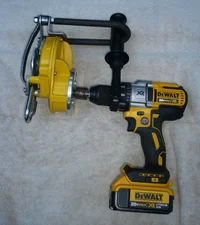
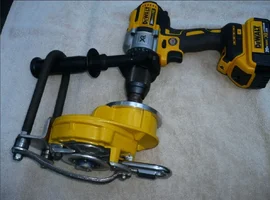
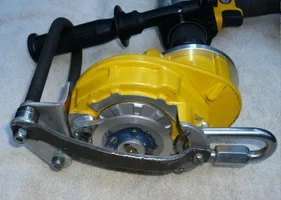
More tests this afternoon, up and down repeatedly about 25 feet in a big cedar by my house. The new DeWalt drill is a heavy duty model DCD991-20v and it lifted me again and again, several dozen times, in all three speeds without ever getting warm or running the 4ha battery down very much. I weigh 185, the device and drill is maybe 12 to 14 pounds more, and another 10 pounds of assorted gear, so it was lifting maybe better than 210 to 220 pounds total, with no problem. And on high speed, it was quite a wild ride until I got somewhat used to it. Next test will be a much higher sustained ascent in another tree. Some issues that became apparent, aside from the previously mentioned one of the 1/2 in. Tachyon Ash being a bit slippery. First the assembled unit will not in itself hold position when one lets off the trigger. The unit and drill will sometimes freewheel backwards and lower one's weight so it is imperative to use a rope grab, hitch, or whatever above it, linked to the bridge (which is good anyway as a safety and for when it is time to remove the r500 from the rope once you are high enough). Also, it is tiring to hold onto the drill and keep it from rotating. It develops a lot of torque and it hurt my wrist after a time. So, my solution was a loop of steel rod that extends out to lock the drill handle in position and keep the drill from rotating. Now the only effort required is to hold down the trigger and shift speeds on the drill if desired. What I ended up using above it to hold position was my Bone on a short strap from the swivel on the bridge. The Bone is thus completely self tending as it rides above the r500 and immediately takes hold once I reverse the drill and back off, slacking the line thru the r500. Then, it just takes a few seconds to remove the r500 from the rope and I am on the familiar Bone for moving around and descending later. The long strap from the Bone is captive in my chest roller so I am comfortably upright the entire time. That much repetitive up and down with my SAKA and foot ascender would have had this poor 64 year old completely whipped but with this gadget I was not tired in the least afterwards. It sounds like Santiago is already regularly making some really high ascents with his. I love this thing! I will try to get someone to shoot some video of another test session soon. Here are some photos I took of the final unit. There are ball bearings where the rope exists the top of the unit, to reduce friction. These were robbed from wheels off an old skateboard. The 5/16 in. bent steel rod loop that locks the drill handle is covered with a piece of 5/16 ID fuel hose and the threaded ends of this rod are also the axles for the ball bearing fairleads. - Stewart
blob.webp blob.webp
 
Those are some pretty nice mods.
Thanks, Santiago. And thanks also for introducing us to this curious device. I had never heard of these emergency descenders before.

To me the biggest issue with these is the fact that, out of the box and unmodified, they are not removable from the rope, so that the line cannot be used as one's main climbing line once you get up into the tree. That is why I cut away all the parts of the housing that keep the rope captive. You can see that in the second photo. I used a milling machine but the job could be done with hacksaw and file also. Once that is done, you can remove or attach the device mid-line. You can ascend on it and then remove it from your main climbing line. In my own case my main line is 1/2 inch stuff so I also cut the sprocket in half and widened it with a spacer shim. It might actually still work on the thinner original rope also but I have not tested that.
 
Here is a better view of my modified r500. You can see the parts I cut away to make the rope easily removable and also that I basically flipped the entire device over so that the rope enters and exits on the opposite end from before. If a person preferred smaller climbing line like the stuff that came with it, one would not have to split and widen the sprocket and the mod would be much easier to affect. Smaller line is nice if you have to hike with a big hunk of it for a long distance. But hard on the hands! One further note - I left the internal centrifugal speed brake intact, just in case! So I have an amateur's homebrew Wraptor for about 1/8th of the cost (I would still recommend that a pro buy the real thing). The drill is instantly removable and usable for other normal work and its batteries also fit my DeWalt cordless chainsaw. A fun project! I can't thank you enough, Santiago!
blob.webp
 
so I have purchased one of these and made the modifications as well and I am currently shopping around for the best driver for it. what is everyone's thoughts on a cordless impact? The one I am looking at is small and compact and delivers 1,000 in-lbs of torque. I figured the high torque would prevent any overheating, my only concern would be the effect that an impact might have on the internal components? From past experience I know that they do not actual impact until the load gets higher. Think this would be work, or should I stick to a heavier drill?
 
so I have purchased one of these and made the modifications as well and I am currently shopping around for the best driver for it. what is everyone's thoughts on a cordless impact? The one I am looking at is small and compact and delivers 1,000 in-lbs of torque. I figured the high torque would prevent any overheating, my only concern would be the effect that an impact might have on the internal components? From past experience I know that they do not actual impact until the load gets higher. Think this would be work, or should I stick to a heavier drill?
If you do cabling and bracing, or think you might want to at some point in the future, the Milwaukee Super Hawg is a great piece. In addition, it will run your GRCS. I try to keep "one trick ponies" out of my tool box. I want every tool to be able to do double, triple or quadruple duties. If I'm going to be drilling something off the deck, possibly with less than stellar body positioning...I want the tool to totally dominate the task.

I don't think I'd want to use an impact tool for this application. Why even bother having to think about whether you're beating the crap out of your lifting system with impact, when you need to be focusing on safe climbing.
 
. . . I don't think I'd want to use an impact tool for this application. . .
I second this. I would not use an impact or hammer drill here at all. With your weight on it, the impact drill will be under load and impacting and this is not a smooth transmission of power like an ordinary drill. And a heavier cordless drill is so useful and versatile for other stuff.
 

New threads New posts

Kask Stihl NORTHEASTERN Arborists Wesspur TreeStuff.com Teufelberger Westminster X-Rigging Teufelberger
Back
Top Bottom