Lanyard length

i guess my question didn't get answered, cuz it didn't post.......!!!


When climbing above my TIP; i like taking small slings every 5-8' running both lines through them, as to secure that at each level if they above one gave the next would catch. Also, secure that my TIP can't ride up. The slings make good handles etc, too; coming down each length is smooth. with longer ones i'll even use them on long horizontals. The length allows the line to pull up off log and give some support; yet, restrict falling/swinging and forces. Imagining crawling through a ledge in a cave and how a rescuer might strategically feed out and put in anchors etc.

i'm very interested in where to get these 5/8" slings Tom (til'Sherrill starts stocking'em), it is time for more slings and i use them for everything, even cut one purposefully in tight spots after using it to get load to certain point for line to take over. In fact if things go wrong they can be pulled off belt, strung and secured with one hand when ya try to tweak too much examining stuff...... ummmm er uhhh so i hear......

Doc amongst other things says that even though suspenders coould present more of a balanced load to spine, routing any weight low waist and under, is better than routing through back. Thanx, though.
 
Can't speak for everyone but 12/16' singles w/Gibbs seem to be the norm here in Portland. Shorties made from climbing line are gaining favor as secondary fliplines though.
 
I've never used a lanyard longer than 12 feet but that's not to say I shouldn't try it out. I'm a startin' climber so that's the way it is for me. Anyway, I'm reading and you guys are talking about DEDA lanyards, so I must ask, what's the DEDA stand for?
Maybe I should know, or maybe I should not know, since I can't figure it out, I'm not sure.
Please let me know either way.
Also, I have used a microcender with my lanyard in the past and I now use an eye and eye prussik with a Schwabish and a pulley and I like it 10 times better!
I'm also using the distel with pulley for my primary friction hitch and I like it a lot. Sorry Blake!!!

Thanks, Russell Van Wijngaarden.
 
Acronym

DEDA is Double Ended Double Adjusting

Do a seach, you should be able to find more information in the archives.

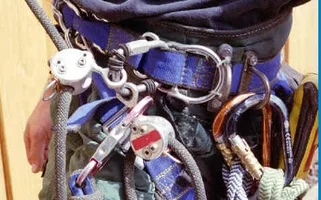
The setup in the picture isn't my current setup. Currently, I have a Positioner on each hip, not like in the picture. I cut off the drings and now have triangular screw links in place. The square one in the picture got a little clunky.

The way mine is configured is with a snap on both ends, an ART Positioner on each hip dring and twenty feet of 7/16" static line between. The lanyard is clipped through a key chain biner in the middle, back, of my waist belt.
 

Attachments

  • 6633-DEDA and B'fly wings.webp
    6633-DEDA and B'fly wings.webp
    32.4 KB · Views: 161
Re: Acronym

Tom,
Where can i locate the 7/16 static line you are using; Is that compatible w/ the grillon i have, i'd like to create my own length of lanyard w/ this piece, the lengths they sell just are not quite fitting my needs. Also do you have any suggestions where i can purchase spectra slings, like the one you are using on the bridge of your butterfly. Sorry thats kind of off of the topic
 
Re: Acronym

Brandon,

You might be able to buy short sections of line from a mountaineering store or marine supply house. Check the side of the Grillion to see what the right sizes are. Same goes for the webbing loop.

Tom
 
Re: mountainclimbing rope, slings

Try www.GearExpress.com They have what they call 'shorts', short sections of rope anywhere from 35' to 140' at reduced prices. They also have all the biners and slings you will ever need, and the guy who answers the phone is usually the same guy who packs your order.
 
Re: Lanyard length--I still prefer 12 feet

Since this post originally appeared, I made myself a long (~30') lanyard. Still single-ended. I almost never use the extra length, but I always have to deal with the dangling, heavy mess by my feet. I tried giving lots of time to adjust, but I don't think I'll be sticking to this system.
My big problem is, since I usually don't need the length, I daisy-chain the excess and clip it out of the way. So, I have to be pretty desperate for the coiled part before I'll go to the trouble of unbundling and rebundling. End up just dragging a couple of extra pounds around for no good reason.

How do you long-lanyard types keep the excess handy, but out of the way?

K
 
Re: Lanyard length--I still prefer 12 feet

Keith- I have a 18'-20' lanyard I made up this past spring. I've used it 3 times and it was handy. I keep it in the truck and only pull it out when I can see where I will need it in the tree (we ALL do that mental climb before setting the first rope, RIGHT?). I normally climb with a standard 8' lanyard and rarely need longer. Gibb's ascenders are large, bulky and heavy so I use a VT hitch on a locking alum. biner for my lanyard adjuster. Nice having a spare friction hitch in the tree 'just in case'.
 
Re: Acronym

I got onto GearExpress.com; looking for a webbing loop, Spectra, Dyneema, and the petzl all rate @ 22 kn. Not what i'm looking for I did find what was called the Metolius, which is made of nylon, rates at 5,000 lbs, but i'd never heard of this product before, and tips. This loop is for my B-fly bridge, probobally needs to be rather sturdy.
 
Interesting point about climbing above TIP, though I was always taught that this is a no no, I have come in the situation where it was done. You are clipping in with a wide biner to your line every 5-8' that way if you were to fall it's distance is being minimized. Am I correct on this? Sounds like a neat idea.
 
Junkie--you have the correct picture with climbing above your TIP. If you are working doubled rope technique, place both legs of your line through the carabiner, basket hitch slung as protection point. Make sure that your bombproof TIP is in such a position that you cannot pull your lifeline off of that location as you go above it. I would urge closer together placement of your pro above TIP than Spyder suggests...a fall 8 feet above your last pro allows a 16 foot drop, and that is way too much for me to be comfortable with. I limit myself to 3 or 4 feet between pro points. This works well with single rope technique, too, but make sure your attachment to the lifeline is appropriate (no toothed ascenders, for example) and oriented to the direction of loading that would occur in a fall...this may mean your friction hitch looks like it is tied upside down from what you are accustomed to seeing when below your tie in point. Maybe try this out low in a tree at first to get your system worked out...take a SHORT jump and see how it all functions. Once you start climbing in the smallwood you may really enjoy it. Lots of motion up there.
 
If I'm climbing more than 8' above my tie-in, then I'm not tied in high enough.
In practical application, I could see this helping when working horozontally. Pretty much useless babblings when discussing working vertically above your tie-in (for the trees in my area, anyway). If I'm working the whole tree, my tie-in is typically within 10'-15' of the top of the tree. I'm not going to waste my time or energy tying in halfway up and using some sort of jerry-rigged daisy chain on my lifeline to climb the rest of the way up. If the lead is strong enough to daisy-chain my lifeline to it, then it's strong enough to tie into it.

Sorry if I'm sounding arrogant, guys. Just my take on it. Just saying this so when some climber reads this thread and asks himself "What the heck? Do people actually do all that stuff instead of just climbing up and setting their lifeline higher?", at least he won't feel alone.
 
Rocky, I agree w/ exactly what your'e saying. Why wouldn't you just recrotch? If i move up enough horizontally, to where i'm getting to the level of my tie in then i'm more likely to recroth or double tie in depending on the route of my climb.
 
Rocky, Junkie--I work almost exclusively in conifers. Working above my TIP is required, if you define TIP as a point in the tree that is strong enough for you to be SURE that you won't break the top out when you are working up there. A higher TIP does you no good if it isn't going to for certain hold you. As I move above this point, say 4 inches stem diameter, I will be climbing on limbs that are less than one inch in diameter. They sometimes break. When that happens, or as I work the upper crown, I load the stem enough to cause concern for its' strength. I place protection as I go just as a route leader on a rock face would do, with the difference being I adjust my belay myself, rather than that being handled by a second. In my situation, I may climb well over 20 feet above the place where I am sure that the tree is strong enough to hold me. I anchor in below that. If I do break out the top, I am tied into the tree by a series of protection points and should stay up there.

We are occupied in different missions...if you had to go where I must go in these trees, pick a bushel or three of cones or harvest grafting scion, you would do something like I do, or you would stand a decent chance of falling to your death...it has happened to more than one climber who failed to follow this procedure. And using this method has kept more than one climber in the tree when the top has failed on them as well. This in no fun, but it beats the alternative hands down.

I offer this and my earlier post as a part of the discussion. If a climber IS going to need to work above or laterally from their TIP my experience could be valuable to consider. I don't expect anyone to tie in lower in the tree than they consider safe and work above that TIP for the fun of it...:).
 
rocky i completley agree with you.i always climb trad with just a grillon with 9' strop.i will tie in as high as possiblethen strat work.if i have to work above my TIP i just flip my strop around a branch that will hold me in a comfortable position to do what i gotta do then move to my next point.if ihave to go out onto the end of a long limb and i don't fell to comfortable about being to stay where i am without slipping i just undo my strop and click in.14 yaers and have never come to any greif this includesdoing some very large trees.looking at some of thr pictures,the amount of gear some people attach to thier harnesses i think to myself"how the hell do they manage to move through a tree with that lot"
still each to their own i suppose
 

New threads New posts

Back
Top Bottom