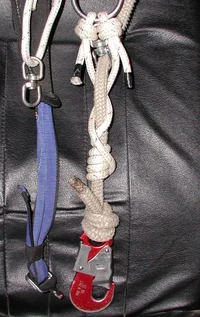
Lanyard adjuster

Tom Dunlap

Here from the beginning
Administrator
For years I had my lanyard attached to my hip dee. The hip dee acted as my slack tender to take care of the adjusting hitch.

After reading so many posts about the convenience of moving the lanyard to the bridge for spar removals or a different positioning setup I decided to make a change.

The ISC biner is so nice! Compact and solid. The ring was at the hardware store and is tied directly into the scaffold hitches that terminate [is that an OK word to use? ] the Tech Cord that I use to tie a Distal.

This setup is working like a champ for me! Cheap, compact and adaptable...I like it!
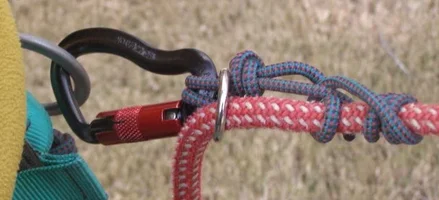
 

Attachments

  • 114642-CRringslacktender.webp
    114642-CRringslacktender.webp
    27.6 KB · Views: 605
I'd worry that the turns of the Scaffold hitches that are on the 'biner could push and twist the barrell of the 'biner, leaving it unlocked. This happened to me when I used a termination knot instead of an eye splice on the end of a climbing line. I now always rotate the 'biner so that the turn(s) of the knot(s) is(are) at the wide end of the 'biner. Another option would be to use a 'biner that opens by pushing the barrell towards the small end (rather than the large end) to unlock it.
 
Good point Mahk, thanks for sharing the insight.

I'm going to take a close look at the setup. Do you know of another small biner that opens by pulling the barrel towards the small end?
 
[ QUOTE ]
I'd worry that the turns of the Scaffold hitches that are on the 'biner could push and twist the barrell of the 'biner, leaving it unlocked.

[/ QUOTE ]

Why not use a double-locking swivel snap instead? The closed eye of the swivel would keep the hitch from touching the lock.
Locking+Swivel+Snap+Hook-Load+Indicator.jpg
 
[ QUOTE ]
http://www.caves.org/section/vertical/nh/49/cthsc/cthsc.html

Laz posted this in another thread. Made me think about how I use Tech Cord. Scroll down to the "Slow pull test" results to read about double vs. triple fishermans(scaffold). Read the conclusion for other good insights.

[/ QUOTE ]

A couple of things:
1. Tom is using the tech cord doubled so after knot efficiency loss is factored in he's still well above 23 kn I think.
2. It looked most of the slow pull test break values were close to or above the static rating of the Maxim tech cord, not sure what the problem is there.
3. The triple fisherman's was only slightly stronger percentage-wise than the double.

I think the main thing with tech cord is that it's small enough diameter that it's going to wear faster than typical friction cords.

Very nice setup for a minimal lanyard rig.
-moss
 
[ QUOTE ]
Why not use a double-locking swivel snap instead?

[/ QUOTE ]


Good idea. A captive eye carabiner would work as well.

But, both the snap and the captive eye 'biner are bigger than the ISC. I think Tom is taking a minimalist's approach.
 
moss,

I agree with your 3 points. However, I want to highlight the fact that Tom is not using the Maxim Spectra A cord listed in the study. He is using the Maxim Tech Cord which is identical to the Black Diamond Gemini 2. The study finds that Gemini's cover broke and the Doublefisherman's(scaffold) came undone. The Triplefisherman's advantage isn't huge but... food for thought. Also, the flex test showed a dramatic drop in tensile strength for all but the Spectra/Nylon type. The legs of a friction hitch tend to flex in the same position as slack is tended and released. Again, the strength loss leveled off at about 15Kn. Enough to handle a work positioning scenario (especially while doubled) but still a significant drop.

I use the Maxim Tech Cord and often wonder about strength loss. If I'm buying it for the 22Kn rating, I want to take advantage of that strength (knotted or unknotted).
 
More on the rope snap: if you want light and compact, why not use one of those aluminum rope snaps.

Alot of guys who use biners everywhere else in their climbing system use rope snaps on the lanyard. I'm guessing it is because they are easier to open than triple locking biners?
 
The Tech Cord that I'm using has a break strength of 5k#. So, in theory I'm climbing on 10k#.

Tomorrow I'm going to look at the setup. Adding another turn to the scaffold hitch will be easy enough.

Mahk knows me!

I'm trying to shave weight and bulk by using the ISC biner.

There are a couple of solutions simmering in my noggin. One is to stitch the tails of the scaffold hitch or use some of the dental floss Spectra to tie a constrictor hitch to bind the tails. Still thinking about this solution.
 
[ QUOTE ]
For years I had my lanyard attached to my hip dee. The hip dee acted as my slack tender to take care of the adjusting hitch.


[/ QUOTE ]

I like how the slack tending hardware is held in place by the scaffold hitches. I've been tying mine like that for about two years now but not in exactly the same way...or the same hardware. I'm ready to move my set up to a biner like you have done for the flexability it offers.

The swivel hardware on the left is the same piece that is included in the two scaffold knots..but it is hard to see.

114791-VTLanyardFinalSwivelBack.jpg
 

Attachments

  • 114791-VTLanyardFinalSwivelBack.webp
    114791-VTLanyardFinalSwivelBack.webp
    172.6 KB · Views: 90
Tom, I see the ISC advertisement on this site, but not sure how one goes about purchasing some of those tools, didn't see where they were for sale?

I'd like to get an oval steel biner.
 
Cory,

Check with the Treebuzz sponsors to see which ISC gear they handle. Not all of the ISC line is available in the US which is too bad. You could contact ISC directly to find out which vendor handles the gear that you want.
 
[ QUOTE ]
TreeCo,

How does that swivel feel when advancing? Is it as smoothe as a pulley?

[/ QUOTE ]

It's only on a lanyard and it works quite well. Yes it is smooth but I would not use it for my main climbing friction hitch advancer.
 

New threads New posts

Back
Top Bottom