Knots for joining two ropes for life support

Phil

Carpal tunnel level member
Location
Oak Lawn, IL
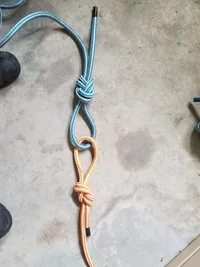
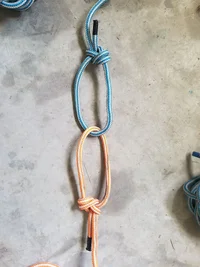
Long story short: had to join two ropes to get enough length to access a large walnut tree. SRS was the setup with the lower of the two lines being basal anchored to itself in a choked configuration. The ropes were joined by linking two bowlines with Yosemite tie offs. The bowlines were about 25' from the ground.

This got us all talking about the best way to join two ropes like this. There were basically 3 knots/methods debated:
1. Joining with linked bowlines as described
2. Joining with linked retraced figure eights
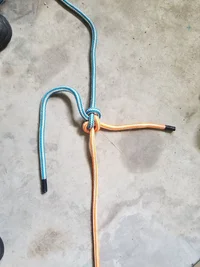
3. joining with a zepplin bend

I personally feel the most secure on a visibly linked setup like the bowline or figure eight, though the argument was made that the zepplin bend is just as secure.

Input from the group is always welcome. I did do a search for this topic but didn't find anything specifically addressing this comparison in great enough detail.

Here is what I am really hoping for: Can someone break test these configurations and share the results?

Pics attached just for reference and clarity.

Thanks
 

Attachments

  • bowline yosemite tie off.webp
    bowline yosemite tie off.webp
    488.6 KB · Views: 104
  • figure 8.webp
    figure 8.webp
    467.5 KB · Views: 129
  • zepplin bend.webp
    zepplin bend.webp
    399.4 KB · Views: 138
I'll put it on my To Do List. No promise when I'll get it done. Kind of a busy time right now.

I'll add, strength is probably about 3rd on my list of rope knot attributes behind
1. security of the knot
2. ease of tying
3. ease of identifying (Oops, it just went to 4th.)
5. easy to untie (Ok, I'll stop now that I've pushed it to 6th.)

well, maybe I should say the strength of the knot is usually the last on my list of rope knot attributes.
 
Last edited:
I've used a zeppelin bend in a rigging scenario taking some pretty big pieces. I tied stopper knots in both tails as I hadn't used that bend enough to really be comfortable with it. The zeppelin bend never moved, so the stoppers were not even needed. That job gave me a lot more confidence in it.

I've heard others using the European death knot, but it's a little harder to untie afterwards.
 
Sheet bend for me, long tails secured with double overhands.
Nothing wrong with a retraced 8 or double fisherman’s, but those can be hard to untie.
I have no experience with the zeppelin bend, so can’t speak to that
 
I've used a zeppelin bend in a rigging scenario taking some pretty big pieces. I tied stopper knots in both tails as I hadn't used that bend enough to really be comfortable with it. The zeppelin bend never moved, so the stoppers were not even needed. That job gave me a lot more confidence in it.

I've heard others using the European death knot, but it's a little harder to untie afterwards.
The EDK has the benefit of being hard to get stuck in unions.
It still weirds me out a little, but I've been using it to tie my retrieval ropes on for months. Super fast and easy to tie and dress. I came here looking for people's thoughts on this specific knot, particularly on stiff kernmantle lines.
 
I prefer double fishermans and fig8s, but I'm curious to see how they each compare and perform under load.

Please include a Alpine Butterfly and a Figure 8 on a bite to compare the integrity of frequently used canopy tie in knots, using either delta screw links or tree quickies. Both are solid options, but its fun to rip stuff up too.
 
Over the years the consensus is Zeppelin hits the mark for all around winner.

Coming from the generation that transitioned from natural fiber ropes to synthetic leaves me with a much different view of rope/knot 'strength'. My list of criteria is more aligned with @yoyoman

Pete Donzelli shared an interesting thought on tying knots. His spin is that we should look at loss of efficiency becomes an issue depending on which knot is used. The rope isn't weaker and there's no strength loss. Once the knot is untied the rope is unaffected, the efficiency is retained. Choosing a knot/hitch solely on its 'strength loss' or efficiency doesn't account for a systematic look at what you're doing.
 
For joining two climbing lines (the original question), I like the Double Overhand/Fisherman's knot. I've never had an issue separating ropes reasonably quickly after climbing use, there's a method and skill to it just like everything in tree climbing. I like the neatness, compactness and tail orientation compared to say the Zeppelin. For rigging? Ugh, I really dislike tying ropes together for rigging, no matter what knot you use, there's a good chance you'll weld two ropes together if you're rigging anything with above average weight. Been there. For light rigging whatever you like the most, double overhand fisherman's no.
-AJ
 
Over the years the consensus is Zeppelin hits the mark for all around winner.

Coming from the generation that transitioned from natural fiber ropes to synthetic leaves me with a much different view of rope/knot 'strength'. My list of criteria is more aligned with @yoyoman

Pete Donzelli shared an interesting thought on tying knots. His spin is that we should look at loss of efficiency becomes an issue depending on which knot is used. The rope isn't weaker and there's no strength loss. Once the knot is untied the rope is unaffected, the efficiency is retained. Choosing a knot/hitch solely on its 'strength loss' or efficiency doesn't account for a systematic look at what you're doing.


I agree with this. I would amend my request for break testing to include applying heavy load to each setup and then remove load and see how well the knots come undone...then brake those babies.

I like the linked setup with a bowling or figure eight because I can easily see it from a distance. The zepplin bend, not so much.
 
I'm a fan of the bowlines, but I add a square know in between then (both legs if the loop form a square know with the loop from the other) keeps everything nice andneatly together
 
Sheet bend for me, long tails secured with double overhands.
Nothing wrong with a retraced 8 or double fisherman’s, but those can be hard to untie.
I have no experience with the zeppelin bend, so can’t speak to that

When used life support I use knots tied as they are supposed to be. But when rigging or winching heavy I often use a fid in the middle of the knot (often a slick smooth stick) that once finished I can pull/slide out of the knot and untie what would normally need cutting to untie/separate...

In joining ropes for rigging medium applications I can be partial to a double sheet bend but have to be careful if lines same diameter as weight can put a nasty bend on what would normally be the smaller rope if used too heavy an application.
 

New threads New posts

Kask Stihl NORTHEASTERN Arborists Wesspur TreeStuff.com Teufelberger Westminster X-Rigging Teufelberger
Back
Top Bottom