Knots for joining two ropes for life support

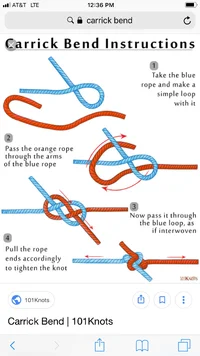
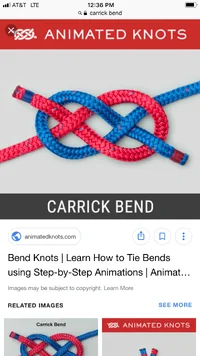
I’m a big fan of the Carrick bend backed with figure eights when joining lines together. Everything is nice n tight and a neat package. But that’s just me. Not a fan of two bowlines, not because it doesn’t work. Just seems like a mess of line. My preference
 

Attachments

  • F630ADEB-1C1D-442F-869B-0ED19534183E.webp
    F630ADEB-1C1D-442F-869B-0ED19534183E.webp
    123.2 KB · Views: 29
  • F4456047-566A-4577-BB84-FF41222EFA69.webp
    F4456047-566A-4577-BB84-FF41222EFA69.webp
    146.7 KB · Views: 29
I’m a big fan of the Carrick bend backed with figure eights when joining lines together. Everything is nice n tight and a neat package.
Interesting that your attached image doesn't mention that the #1439 Carrick bend tying method (as shown) results in capsizing to arrive at the final load stable geometry. Step #3 in the tying sequence shown is a transient state - which capsizes to reach the final step #4.
It is also possible to tie the 'bend' directly - which involves interlinking 2 'Munter hitches' (#206).
This method bypasses the capsizing step and arrives directly at step #4.

If you have to add a 'backup' stopper knot or perform any additional tail maneuvers - then by definition - your primary knot isn't secure.
Have you considered the Zeppelin bend? It is stable and secure and is totally jam resistant. Also works with different diameter ropes.

Not a fan of two bowlines, not because it doesn’t work. Just seems like a mess of line.
With regard to 'Bowlines' - there are well over 20 different types/species (which one do you mean?). I presume you mean linking 'eye'-to-eye' (ie loop-to-loop)?
But in principle, 'Bowlines' are a fixed eye knot... they aren't intended to be employed as an end-to-end joining knot. So yes, your comment re 'mess' is true - since there is no way to achieve a small symmetrical footprint.
 
i hope ... knudeKnoggin find the way back around.

i'm sure in many ways he is right, in actual human load usage against these lines ...
Hi, I'm back around (looking futilely thRU the TreeBranches for a TreeSpyder, but all I see is Useless Knowledge?!).
And I've now spent more than hour going through these now-seven pp. of knotty chatter, and exploring various supporting/conflicting other sources found on-lilne. <whew> + <sigh>.

My topic-&-others reply could span enough lines to roll a great many eyes, and so maybe I'll (later than now) chop my remarks to some several topics as have arisen in this hearty e-chatter. Now, let me make a few overall knotty comments.

Firstly, to the OP, that trio of discussed end-2-end joint options is woefully in need of improvement (well, losing two and gaining others) --yeah, they can all work, but are less than optimal. The key point, though, is echoed above : knot *strength* is far from important in this situation. Security will be the main quality, and of course one needs to be able to tie & untie and so on.

Now, a few thoughts before checking out.

A:: "flat" is what all webbing is, thus let's establish "SOLID" vice "flat" as the complement to "tubular" --which makes real sense.
AND, it's NOT what the EDK is, so, no-no to "flat 8" and hello "OFFSET fig.8" !
.:. And then the world will be a better place.

B:: Knot strength is a dubious thing to consider, for many reasons.
1) What sort of "strength" counts --slow-pull is where the (most) #s are; but dynamic (of some sort) is likely more where reality lies, and strength of USED ropes more than new, and in some cases it's less what happens w/new rope on a test device than with the knotted rope put through rigors of usage AND THEN checked for strength. (The nice, abrasiion-sharing paired parts of the fisherman's knot show their value in this after many passages through the rope hauler and so on.)

2) Whose >>knot<< is tested --in which rope, dressed how, set how (if even), what load rate & how long a test specimen. A quick look over references for the commonly discussed & tested (somehow) Fig.8 eye knot (& joint/end-2-ender) will show asymmetric dressings (the OP's upper/blue&white knot) or symmetric ones loaded on usually the interior strand (as done by RM) but sometimes the exterior one (as the OP's lower/orange&white knot; and as done by another Richard, Delaney, oddly in the 2nd out of 8? tested knots with VERY short tails --the last two have the tail pulled out for the loading :: moral, they ALL stayed tied into serious loading (so much for that fabled "back-up" knot!)
But, really, there can be such variety in the test item that comes with one simplistic name on it that one really cannot go by commonly presented names & figures. (So MANY sources don't give a hint --but for this simplistic ID of a knot name-- of what exactly met the test rigor; many if not most sources for the Fig.8 e.g., don't bother to show which of the two ends is loaded (which is what gives meaning to my "interior/exterior" strand language.

B :: Lapp Bend / Santa knot. NO NO NO --but, sadly, I see that I responded to this way back in 2012, here; my assessment remains the same --esp. for the recommended Lapp extension.
http://www.treebuzz.com/forum/threads/knot-for-joining-two-lines-for-an-srt-base-tie.21143/page-2
To UNtie the multiple Lapp bend, pull the ends of the U-part/bight apart, to pry out some small bit of mainline of the hitching part through those tight coils/wraps --for many loads, at least, this should be possible, since the line is being initially pulled straight back, giving enough looseness to then back out the bight's tail.
(This wrong-way Lapp bend is why the common bowline should not be ring-loaded.)

... and I'm already out of time.

*kN*
 
Last edited:
That was sooo much fun reading your post with "strike-through" formatting but I did 'cause I enjoy what you write ;-)
-AJ
Egadz, am I rusty at this or what? --control-S??? : new one, on me.
So sorry, I usually strike out the more natural way.
|-:
 
That was a long read and I waited until it was fixed before I tried. Good points are made but it reminds me a little bit of my friend Bart. He can go on forever about spiders bugs and plants and use all the Latin names. One day we were on a climb in Costa Rica ascending a huge Ceiba and I saw a strange looking bug that looked like a spider to me, I asked Bart what it was. After 15 minutes I had to walk away and get back to climbing, to this day I don't know if it was a spider. I love the guy and I consider him a good friend.
Press on.
 
This thread got a bit side tracked by an argument about scientific philosophy. But the premises were never brought to light for consideration, so I thought I might comment to share an observation, for what it's worth.

The subtext of one line of thinking on this thread is scientific method vs data. I would propose that what @yoyoman is offering in his videos is data. This stands apart from the purpose of the scientific method which is to falsify or validate a hypothesis. Data and data points are valuable. The scientific method is valuable for forwarding our knowledge and worldview through inductive means. It isn't an either/or. One just has to know what is being produced, data or validated hypothesis which produces a valid theory, and use it accordingly.
 
Last night, I hypothesized that it would take me at least two beers to get through this thread. Although the six empty beer bottles provide some data, I woke up on the floor and can only theorize that my headache is somehow related to a failed scientific experiment that was poorly planned and executed. It would never pass peer review.

I'm just going to suggest that people buy longer ropes and forget the whole thing.
 
The original post and intent of this thread topic was:
Long story short: had to join two ropes to get enough length to access a large walnut tree. SRS was the setup with the lower of the two lines being basal anchored to itself in a choked configuration. The ropes were joined by linking two bowlines with Yosemite tie offs. The bowlines were about 25' from the ground.

This got us all talking about the best way to join two ropes like this. There were basically 3 knots/methods debated:
1. Joining with linked bowlines as described
2. Joining with linked retraced figure eights
3. joining with a zeppelin bend

From an efficiency and security viewpoint - the Zeppelin bend is the clear choice.
Knot efficiency has nothing to do with 'strength' - the key metrics being amount of rope required to tie/create the knot, jam resistance, footprint, stability and security. The Zeppelin bend ticks all of these metrics (in EN892 and EN1891 or equivalent human rated ropes).

per knudeNoggin:
Knot strength is a dubious thing to consider, for many reasons.
I agree. There is no load that a single tree climber can apply that will reach the MBS yield point of a knot. Even with a 2 person rescue payload - the MBS yield point of knot is beyond reach.
The general way to reach the MBS yield point of a knot is on the test bench with a force generating machine (eg a hydraulic ram).

per knudeNoggin:
of what exactly met the test rigor; many if not most sources for the Fig.8 e.g., don't bother to show which of the two ends is loaded (which is what gives meaning to my "interior/exterior" strand language.
I would go even a step further and state that most 'testers' perform their tests from the default mindset of slow 'pull-it-till-it-breaks' mentality.
There doesn't appear to be much imagination beyond this mindset.
After receiving hints from me - Richard Delaney has started to perform tests other than the default mindset of slow 'pull-it-till-it-breaks'. Refreshingly, he produced video's of slack-shaking and cyclic loading tests of F8 eye knot (#1047) - although he could have been clearer on the geometry of the F8's. What is missing is a 'control' for the test - and it is here where Richard could have used a particular geometry and rope type as the control - and then tested variations against the control.

per knudeNoggin:
This wrong-way Lapp bend is why the common bowline should not be ring-loaded.
Yes - the simple (#1010) Bowline is vulnerable to circumferential loading. But, when the tail is oriented outside of the eye (per #1034 1/2), it gains a boost in resistance to circumferential loading profile (but this resistance is not 'ever-lasting').
In any case, #1010 and #1034 1/2 both benefit from Scott's locking maneuver - which is surprisingly easy and quick to do.
It also puts 3 rope diameters inside the nipping loop - and I am still waiting for definitive tests to be performed to answer the long standing questions about 2 rope diameters versus 3 rope diameters. Such testing should include dynamic (shock) loading profiles (not just slow pull-it-till-it-breaks).
 
Hi, I'm back around (looking futilely thRU the TreeBranches for a TreeSpyder, but all I see is Useless Knowledge?!).
.
Some say that is all it has ever been across the decades of drawing etc.;
But in any case feel terrible license given, can say anything in great amounts!
(kinda harder to call out a guy that already calls himself *Useless Info*, jest nothing else to say to 'em.. ).
But, none the less; hope this visit finds you well bro!
.
A:: "flat" is what all webbing is, thus let's establish "SOLID" vice "flat" as the complement to "tubular" --which makes real sense.
NOTED! : Thanx!
Wasn't really trying to be re-dundant; just emphasizing of reverse geometry away from the wonder of round; and try to exploit differeance by seemingly reversing strategies from what is shyed from in round flexible device by contrast.
Are we seeing different science between the 2 flat (rather than standard round ) profiles? Or just delineating between the 2 in case need separation in future? If any standing question to references made, always visulizing the tubular flat /oxymoron webbing when noted here. (oxymoron like passive aggressive, Civil or holy War, friction saver etc. if i'm to be clearly misunderstood in my random order ).
.
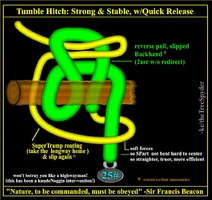
i was just showing YOUR Tumble Hitch as of course far superior to usual quoted and cowboyish named Highwayman Hitch as quick releases. i always show Tumble as kinda backward pulled , slipped Muenter/Backhand on spar; that explodes cleanly off on release. AND very little sideforce against SPart(like strategy Sailor's Hitch exemplifies, but force traces more past the opposing hang point/peak of hook in drawings than Sailor's), as IBeam of support of load, so theoretically stronger than if same SPart /IBeam bent. Always try to show this design only allows host mount to deform SPart, Highwayman's increases deformity beyond that necessitated by host mount as deforms SPart as forms primary hook around support; and deforming shank part as further deformity with other rope parts (that aren't always necessary deform points in other/stronger knots not deforming shank of primary hook). Also the point of instability i think in Highwayman's.

edit:This is really a great, clean release hitch guys that should be noted! (wow: a knot drawn in less than a week!). The design notes and mechanix are of curse my own sight, but also shorthand how i remember construction.
TumbleHitch-Strong-Stable-Quick Release.png


I agree. There is no load that a single tree climber can apply that will reach the MBS yield point of a knot. Even with a 2 person rescue payload - the MBS yield point of knot is beyond reach.
Mostly, we worry about rigging MASSIVE shock forces thru rope system into wood support. Stuff by design you wouldn't do to a human body you were looking to keep around very long. Also hope not dependent in chain on support of co-dominate tree growth or other errant growth or hidden decay, rough calculating overhead frictions that limit control leg pull on support as it travels to ground control frictions to manage load slammed into line repeatedly. We REALLY test sh!t sometimes in really dogged out lines that have been so faithful; more than should, day in/day out; please excuse but extra headroom is really much thought about still.
.
But, please; playing that backwards:
>>if reducing rope efficiency by temporary usage architecture
>>while rope really is just as strong just tensioned harder for same work
>>AND also now needs to be supporting sideforces at this higher tension for same job
Would seem to reduce cycles and confidences to failures ranging
>>especially in repetitively hammered lines perhaps used daily for years in dirty conditions.
But even in present usage be another multiplier in stacked multiplier list to risk as higher sum input into sub/system.
.
i once again get the raw knot strength is of less importance
>>but it's chase gives us numbered scaling that has lead to higher science and understanding
>>other considerations can be harder to scale; and more subjective to person and specific shituation gotten self drawn into.
>>in possibilities of high overloading, extra headroom is comfy!
>>it engages more grooming and caring for the structure created in the form-amiable rope substance that doesn't need heated, pounded nor pinned to INSTANTLY comply; thus can be much more easier to re-deploy on the fly; per imagination employing but not exceeding mechanical rules.
.
Truly, truly other usability features of security, re-usablility/untie-ability, forming methods, if can Tie-in Bight (TiB) carry great weight inside proper powerbands; especially if only a few percentage points difference in efficiency/strength rating anyway.
.
i'm great beleiver in 3arc Round Turn base. Including in Bowline as superior muting of many faults by really better mechanix. Extending to RT in lock of Sheet Bend or Becket (Sheet Bend hitch function lock to eye instead of bight); especially in mis-matched lines. lock side always getting smaller/stiffer line, softer /fluffier line under same strain is the host mount for the lock. In workplace this gives less knots to know to extend eye or tail to another line. DBY very friendly, clean open eye in most arbo lines. But otherwise go with Zepp or BFly all day, every day! Once again (as with Sheet/Becket)the multi-use of BFly (mid eye, isolating weak rope part or as Bend) gives less knots to know for more utility functions.
 
Last edited:
That was a long read and I waited until it was fixed before I tried. Good points are made but it reminds me a little bit of my friend Bart. He can go on forever about spiders bugs and plants and use all the Latin names. One day we were on a climb in Costa Rica ascending a huge Ceiba and I saw a strange looking bug that looked like a spider to me, I asked Bart what it was. After 15 minutes I had to walk away and get back to climbing, to this day I don't know if it was a spider.
Spiders have 8 legs (unless...) and two body sections : cephalothorax & abdomen. And they are neat-O !! Bugs have exposed wings; beetles' being beneath shell. And carpet beetles are amazingly good at getting free from web-based spiders!

"a long read" :: Well, yes, but how does one convey a lot in a few words? Is it at all helpful to have fewer words over & over & over again repeating the same half-truths and getting us nowhere?! Such is knotting, alas.

Now, here, I'll quickly dump some more thoughts.

*kN*

stmtn-1 : retraced 8 is about as strong as knots get because the bends are gentle.

Many test reports support the strength assertion. But let's consider what we
just got via yoyoman : the fig.8 joint was 2nd WEAKest of his quartet, just keeping
above the infamous & reportedly weak EDK (OWKnot) !!
(Tachyon advertised rope strength = 5_500#)
47% <> offset water knot / EDK (in arc-choking orientation; too loosely set)
51% <> Fig.8 joint (perfect form, interior-loaded; loosely set)
59% <> zeppelin joint (non-crossed tails; maybe too loosely set too, but ...)
75% <> grapevine / dbl.fish. (lightly set)

Meanwhile one can find these other test values, for different
cordage (low-elongation kernmantle), and who-knows
what exact knots per orientation/dressing/setting;
the first is from CMC Rope Rescue Man., 3rd Ed., Rhino rescue rope (half-inch);
the following from Dave Richards's testing of
{similar rope - 7mm accessory - 10.5mm dynamic}:
Grapevine : 79% {81% - 78% - 73% (resp. 3 ropes)}
Fig.8 joint : 81%
& " {eyeknots >> 73% - 76% - 70%}

Funny : while it doesn't occur to most people to recognize
that there is a choice of two ends to load in these *traced* knots
(w/Fig.8, OHand, Fig.9) --and many sources don't indicate one--,
TWO sources --viz., CMC Rope Rescue Man.(3rd) & Dave
Richards's Cordage Inst. testing-- while ignoring that choice,
nevertheless thought to test (I'm not making this up)
"(with a bight)" & "follow through" versions
--as though the knot cared how it got to what should
be a common/single "dressed & set" form.
Except, well, where is that ideal dressed-&-set form presented,
with any such guidance?! (Dave Merchant, in his Life on a Line (2nd ed.)
does recommend a particular & NOVEL symmetric form,
for both asserted better strength but also easier untying
[oops, apparently he copies On Rope 1st ed.].)
see https://drive.google.com/file/d/0BxRqjb05JpZockNIbzZTXzNUY2c/view
And as one should hope, the test values for these two differently
tied sets (5 samples in each source) of like knots were nearly equal
--but we can wonder at other variances described.

(But folks can go on testing & re-testing their who-knows-whats
and presenting the cursory data as . . . informative, to be parroted
in Net posts all over, take for Gospel (vs. other Gospel).)

(Btw, it COULD (should!) be an object of some empirical
studies --good observational science-- to see what actually
results from the different tying methods (with-a-bight vs. traced)
for these sorts of *trace* knots.
AND THEN, should a difference IN FORM/structure/geometry
be found, test THAT. But that hasn't been done.
((And the knot remains being claimed "easily recognized as correct"
in this set of confused, various forms!))

Here, in this presented many-ropes (though looking much similar)
tested with short tails, or a spilled-beforehand final tuck,
of the perfect-form Fig.8 eyeknot are shown loadings of the two ends,
for the FIRST rope (green) only --thereafter, only "interior" loading.

And here are the "same" Fig.8 eyeknots loaded on their exterior
strands (and not well set : their tails should've been hauled hard,
to give strong shaping/resistance to the exterior strand's pressure).

Now, about the CMC & Richards references, we have no idea of form.
only a knot name.

stmnt-2 : The Bowline ("BWL") causes lots of trouble among the
rockclimbers as being "hard to recognize"/"confusing",
and
even I recall in some long-ago early look at knots in a sailing book
(Chapman's Piloting) that I could understand the sheet bend but
didn't come away knowing the BWL or (IIRC) recognizing the geometric
likeness of the two.
But the BWL is almost ALWAYS shown bass-ackwards [tech term!]
--to wit, consider the common presentation of the sheet bend:
https://knots3d.com/knots/en_us/2/sheet-bend
but then comes the like-structured BWL:
https://knots3d.com/knots/en_us/1/bowline
(Google Images show many more of this flip-flopping of views
(it's "monkey see, monkey do").)
.:. IMO, much of the misunderstanding of the BWL
comes from showing it bass-ackwards, and a big step
(which alas Agent_Smith's PACI document takes too
tentatively, though boldly (thankyou)) in the right
direction would come were the knot properly shown!
Let's see the CROSSING of the main line;
the in/out straight lines of the bight (collar) legs are
readily understood.

stmnt-3 : Just use an inline figure 8.
Interestingly/ironicly/comically, the CMC testing had
the non-inline, regular (somehow oriented) Fig.8 eyeknot
STRONGER than the supposedly-better-for-thru-loading
dir. Fig.8, and not much weaker than the butterfly --ha!!
(through loading the Dir.8 is essentially a slipped square knot,
so we shouldn't be terribly surprised).

Further interestingly, CMC have the simple overhand eye knot
(of whatever form/loading) as their strongest --coming up to
that mythical "15%" reduction of rope strength!
But nOnElse gets this, though some do find it equal to fig.8s.

YMMV?!
=========== *
 
Now, here, I'll quickly dump some more thoughts.
I must hasten to add a qualification to these "long" discussions
of the finer aspects of knots : i.p., that they are made in an effort
to gain understanding of what's going on, to advance knowledge.

But NOT to suggest that knot tyers in general must know
all of this. We don't now have all sorts of problems with this
knot not as strong as that knot ... and so on. Still, it's worthwhile
getting a better understanding at least for those who are going
to recommend this vs. that,
and also for tyers to call upon where situations arise for which
there isn't a readily indexed-by-situation solution. (Heck, I have
illustrated --note the difference between this and "I know"--
perhaps 2_000 knots(?!), but often just wing it with some
knotty entanglement, knowing what is needed, and how
the cordage will hold, et cetera.)

(Sometimes it appears that anglers DO have legitimate
concerns regarding knot strength. I just came across one
guy's fairly specific-tying method for the palomar knot,
nominally responding to hearing about anglers sometimes
having versions that seemed weak --he suggests a reason!)

*kN*
 
Whenever high loading and/or wear, the extra confidence of more headroom logically seems appealing. Even as it did in Ashley's day as many strength references are made as warnings.
.
In that time they had high loading, fewer choices, less testing devices and very accelerated wear compared to what we know today. Also men killed on loading docks etc. from using Square Knot for other than binding, or only 1 Half Hitch etc. Tho, in comparison, their ropes used as a knot device were more 'frictive' and faster deteriorating while weaker to start with (so thicker/broader more friction bearing/serving surfaces loaded less force per inch diameter) in exact contrast to today to be known when comparing to today's synthetics.
.
ABoK#1891 Cat's Paw gets a lot of focus as common sling hitch that "leaves nothing to be desired" -ABoK chap.25 hooks's etc. pre-ramble Later quoting Cat's Paw at 100% strength efficiency and even 1 leg can fail and pkg. (probably not @100% efficiency so much)still carry until weight off of it. Probably partially due to pinched together at top by hook to stop unravel of each section of splice like runs that don't cut across the loaded line of force holding load as common choke sling does, but rather pulls more along the loaded line of force bearing load like stronger than choke Bull Hitch extended further.
.
i have used Cat's Paw in single line to pole that pulls front of carts etc.; making Blake's back to SPart to simulate sling, then pull a finger of slack past Blake's to load side to then groom both legs out straight to share load as evenly as possible. The Cat's paw splits the loading and stabilizes the pulls, Blake's becomes backup stabilizer and SPart has no outright deformities like making 'seam' with Bowline(As referenced in ABoK as Axle Hitch#1850 similarly, tho i'd never pull an axle like this..). Also , rope around tree to serve load leg long and hold leg again is Blake's, but pulled out from tree to longer, more pointed 'teepee'. Strength gained is lost in grip, so may seek 1 wrap on host first. Next best thing is to hide the Achilles heel of the seam (Blake's) buffered from loading in wrap on tree etc. as in wrap 3, pull 2 >>with long nose/beak/teepee. AS most of strength chase is trueness of geometry. These are too ungamely and rope hungry for joining lines, but i believe shows the same science in the same materials and forces, only from different aspect to then fold those insights back to the main topic. That SPart should be as pure straight IBeam anything else begins list of compromises. Can't evade deformity from round mount, but try to minimize in rest of most loaded structure parts (SPart)to chase strength thru system.
.
There is a chance hear, that Arbo's dog their lines out more, longer in dirtier conditions than other disciplines (or our lack there of); if so would perhaps lend a bit more towards ABoK strength chase in more rapidly declining rope strengths of Manilla etc. for best headroom thru that lottery of functions. Just as the degrading /less pristine conditions and production rope hammering like old docks; may be looking at extended cumulative abuses, that stacking forces to lower loading to test ceiling less and perhaps running at less leveraged loading for less longterm wear is really best in some ways; at least not t be totally ignored; and some 'upper class' /but perhaps not strongest chosen if margins are close in that set of lacings and sibling offers more usability in different directions.

cats-paw-abok_1891.png

(from 1 of other projects working on that includes Tumble H. as set of hitches with 3+ arcs and a crossing that is OFF of host mount like Muenter and Cow as extensions of Backhand Turn
1arc simple Turn as a redirect mechanic at friction co$t, 3arc uncrossed RT and 3arc crossed and backhand turns as family of real base work horse forms used beyond just simple primary line extension straight or redirect back of Turn as arc with line extension from diameter level of support then towards load)
.
i also think that some stopper knots that aren't necessarily free hanging, can keep knot parts more properly aligned, by not letting deform, kinda like Blake's after Cat's Paw model. Just like as in metal or wood as rigid supports, can find some small tweaks that jumps utility forward like slick martial arts move.
 
Last edited:
Pile and Sailor Hitches to me are amazing hybrid of 2 basic 3arc RT (Round Turn knudeNoggin IGKT abbrev.) crossed forms of crossing ON & OFF host as Crossed/Frapping (Clove etc.) and Backhand (Munter/Cow etc.) Turn type bases. Both and their respective friction hitches(add turns to Crossed Turns 'bundle' to make Icicle or Sailor's Gripping Hitches) are truly different class of knots than usually seen. Also a fair observational point to test hypothesis for me.
.
This pic shows view of relationships between these lacings, then how and why pulling 1 end would be more efficient/stronger rope usage on break tests. Rope just as strong, but loaded thru less efficient architecture, so leverages load pull to greater rope tension for same job and breaks earlier.
.
Once armed with this info, we'd never seek to push rope that far nor even close. But, just like metal or wood, if loaded essentially with less force; by not wearing out at bad angle as hammered with daily impacts in rough conditions; would expect longer, more confident service life by correct handling of the rope device as any other tool; even wearable item like rope.
load-pile-sailors-icicle-by-crossed-not-backhand-turn-side.png

.
Also, another parallel between these 2: Would load from the Crossed Turns (over coil of turns) side for friction hitch forms, and pull SPart(knudeNoggin IGKT abbrev. for Standing Part) from Crossed Turn side into direction over and Nip/pinch Bitter End (BE another knudeNoggin IGKT abbrev.)to host. Any of these work at right angle to host pull of course; but would always place BE of Pile or Sailor Hitches to the most likely/if any side pull side as continuation of that principle.
.
Visualize straight rope as pristine state, anything less is compromise, thust any deformity renders weaker/less efficient. Must incur host mount deformations. Deformations off of host mount are more severe, as 'are not hosted', are w/o host backing!
 

New threads New posts

Kask Stihl NORTHEASTERN Arborists Wesspur TreeStuff.com Teufelberger Westminster X-Rigging Teufelberger
Back
Top Bottom