[ QUOTE ]
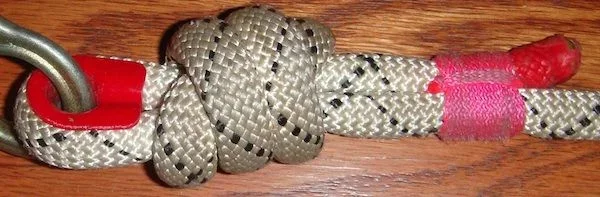
Jack, the knot you pictured is still in the sliding noose stage as it has not bottomed out. Your strong seizing is doing most of the work.
Dave
[/ QUOTE ]
Good eye!
And the "bottoming out" that might occur with this particular structure
isn't going to be pretty: i.e., the first potential *bottom* it would encounter
is the thimble (sides); but, that's rather slight, and conceivably the knot
could be forced around that to the ring, which itself doesn't offer much
of a base.
[ QUOTE ]
When I need to seize the ends of a knot I only dream of doing it as neatly as SingleJack.
The seizing technique I use is called the 3M End Seize. Black electrical tape is wrapped around the base rope then spiraled down to smoothly cover the tail of the rope.
Brion Toss used the term 'Butane Backsplice' for using a lighter to melt the ends of ropes. In that application I use the 3M Backsplice...similar to the 3M End Seize

[/ QUOTE ]
But that doesn't make a strong seizing! (And ... black, vs. hot pink?!
)
The shown
strangle knot itself can be adapted-extended to make
a decent whipping or seizing : using mason line (about what the hot pink
is, if not precisely --mason line comes in hot green, pink, white, & gold),
make a
strangle knot with 5 or 6 overwraps, finishing it with a tuck
of the tail folded into a <u>bight</u>; give one additional twist-wrap of this with
the opposite end (the 5-6 overwraps in mason line, and 7-8 in 30#(?)
monofilament fishline, provide sufficient breadth of the knot for the
extra inner wrapping of ends); finally, with ample bight material, one
can add a finish of a few more wraps using the
sailor's whipping
technique of wrapping side of the bight around & around over the other
which will be pulled out to tighten it all --then cut off neatly.
One can haul on substantial whipping material with tools for purchase,
which is nice, in contrast to maintaining a high tension in putting on each
wrap. I use pliers (or hammer) to compress the whipping in the belief
that it helps distribute the hauled tension throughout the overwraps
(hauling on the ends, after all, delivers force directly to only the ends
of the wrapping, not so surely the central wraps).
In the attached photo are whippings on three half-inch sized ropes
(pale blue CoEx laid, dirty white nylon(?) 12-strand, & Yale <whatever>
The top one (blue CoExtruded PP/PE) uses fishline, and the
sailor's whipping
finishing wraps are on the right (at the rope's end; else one would have
to pull the entire rope through them, on the other end!); one can just
make out that the ends' wrapping each other runs in the crease of the
lay, starting about 5 wraps in from the right --i.e., this is the right
side of the
strangle, right of which come the
sailor's wh. wraps.
(The gold mason-line whipping right of this was put on because the
dang <--can I say that?-- bristly end fibers were really annoying me!)
Now, the bottom, yellow, arbo-rope has a similar whipping oriented
the other way 'round, which is maybe easier to start, but okay to finish
only if --as here-- one has a short bit of rope (this was a sample).
The center whipping is of mason line (150# tensile).
All in all, these are also examples of recycling. (;
*kN*