- Location
- NW Indiana

Navigation
Install the app
How to install the app on iOS
Follow along with the video below to see how to install our site as a web app on your home screen.
Note: This feature may not be available in some browsers.
More options
You are using an out of date browser. It may not display this or other websites correctly.
You should upgrade or use an alternative browser.
You should upgrade or use an alternative browser.
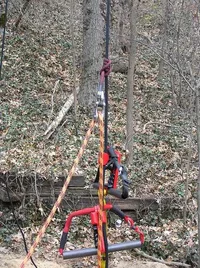
Is this safe to work from
- Thread starter treemann
- Start date

- Location
- Home of the New Jersey Devils
Looks alright to me. It's backed up with two ascenders right?
- Location
- NW Indiana
Correct. Would it be ok for comp or should I use the carabiner and put it into a knot under both accenders.
- Location
- Home of the New Jersey Devils
I would guess that it'd be alright.
- Location
- Asheville,NC
Let me get this straight. You mar-bar up a single line, then switch to DRT by hanging from the prussik. The ascenders are considered a back-up if the prussik was to slide. A version of the "weapon" with mechanical stuff? Is the other end of your single line tied to the base of the tree? I get a little concerned with the other end of my rope tied near the base. Falling objects hitting it, or some other freak thing. I know folks justify this for the purpose of rescue in the event of an injured climber. Everything can be lowered from the ground. I'm not sure how practical this really is since the climber may have used a laynard, thus making this useless. Seems like the risks of a base tie in out way the rescue potential. A preset access line makes more foolproof sense. Falling objects are common in the workplace. What if the unthinkable happenned and you dropped a sharp object and it made contact with your fully weighted rope.BAM!that would suck. I think single lines are great for access but could be risky for overall work.

TreeCo
Carpal tunnel level member
I like it. I srt using cmi's in a frog and then switch over.
When you are ascending are you just on the pulley or do you tie in to your top mar bar too?
Do you sit back in your saddle on every advance?
When you are ascending are you just on the pulley or do you tie in to your top mar bar too?
Do you sit back in your saddle on every advance?

- Location
- Retired in Minneapolis
Putting the upper ascender close to the friction hitch would be a bit better. That would reduce the slippage and shock load in case things went pear-shaped for you.
*************
NB,
Your concerns about the rope anchor at the base of the tree is valid. The system does have a calculated risk component. There are procedures that can be followed when this is used that would reduce the risk.
If the victim on either an srt or trad setup had their lanyard on a rescue climber would have to go up, either scenario. But when the rescue climber got to the victim and removed the lanyard the victim could be lowered from the ground by a second rescuer and the climbing rescuer working together.
*************
NB,
Your concerns about the rope anchor at the base of the tree is valid. The system does have a calculated risk component. There are procedures that can be followed when this is used that would reduce the risk.
If the victim on either an srt or trad setup had their lanyard on a rescue climber would have to go up, either scenario. But when the rescue climber got to the victim and removed the lanyard the victim could be lowered from the ground by a second rescuer and the climbing rescuer working together.
TreeCo
Carpal tunnel level member
Tom in order for your lowering scenario to work the victim's rope would have to be three times the length of the height of the victims tie in point. A lot of climbing ropes usually are not that long.
This would mean the srt line would have to be tied in to and then untied from the tree. A scary move indeed.
It seems the airel rescuer should carry a second rope so that a second rescuer on the ground could lower the victim as the first rescuer guided the victim through the crown.
This would mean the srt line would have to be tied in to and then untied from the tree. A scary move indeed.
It seems the airel rescuer should carry a second rope so that a second rescuer on the ground could lower the victim as the first rescuer guided the victim through the crown.

TreeCo
Carpal tunnel level member
[ QUOTE ]
Where is the rope going from the friction hitch?
[/ QUOTE ]
That is the rope the climber climbs on while they trim the tree.
Dan
Where is the rope going from the friction hitch?
[/ QUOTE ]
That is the rope the climber climbs on while they trim the tree.
Dan

this might be a dumb question, but is the friction hitch cord under greater load than if it were being used in a Ddrt system? and is there anything besides the hitch keeping the secondary system from failing?

- Location
- NW Indiana
Tree co
I am hooked into the top mar bar also via the yellow sling and gold carabiner. The sling is short enough that I do not have to hold my weight on my arms and I can raise my legs higher. I do sit into my saddle every time.
Tom
I do keep the pulley a little bit lower but I do like it completely above the ascender because sometimes if it is to low I can feel increased friction. I took the picture before I left the ground yesterday.
Tree co
My ascent line is 250 in my area that is almost always enough to be triple the length of my tie in height. And my line is hooked through a gri gri and backed up with a knot and annother carabiner.
I am hooked into the top mar bar also via the yellow sling and gold carabiner. The sling is short enough that I do not have to hold my weight on my arms and I can raise my legs higher. I do sit into my saddle every time.
Tom
I do keep the pulley a little bit lower but I do like it completely above the ascender because sometimes if it is to low I can feel increased friction. I took the picture before I left the ground yesterday.
Tree co
My ascent line is 250 in my area that is almost always enough to be triple the length of my tie in height. And my line is hooked through a gri gri and backed up with a knot and annother carabiner.
TreeCo
Carpal tunnel level member
Thanks for the info Treeman. I likely will start using your system shortly. I noticed that systems very similar to yours were very popular at the TCC in Nashville.
Dan
Dan
- Location
- Asheville,NC
One other thing to consider is that with the rope running over a crotch and back to the base, this doubles the climbers force on the TIP. (2 to 1) My co-worker usually runs his line up to the top, still a single line ascent. This isn't "lowerable". It seems like this set up works good for trees with a narrrow crown. In a broad crown, it would better to a fix a line on both sides of the crown. Planning on lowering an injured climber from the ground would probably be a bad idea anyway. They could flip upside down or bounce across limbs on the way down. Most tree climbing harnesses aren't designed for upside down falls. A seperate access line is probably a safer bet. Belay escapes a complicated, a grigri simplifies this pending your rope is long enough. I've also seen a few climbers "dropped" using a grigri, by trying to use the release lever to control rope speed. I pretty sure the manf. recommends putting the rope in a brake position then releasing the lever completly and controlling the rope like any other braking device. DRT good old standby.
- Location
- Retired in Minneapolis
Dan wrote:
Tom in order for your lowering scenario to work the victim's rope would have to be three times the length of the height of the victims tie in point. A lot of climbing ropes usually are not that long.
This would mean the srt line would have to be tied in to and then untied from the tree. A scary move indeed.
******
The SRT system that I use always has enough rope to do a ground lowered rescue. There are too many other ways to climb SRT to go into all of the variations.
I don't know what you mean about untying??? When would that happen?
I'd prefer to see the pulley that the climber is using as a false crotch is positioned lower than all of the backups. Having long tails would make sure this happens. I get nervous when I see parts of the climbing system banging into each other. It would be too easy to have a rope cross over a critical component leading to a fall.
In case of an accident it is nice to have lots of options. Having the option of doing a ground lower without putting a rescue climber in the tree could save time and keep people out of harm's way. AR is complex. There are concerns about how AR is used. It's good to have these discussions. At some time there might be some guidelines for tree AR that approach the standards that have developed for other rope rescue situations.
Tom in order for your lowering scenario to work the victim's rope would have to be three times the length of the height of the victims tie in point. A lot of climbing ropes usually are not that long.
This would mean the srt line would have to be tied in to and then untied from the tree. A scary move indeed.
******
The SRT system that I use always has enough rope to do a ground lowered rescue. There are too many other ways to climb SRT to go into all of the variations.
I don't know what you mean about untying??? When would that happen?
I'd prefer to see the pulley that the climber is using as a false crotch is positioned lower than all of the backups. Having long tails would make sure this happens. I get nervous when I see parts of the climbing system banging into each other. It would be too easy to have a rope cross over a critical component leading to a fall.
In case of an accident it is nice to have lots of options. Having the option of doing a ground lower without putting a rescue climber in the tree could save time and keep people out of harm's way. AR is complex. There are concerns about how AR is used. It's good to have these discussions. At some time there might be some guidelines for tree AR that approach the standards that have developed for other rope rescue situations.
TreeCo
Carpal tunnel level member
It looks to me that having the climber exposed to the danger falling objects present to the srt rope and anchor far out weigh any rescue advantage. In addition the risk ground crew members present to the srt line using chainsaws in the area of the ground anchor is scary.
Sure lots of options are good but when the options keep adding links in the chain that could possibly fail and result in an injury they need close consideration.
For instance the anchoring cam device you use......can it take blows from falling chunks of wood?
Even a 5 inch diameter 12 long piece of wood falling 70ft. may well destroy the device leaving the climber doing an air rapel.
Crater in!
Dan
Sure lots of options are good but when the options keep adding links in the chain that could possibly fail and result in an injury they need close consideration.
For instance the anchoring cam device you use......can it take blows from falling chunks of wood?
Even a 5 inch diameter 12 long piece of wood falling 70ft. may well destroy the device leaving the climber doing an air rapel.
Crater in!
Dan
from what i understand, the line doesnt need to be tied to the base of the tree being climbed. that might solve one issue.
also, the climbing rope would not need to be thrice as long if the rescue person had a rope on the ground. That rescue rope is secured into a belay system and also tied to the climber's rope just above the anchor point, the remainder of the climber's line is untied or cut and the injured person is lowered.
the victim wouldn't be hitting too many things on the way down if the tail of the climber's SRT was manipulated to guide the victim through obsticles.
even if the victim was tied in with a lanyard, one rescue person could climb the tail end of the SRT sytem, cut the lanyard and both the rescue person and the victim could be lowered to the ground by a second rescuer. a second line would not need to be set and the first rescue person would be able to focus on helping the vitcim rather than figuring out how to lower them.
also, the climbing rope would not need to be thrice as long if the rescue person had a rope on the ground. That rescue rope is secured into a belay system and also tied to the climber's rope just above the anchor point, the remainder of the climber's line is untied or cut and the injured person is lowered.
the victim wouldn't be hitting too many things on the way down if the tail of the climber's SRT was manipulated to guide the victim through obsticles.
even if the victim was tied in with a lanyard, one rescue person could climb the tail end of the SRT sytem, cut the lanyard and both the rescue person and the victim could be lowered to the ground by a second rescuer. a second line would not need to be set and the first rescue person would be able to focus on helping the vitcim rather than figuring out how to lower them.
- Location
- Retired in Minneapolis
For quite a while I've been using a rack for my anchor. A number of reasons. The rack is much more intuitive to use. There is enough internal friction so that even an inexperienced belayer doesn't have to learn how to 'feather' the friction. The belayer's stance is upright and they can stand away from the device since the friction is more dependent on rope tension than holding the handle open on a Gri Gri or I'd. With either of those tools there is a higher learning curve.
I would be really cautious about recommending that the rescuer climb the victim's rope. All of our gear is sized and rated for single person loads. Has anyone ever tested the tie in point to really know how strong they are? My experience, and bounce testing, we know which TIPS we can use. We don't know how to test for two person loads.
Being aware of where the anchor leg of the SRT rope is VERY important. Sometimes I set up the anchor at a nearby tree. This keeps the anchor away from the base. I've even run the SRT rope horizontally, high in the crown, and then down another tree. this keeps things out of the way.
Working from an SRT line has it's place in tree climbing. Will SRT ever completely replace traditional DDRT? Not likely but there is a place for both in a climbers kit bag.
I would be really cautious about recommending that the rescuer climb the victim's rope. All of our gear is sized and rated for single person loads. Has anyone ever tested the tie in point to really know how strong they are? My experience, and bounce testing, we know which TIPS we can use. We don't know how to test for two person loads.
Being aware of where the anchor leg of the SRT rope is VERY important. Sometimes I set up the anchor at a nearby tree. This keeps the anchor away from the base. I've even run the SRT rope horizontally, high in the crown, and then down another tree. this keeps things out of the way.
Working from an SRT line has it's place in tree climbing. Will SRT ever completely replace traditional DDRT? Not likely but there is a place for both in a climbers kit bag.
TreeCo
Carpal tunnel level member
Sizzle how does the rescuer know the victim didn't damage the srt tail during the accident? Climbing that tail may not be wise, especially loading it with two people.
As far as lowering two people on one rope that is through a natural crotch. Most of the srt ropes I am seeing are not designed for that much load.
The sceneiro where the tree crew has an injured climber in the tree, another climber good enough to do the rescue and a third person trained enough to lower the rescuer and or victim is a rare tree crew in my experience.
Another point about lowering the injured party to the ground by someone on the ground is that most arborist saddles are not designed to hold an inverted person. It would be highly likely the victim would invert and slide right out of their saddle. Part of airel rescue for arborist includes securing the victim so they can not invert.
Sorry about this thread being rail roaded into rescue. This climbing system and similar ones are most interesting and from what I see they are being used by many advanced climbers. Almost without exception these climbers have lots of climbing education on their side.
Dan
As far as lowering two people on one rope that is through a natural crotch. Most of the srt ropes I am seeing are not designed for that much load.
The sceneiro where the tree crew has an injured climber in the tree, another climber good enough to do the rescue and a third person trained enough to lower the rescuer and or victim is a rare tree crew in my experience.
Another point about lowering the injured party to the ground by someone on the ground is that most arborist saddles are not designed to hold an inverted person. It would be highly likely the victim would invert and slide right out of their saddle. Part of airel rescue for arborist includes securing the victim so they can not invert.
Sorry about this thread being rail roaded into rescue. This climbing system and similar ones are most interesting and from what I see they are being used by many advanced climbers. Almost without exception these climbers have lots of climbing education on their side.
Dan
New threads New posts
-
test
-

-
-
 Fruit tree holding on by a thread, client wants to get another year out of it. Thoughts?
- Started by climbingmonkey24
- Replies: 32
-
-

-


