Is this dead tree removal plan workable?

Winchman

Carpal tunnel level member
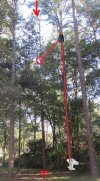
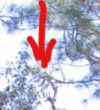
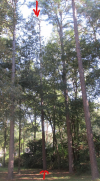
It's a pine that's been dead for at least three years. It's about seventy-five feet with a dbh of 12". No limbs below the few short stubs near the top. Most of the bark is gone. There's no lean that I can see. It's within range of the houses to the right and left in the picture, and also the house behind the camera. The only clear area is between the tree and the camera with a little on either side. The tree is obviously a danger to everything within range as it is. It's a shame the HO let it get in this shape, but she's got plenty of worse problems to deal with.
1663608849125.png
Here's the tentative plan:
Get a pull line around the tree about twenty feet up.
Rig a heavy rope between the closest pines on the right and left about fifty feet up to catch the tree as it starts to fall.
Slightly tension the pull rope, notch the tree close to the ground, add tension to the pull rope, and make the back cut.
The tree will ease through the foliage up high, and land softly in the catch rope. The top will only move about fifteen feet.
If the top breaks off, it'll land in the clear area. Ditto for the lower part if it breaks below the catch rope. OK either way.
If it stays in one piece, start cutting short sections off the bottom to let it wobble side-to-side as it gets shorter.
The rest of the tree will fall in the clear area when the top gets below the catch rope.

I know there are all sorts of things that could happen with a tree like this, but I think this plan is better than the HO's wait-and-see plan. Once the tree leans over a bit, the danger zone shrinks to a small fraction of what it is now, and it's possible to work on the tree from outside the area of highest risk.
 
Do you have any mechanical advantage pulling devices in your rigging kit? Fiddleblocks and a Portawrap? A buddy with a GRCS?

Personally I’d much rather lower the tree than try to catch it.
 
Do you have any mechanical advantage pulling devices in your rigging kit? Fiddleblocks and a Portawrap? A buddy with a GRCS?

Personally I’d much rather lower the tree than try to catch it.
Nothing that I'd trust for that weight and that distance. And there's not enough room to lower it to the ground in one piece in any direction anyway.
 
The way I'd handle it if the tree wasn't safe to climb, based on just this photo and description, is to use a throwball to set a line like 2/3 up, where it is still strong enough to support it, hang a block in the neighboring tree, put a porta-wrap at the base, and then fell the dead tree towards the block. It won't have a ton of force landing into that other tree and the lowering system will easily support it, since the butt of the tree is still on the ground. That line is just to keep it from tipping at full length. Then you can cut pieces off the bottom until it is short enough to lower to the ground. Just don't take so much it shifts the balance point and upends the piece.

Then again, I not there looking at it, so that may not be an option, just looks reasonable from the photo and I've done it with many many trees in the past.


lower.jpg
 
Rig a heavy rope between the closest pines on the right and left about fifty feet up to catch the tree as it starts to fall.
Bad idea, because your rope will only be anchored on some small limbs on those two trees and the force of the felled tree will break those branches, causing unnecessary harm to them, and ruining your whole afternoon.

You might could get a rope as high as possible on the tippy top of the dead tree and just yank it a bit and see what comes out. You might lose 20’ off the top. If you don’t, at least you’ll know it’s fairly solid, because the next option is climbing some adjacent trees, probably with two tie in points, and popping a top out of the dead tree… WITH a tag line to make sure it goes away from your systems.
 
If you go this route, I'd use s back tie to slow the movement and allow for you to take it up as you go.

My question though would be what do you do once you cut it off at the base if you can't lower it in one piece?

If it needs a control line like that of course depends on how heavy it is and how far the distance it is falling is, as farther creates a larger dynamic force. If the dead tree falls into those other limbs it will slow and absorb much of the force. From the photo, it looks like it isn't too far and the force won't be too great, but again, this is just an internet diagnosis.

And since there may not be room to lower it whole, that's why I mentioned taking some off the bottom while it is supported, like this:

 
If it needs a control line like that of course depends on how heavy it is and how far the distance it is falling is, as farther creates a larger dynamic force. If the dead tree falls into those other limbs it will slow and absorb much of the force. From the photo, it looks like it isn't too far and the force won't be too great, but again, this is just an internet diagnosis.

And since there may not be room to lower it whole, that's why I mentioned taking some off the bottom while it is supported, like this:

I worry about the "tie ropes 20' up...the tree is 75' tall" part more than anything.
 
I had planned to climb both trees to wrap the catch rope around the trunks. I wouldn't take a chance on the limbs. That part's pretty easy. It would also give me a way to get the pull rope higher up on the dead tree.

I considered securing the dead tree to the closest tree, but thought the catch rope would reduce the chance of damaging the good trees. I also thought the dead tree would slide on the taut catch rope easier that it would on a rope that was looped around it. Plus the top of the dead tree might get caught in the limbs of the good tree.

As 27RMTON said, it's not going to fall very far before it hits the catch rope, so there won't be much force involved. With no limbs or foliage there's not much weight up high.

I'm a little concerned about the tree breaking up from the shock loading as the short sections are cut off the bottom, but that loading is going to be along the trunk, not bending. After cutting the notch and a bit of back cut, I can pull to the side from a safe distance using a come-along if need be to break the hinge. I'm thinking taking two foot sections at a time would be a good length to start at.
 
If it doesn’t have far to travel to fall into your proposed “catch rope”. Why not tie in to those trees and spike up the thing, or gently swing over and blow out the top? I like @27RMT0N explanation, and I’ve used it often. I’d advocate that before dropping into the cradle of rope….. (I’ve never seen this method)
 
No spikes, and my only experience with spikes was one climb fifty years ago.

Another thing I can do while climbing the good trees is rig pullies for the pull rope so I can pull the dead tree toward the catch rope from a safe distance in the other direction. It shouldn't take much to get it to lean into the catch rope after some cutting at the bottom.

Once it's leaning on the catch rope I can work on shortening the dead tree from the bottom with a notch, back cut, and a pull (from a safe distance) to break the hinge. It's a lot like the video above, but the sections would be much shorter, and the angle of lean much less. I've never done it, but it seems like it would work. I'm going to try it on some old lumber I've got.

I'll also take another look to see if I feel comfortable using Chris's suggestion. My default is to do as much cutting at ground level as I can, but it's worth a look.
 
Last edited:
I haven’t read every reply yet, but by the time you set your described rigging plan, I think you could set one block and one bollard on each adjacent Pine.

With those two blocks and two bollards, you could set two choked rigging lines on the dead pine and pretension both similarly. There may even be the potwntial to cut a trunk section out and hamg the whole thing.

My main concern is something breaking out of the top while youre working beneath, which leaves another option of setting a highline to climb on and dice it from the top down.

Sherbrook Trees did an amazing dismantle in a sensitive area in a video called ‘trivect rigging’ or something similar. You may find food for though in that vid.
 
Ok, I just read through everything. My opinion is to aim for as much control as possible. Seeing that the dead Pine is clear of branches for most of its height makes me think you can climb up high in each healthy Pine and then pull up an opened running bowline which can be cinched up tight on the dead tree.

Try to set these at a safe height on the dead tree and high enough on the good trees to have a bit of downward angle leading to the dead tree so they don't have to over-tensioned. This rigging would provide the most control IMO.
 
I wanted to see if I could get a line high up in the dead tree to assist in getting other a pulling line to the right height. On the first shot the throw bag bounced of the bottom of the fork at the top, and promptly got solidly stuck in something a little lower.
1663997518382.png
Now I've got a throw bag near the top with super strong 2.2mm Notch Acculine attached. It's the first part of what 27RMTON suggested in post #6 above. There's no rigging block, but I could probably get the Acculine higher up around the live tree to improve the mechanical advantage, and I could add some rope so I could pull from a safe distance.

It was a breezy day, and I could see the tree moving around (probably inside a two foot circle) as the wind blew. When the wind died down I could easily pull the dead tree toward the closest live tree, but I was careful not to move it more than it had been moving from the wind. Because of the oak branches around the trees, I can only pull toward the closest live pine (on the right in the picture). It's only several feet to the closest foliage.

So, what now?? It seems like the dead tree be less of a danger leaning into the closest live tree than it is now. It would be easy enough to cut it at the base while applying tension to the Acculine to pull it in that direction. I've seen a dead leaner stay like that for more than a year. It certainly reduces the area where pieces are likely to fall as it weakens, and there's nothing of much value in that area.

Of course, there's no guarantee the Acculine won't come loose or the dead tree won't break with a harder pull.
 
Last edited:
I would suggest you don’t cut it and leave it leaning into the other tree. Once you cut it you own it and if anything happens later you could be held liable. Can you pull it into the other tree and then get it down by cutting the base repeatedly? Or by pulling it out with a truck or come-along?
 
I would suggest you don’t cut it and leave it leaning into the other tree. Once you cut it you own it and if anything happens later you could be held liable. Can you pull it into the other tree and then get it down by cutting the base repeatedly? Or by pulling it out with a truck or come-along?
Good point about not cutting and leaving. Yes, I could cut pieces off the base or pull on it with my truck or come-along.

If I decide to do this, I'll rig up something lower beforehand that's more substantial to keep the heavy part from getting too far away from the good tree if something goes wrong. Maybe even two somethings.

I'm planning to climb that nearest good tree next week to get some dead limbs. I may arrange some rigging points while I'm in the tree.

And there's always a chance the hurricane will change everything.
 

New threads New posts

Back
Top Bottom