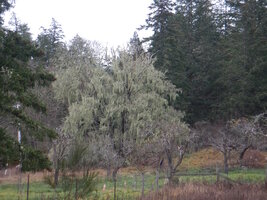
Interesting statement in TCIA magazine article

I’m in coastal New England. Lichens are common place on healthy in my area, such as mosses on the North face of lower trunk, and sometimes thinner plate-like Lichens on older leaders/branches.

However, there are puffy, hair ball-like looking Lichens that develop on younger aged wood which I would strongly correlate with a tree being under stress or even in decline.
Usnea genus lichens are common in southern New England coastal forest, Old Man’s Beard is a catchall name for a few similar Usnea species. Usnea strigosa is a good match for the one Oceans is describing.

Usnea and many other arboreal lichen species are sensitive to ambient/average humidity. Marine air along coastal areas promotes steady humidity and many lichen species thrive in these conditions.

In more inland forest trees adjacent to rivers, ponds, and wetlands will also have strong lichen growth. Move 50 yards away from surface water and the trees will have dramatically less lichens on their limbs and branches.

All this is to say, if a tree is in favorable habitat for strong lichen growth it can have a lot of lichen growth and be a very healthy tree. The lichens can’t be counted on to be diagnostic for a tree’s health, the habitat dictates lichen quantity and diversity.

A tree already in decline will have relatively more lichens due to foliage loss and increased available light as mentioned earlier in this thread. There are already such strong visible indicators for a declining tree that lichens are less important in making assessments.
-AJ
 
Last edited:
On the point of lichens, I love seeing it on old rock walls. Has everyone heard of a method of speeding up the process of its spread? I've heard but never done it that you can scrape off starter lichens, put in a blender with milk and blend it up. Then when painted on rocks it spreads fast. I'm sure google would have examples and or refinements.
 
I’ve been wanting to try that for yrs Merle! Clear off some ledges or boulders and inoculate. Would be a pretty sweet finishing touch to a new stone wall too.
I have a friend that does really nice stone work and he collects moss for patio tile seams. They spread and fill in nicely but he has never said anything about the inoculation trick. I’ll ask him…
 
  • Like
Reactions: ATH
I was hanging out with a lichen expert recently, they just returned from Madagascar where they'd climbed baobab and other unique tree species.

Interesting thing they mentioned is that in tropical forest it takes longer for leaves to be dropped from trees, no annual cycle like we have in northern temperate growing zones. Many leaf specific lichen species take advantage of this. One leaf could have 50 lichen species on it. It is not harmful to the tree, the lichen load is dropped when the leaf's life cycle is finished.

54218741428_54f0e999f3_b.jpg


Some lichens are generalists and can grow on a variety of arboreal substrates, others are very specific per tree species. Lichens like Usnea strigosa tend to be in a tree's crown, they like more light. Other lichens and mosses require less light and can be found in cracks and crevices or lower on the trunk.

54218519716_5845889d3c_b.jpg


-AJ
 
We also talked about "sloughing off bark and lichens". They said that lichens occupy sites on trees for very specific reasons, sloughing bark doesn't particularly regulate lichen populations on trees. Per tree species and locale/habitat a location on tree substrate is favorable or not per lichen species, there is no correlation between tree health, bark sloughing and lichen populations.
-AJ
 
On the point of lichens, I love seeing it on old rock walls. Has everyone heard of a method of speeding up the process of its spread? I've heard but never done it that you can scrape off starter lichens, put in a blender with milk and blend it up. Then when painted on rocks it spreads fast. I'm sure google would have examples and or refinements.

I know people who blend buttermilk and moss and paint it on rocks, walls and hypertuffa plant containers. I don't know any who do it with lichens though. These folks are hosta collectors with quite impressive gardens.
 
I know people who blend buttermilk and moss and paint it on rocks, walls and hypertuffa plant containers. I don't know any who do it with lichens though. These folks are hosta collectors with quite impressive gardens.
Yeah my pops and I would do that, sometimes adding molasses. We made fountains and garden art out of concrete, fiber, perlite, and peatmoss.
 
each to their own style. But I don't like beating around the bush. Direct and to the point, even if it comes off as harsh. There's nothing wrong with a direct correction, as long as it's true. I wold just say "obviously bad (or wrong) information in TCIA article".
 
Perhaps there maybe a little truth to excess lichen generating a fire hazard? How many of you in the PNW have started muffler fires on dried lichen and mosses? I know I have, yet nothing a quick hand swipe or a water bottle didn’t fix.
It’s quite plausible that cultural fires controlled epiphyte growth thus mitigating lighting strike fires?
@KTSmith have you come across any research related to this?
 
I've certainly gotten moss shouldering when making a stump cut in the summer before. Generally I try to brush it off with my hand first.
 
The OP is right to read TCIA articles with care. I definitely see trees on occassion that are "malaised"/declined while also having an abundance of lichen. One southern live oak at my workplace comes to mind - half the tree, including the central leader, is in decline while there is a new leader establishing itself off to the side. The central leader has a lot of lichen while the other leader has very little lichen. I prescribed a retrenchment cut to the central leader to speed up the transition. I agree with the main point of what the OP says the articles says - decline and lichens are sometimes bedfellows beyond coincidence, but I know not the reasons.
 
The OP is right to read TCIA articles with care. I definitely see trees on occassion that are "malaised"/declined while also having an abundance of lichen. One southern live oak at my workplace comes to mind - half the tree, including the central leader, is in decline while there is a new leader establishing itself off to the side. The central leader has a lot of lichen while the other leader has very little lichen. I prescribed a retrenchment cut to the central leader to speed up the transition. I agree with the main point of what the OP says the articles says - decline and lichens are sometimes bedfellows beyond coincidence, but I know not the reasons.
Man, I miss those mossy old southern live oaks. Those and the big bald cypress. Some of my earliest memories of having a favorite tree.
 
This is an article linked to a facebook video. I didn't watch the video.

Trees, Roots, Fungi, Soil: Below-ground ecosystem & implications for tree health National Museum Cardiff, Cardiff, UK – 13th November 2008 Published March 2009 online at: http://www.treeworks.co.uk/seminars/past_seminars.php A holistic approach to mitigating pathogenic effects on trees Lee F. Klinger M.A, Ph.D. Independent Scientist, Big Sur, CA lee@suddenoaklife.org

"Mosses and Lichens Cryptogams such as mosses and lichens are generally considered to be benign organisms in forests. This may well be true where the cover of cryptogams is low. However, as ecosystems age mosses and lichens become more abundant, and together can eventually equal or even exceed the green biomass of all other plants in the forest combined (Klinger et al. 2002). Where their abundances are high there is evidence that mosses and lichens are contributing heavily to the acidification of the soils and to the mortality of the fine roots of trees (Klinger 1990). For instance, Usnea lichens collected from the 1Soil types follow the USDA Soil Survey taxonomy branches of several Oregon oaks (Quercus garryana) in southern Oregon were soaked in distilled water2 for 20 minutes. The pH of the water was then measured3 and found to be very acidic (mean pH [± s.d.] = 3.40 ± 0.06). Thus, any precipitation and throughfall that comes into contact with these lichens has a high likelihood of being acidified. These waters then fall to the forest floor and acidify surface soils as well as leach away nutrient (base) cations. Mosses are also known to acidify surrounding waters and their effects are most pronounced in the surface soils (Klinger 1990), which is where the majority of tree roots occur. A heavy cover of mosses is also linked to fine root mortality of trees (Klinger 2005). With regards to fire, mosses and lichens are found to be noticeably less abundant in oak forests and woodlands that have recently burned or are regularly burned."
 
Interesting. I’m curious if the rainfall through the lichen acidification is actually a benefit allowing for easier mineral uptake by the tree.
 
  • Like
Reactions: ATH
"Acid rain is closely linked to the depletion of base cations (e.g., potassium, calcium, and magnesium) in surface soils. Recent research has shown that while some of these mineral nutrients in trees are derived from the breakdown of rocks and soils, the majority arrive from the atmosphere (Kennedy et al. 2001). In unpolluted forests, dilute amounts of base cations dissolved in rainwater were shown to be the dominant source of these and other essential minerals in trees. These scientists go on to explain how acid rain, by accelerating the rate of leaching, decreases the levels of available base nutrients, including the macronutrients potassium, calcium, and magnesium, as well as a number of the essential micronutrients. They conclude that particular attention should be paid to the levels of available base-rich nutrients in the soils of declining forests that are experiencing acid rain."
From the same article.
 

New threads New posts

Kask Stihl NORTHEASTERN Arborists Wesspur TreeStuff.com Teufelberger Westminster X-Rigging Teufelberger
Back
Top Bottom