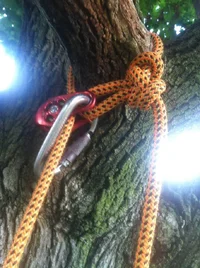
In-tree anchor strategy

Re: sort of a slip knot prussic

[ QUOTE ]
What about using a Pinto Pulley (instead of the shackle pulley) and a Delta Link instead of the ring...midline attachment and the Pinto frame might keep the rope from riding off the sheave unlike the shackle pulley.

[/ QUOTE ]

Yep, that would be good, if I only had a Pinto.
-AJ
 
Re: sort of a slip knot prussic

This has been working out well for me. It is countryboy's photo of something that I have been using for about 6 months. The only thing I do differently is I will put the biner through the pinto the other way to get the gate clear of the tree.
338597-SRTconnection.jpg
 

Attachments

  • 338597-SRTconnection.webp
    338597-SRTconnection.webp
    115.6 KB · Views: 34
Re: sort of a slip knot prussic

A delta link works nicely for the above application.

Squirrel, are you using this as a base anchor configuration or mostly as a TIP?
 
[ QUOTE ]
This is a releasable SRT anchor I've been working on. The idea is to have a remote release in-tree SRT anchor. It's different than a cinched anchor in that the release tether doesn't need to follow the rope path. Anyway something for discussion (not showing how it's tied in this video, just how it works):

https://vimeo.com/49453290

[/ QUOTE ]

Can you do a step by step tying this? I could use this for a few applications as it doesn't have the running end being pulled over the branch the entire length of the rope-but would still not use as primary tie in.
 
[ QUOTE ]
Can you do a step by step tying this? I could use this for a few applications as it doesn't have the running end being pulled over the branch the entire length of the rope-but would still not use as primary tie in.

[/ QUOTE ]

Last climb it failed to release. It's super solid to climb on though. If it doesn't release when you want it to though it's pretty useless. I'm going to do some additional tests to verify my theory why it didn't release. If release can be made predictable I think it will be useful. I'll show how it's tied next vid.
-AJ
 
Played arounnd with my horse knot but keeping my base tie. Interesting concept. Essensially, it limits tje amount of stretch in the rope and tree. If the horse knot gets pulled out by errant rigging, yiur still base tied, if you cut your base tie ( harder since its not tentioned) yiur still on the horse knot. Ive always been able to pull out the horse knot, and it has never come out on me whilst climbing. Requires a solid pull.
 
I've demonstrated a few ideas about switching from a base tie to an isolated limb. With a midline attachable false crotch (eye2eye with carabiner on one side & carabiner and micro pulley on the other). You can slack out the base tied side and put in a Butterfly against the micro pulley. It's nice if your beginning with a base tie and want to cut your load in half to raise the TIP to a smaller, more ideal branch.
 
I ussually wnd up with so many redirects after a climb, only the friction saver method seems practical for me as an in tree tie in point strategy. At the moment probably 90% of my climbs are base tied. I like the idea of takin tension off the base side of the line though, as well as being backed up if that line gets cut.
 
[ QUOTE ]
I've demonstrated a few ideas about switching from a base tie to an isolated limb. With a midline attachable false crotch (eye2eye with carabiner on one side & carabiner and micro pulley on the other). You can slack out the base tied side and put in a Butterfly against the micro pulley. It's nice if your beginning with a base tie and want to cut your load in half to raise the TIP to a smaller, more ideal branch.

[/ QUOTE ]

I like this. I'm going to mess around with it this week. Are you just using a small CMI type micro pulley?
 
[ QUOTE ]
Played arounnd with my horse knot but keeping my base tie. Interesting concept. Essensially, it limits tje amount of stretch in the rope and tree. If the horse knot gets pulled out by errant rigging, yiur still base tied, if you cut your base tie ( harder since its not tentioned) yiur still on the horse knot. Ive always been able to pull out the horse knot, and it has never come out on me whilst climbing. Requires a solid pull.

[/ QUOTE ]

Ive done much the same. My "cambium saver" set up is a three holed rigging plate on one end and a biner on the other. I thread the rigging plate on the line from the beginning using an alpine butterfly to "hang" it at the top of my rope (this way its at the top waiting for me. Once i get to the top i undo the alpine butterfly and tail the cambium saver with me as i advance to the desired Tie In Point. I place the biner through my desired TIP and connect it to my line (line is now running thru the rigging plate and the biner) I use an alpine butterfly again on the basil tie off side (runs into the rigging plate). I use a rigging plate and biner for this application; 1. because the biner makes it easy to attach inline and a quick way to advance your TIP. 2. the Rigging plate because it eliminates the potential for this side to slip thru the biner (thus sideloading the biner against the TIP) I've had good success with this technique. Only downside is that like any cambium saver it must be retrieved with a throwline and sometimes doesn't retrieve easily.

Clear as mud right. I'll try and take pictures or make a video, If anyone cares to see it.
 
[ QUOTE ]
[ QUOTE ]
I've demonstrated a few ideas about switching from a base tie to an isolated limb. With a midline attachable false crotch (eye2eye with carabiner on one side & carabiner and micro pulley on the other). You can slack out the base tied side and put in a Butterfly against the micro pulley. It's nice if your beginning with a base tie and want to cut your load in half to raise the TIP to a smaller, more ideal branch.

[/ QUOTE ]

I like this. I'm going to mess around with it this week. Are you just using a small CMI type micro pulley?

[/ QUOTE ]

I'm using a length of 16 strand, 2 oval biners, and one small Pinto. Each eye holds a biner, but one biner holds the pulley. The lone biner side acts as the large ring, and the pulley acts as the small ring. Retrieval works with a ball, just like a ring to ring FS.

I like how the Pinto frame is rounded. I think a small arb ring between a "sharper" micro pulley and Butterfly would be nice, just to protect the rope a bit.
 
Let's share ideas at the Taylor's/Shelter's H.C.G.t.t.C. event (hopefully you can make it!) I'll bring a few of the eye2eyes I have and maybe you can make use of one...?
 
[ QUOTE ]
Played arounnd with my horse knot but keeping my base tie. Interesting concept. Essensially, it limits tje amount of stretch in the rope and tree. If the horse knot gets pulled out by errant rigging, yiur still base tied, if you cut your base tie ( harder since its not tentioned) yiur still on the horse knot. Ive always been able to pull out the horse knot, and it has never come out on me whilst climbing. Requires a solid pull.

[/ QUOTE ]

I've been taking a close look at the Horse Knot. The release leg of the rope shares the "locking bight" with the leg of the rope that supports the climber so it definitely releases much better than the knot I came up with. With the easier release comes more fear of accidental release. I tried adding an extra locking bight on the Horse Knot, that's really solid. But it might have the problem of not releasing after loading. I'll test.

Edit:
Ah shoot, adding the extra locking bight puts wraps around the standing end which would create problems after the release is pulled, will add too much friction.
-AJ
 
Re: sort of a slip knot prussic

[ QUOTE ]

Pull down is the right side
254613_4816423732987_1279592174_n.jpg


[/ QUOTE ]

This nifty bit failed to release on a test climb yesterday, too much friction around the anchor limb. Only one redirect was enough to bog down the release. Oh well, worth trying anyway.

I think it's going to have to be based on an adjustable ring/ring type setup to work, pretty much what Oceans has suggested.
-AJ
 
Re: sort of a slip knot prussic

[ QUOTE ]
A delta link works nicely for the above application.

Squirrel, are you using this as a base anchor configuration or mostly as a TIP?

[/ QUOTE ]

I have used it for both, but mostly at the TIP. Its important to note as moss found it will bog down when pulling through several redirects. There are a couple things you can do though to minimize the risk of having to go fetch.

1. make sure you have just enough rope on the working end to complete the tasks you need. This insures the tail comes through the pully quickly when retrieving and then its like pulling a single line out.
2. Try to have your first redi as far from the TIP as possible. This will allow for easy pulling until the pully gets the the redi and by then the tail is short and should pass through soon (if # 1 was followed).
3. you can also tend the pull down side into a favorable possition for retrieval.

The TIP works, it isnt the answer to all of the worlds problems but its another tool for the tool box.
 
[ QUOTE ]
Can you do a step by step tying this? I could use this for a few applications as it doesn't have the running end being pulled over the branch the entire length of the rope-but would still not use as primary tie in.

[/ QUOTE ]

Makes sense, could have some rigging applications. Here's a vid, I tied it twice:
Releasable anchor knot

Let me know if you have any questions,
-AJ
 
[ QUOTE ]
Let's share ideas at the Taylor's/Shelter's H.C.G.t.t.C. event (hopefully you can make it!) I'll bring a few of the eye2eyes I have and maybe you can make use of one...?

[/ QUOTE ]

I'll be there for sure, got the day off tomorrow so I'll have time to register. Don't sweat the i2i's I can whip some up here. I don't want to steal your stuff just your idea.
grin.gif


Moss, you need a pinto! Trade you one for your HH?
wink.gif
 

New threads New posts

Back
Top Bottom