I need a favor...rope damage to cambium or bark

Tom Dunlap

Here from the beginning
Administrator
There is concern about cambium damage at the primary redirect or even the secondary redis when using a base anchor. This might be valid, I haven't seen a tree where that was a concern to me. Thin barked trees in the spring are the most likely to be damaged.

In all my years of climbing I've only seen ONE damaged TIP. As I was ascending into a hackberry I spotted 'the TIP'. when I got to the TIP I found that someone else saw the same target :) They had done the sideprune for the pole-pole electric lines.

Now that most people have smart phones or carry small cameras it's soooo easy to document anything.

I'd like to get ANY pictures of cambium, or even bark, damage from the rope moving.

My goal isn't to prove that damage is occuring, I'm pretty sure it is. But, who goes back to the primary redi and checks to see after they've climbed? It's likely going to be years before another climber enters the tree. What I would like is examples, that's all.

Thanks!
 
I have noticed damage on smooth barked eucalyptus when i use a base tie much worse then anything i noticed on natural crotch ddrt, in most cases it's either splitting the cambium parrallel up the branch or its crushing it and opening it up so the rope is sitting on bare timber, i use alternative tie in methods where possible i'll try and get some pictures next week
 
I was removing some hazard deadwood in a wild black cherry last week. I was using a TIP cinch to mitigate any potential damage. When I got to the TIP (70'), I noticed some damage just from setting the line and working the tree. So, I moved the TIP to another union to avoid any further damage to the same location. Of course, it's 'high-spring' here so the tree was still putting on a lot of new growth and the bark was very, very tender. Could have used a base anchor & cambium saver. But, the line setting damage would still occur. Moving the TIP really seemed to work out pretty good and the damage was minor. Had I known about your study, I'd have had a camera sent up -- maybe next time. I have a minor phobia about cameras and tree work. Taken pictures takes my mind off the work plan and staying alive -- but that's just me.

It will be interesting to read the feedback you get, Tom. This should be a good thread!
 
SJ,

Can you describe 'damage'?

Polishing the bark is one thing...rubbing away thin bark wounding the cambium is another.

Using a tube style rope saver would eliminate damage to the bark..and rope too, wouldn't it?
 
I've got an old VHS tape from 92 that clearly illustrates rope damage to crotches in Alnus rhombofolia from close up in the tree.

Probably belongs in the ole timer archives though!

jomoco
 
It was definitely through the outer bark in a couple of places. There was a distinct green color visible indicating the phloem was exposed. The damaged patches where relatively small, maybe a square inch, total. There didn't appear to be any white visible so the cambium was probably not exposed though it must have experienced some crushed cells. The areas affected were just outside the bark ridge of the union.

I was surprised see the damaged area. Apparently, prunus serotina is particularly vulnerable during this period of the spring. I used a cinch because I had to go high to remove the hazard-wood and I was concerned about the extra load of a base anchor. I usually use a cambium saver when base anchored. Next, time I'll use my leather sleeve even with a cinch. However, I am convinced that the 'sawing' motion with the throwline while trying to isolate and the subsequent yarding of climb line through the union was the biggest reason for the damage.

Anyway, moving the TIP cinch while top-side seemed to be prudent and hopefully sufficient so the tree will recover well and not hate me, LOL.
 
I cleaned out the throwline tree in australia. I was amazed at the extent of the throwline damage. Leather tubes and dan house rope sleaves are good options for srt lines.
 
[ QUOTE ]
... However, I am convinced that the 'sawing' motion with the throwline while trying to isolate and the subsequent yarding of climb line through the union was the biggest reason for the damage...

[/ QUOTE ]

This statement, followed by Kevin's observation on the throw line caused damage he saw, makes me wonder. Will adding a cambium saver to the climbing line stop this?

Dave
 
[ QUOTE ]
[ QUOTE ]
... However, I am convinced that the 'sawing' motion with the throwline while trying to isolate and the subsequent yarding of climb line through the union was the biggest reason for the damage...

[/ QUOTE ]

This statement, followed by Kevin's observation on the throw line caused damage he saw, makes me wonder. Will adding a cambium saver to the climbing line stop this?

Dave

[/ QUOTE ]

Absolutely.

Why wouldn't it with either DDRT or SRT base tied?

You can even use multiple CS's on a single rope.

jomoco
 
[ QUOTE ]
Will adding a cambium saver to the climbing line stop this?

Dave

[/ QUOTE ]

Assuming:

---that the throwline didn't do the damage
---the rope saver/tube stays in place and doesn't saw on its own

It should eliminate cambium/bark damage.
 
[ QUOTE ]
....Why wouldn't it with either DDRT or SRT base tied?... jomoco

[/ QUOTE ]

If the cambium is already damaged from the throw line in the process of setting the climbing line with cambium saver, are we not closing the barn door after the horse has left?
On the trees I have worked with SRT, I do not see any evidence of this except for the times when the throw bag gets stuck and requires higher than average pull pressure to retrieve.

Dave
 
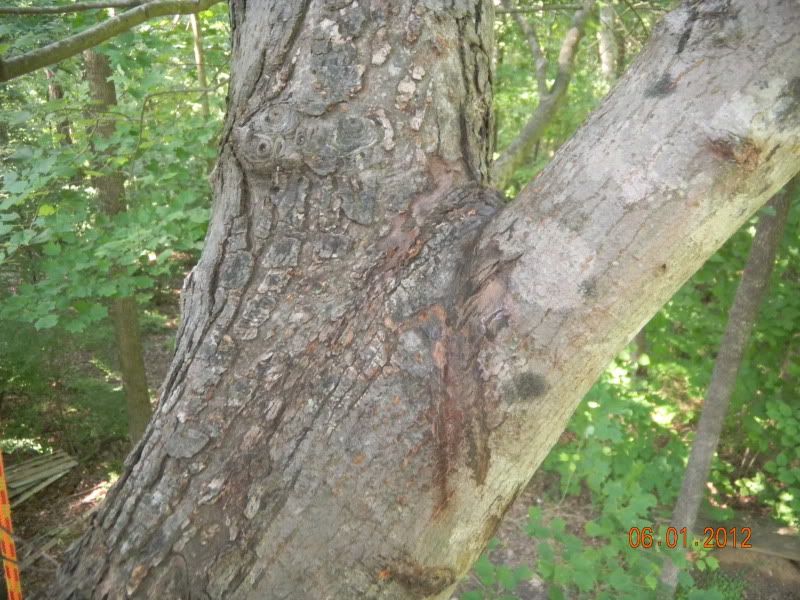
I suppose it is possible that a tree could form a sort of callous. Tom I took this picture of a maple tree, on the TIP (at the log cabin) that I have been using to test gear on for the past 2 years or so. I have used it unprotected with bare rope both doubled and base tied single line, but un-cinched. The bark is intact but very smooth and glossy where the rope has slid. As for the branch it is robust and healthy looking.
002-3.jpg
 
Gordon,

Thanks for the pic, I saved it!

Putting your rope around the trunk instead of the limb would be a first step. The bark is thicker and the plates will take the rubbing better than the thinner bark of the side limb.

Using a false crotch or tube rope saver would be a good idea too since you're using the same TIP a lot.
 
an example

pittosporum - done with the main growth flush but not by much. small wood, too. note sugoi tip for scale.

i knew i was taking this small top out. so didn't protect it with a sleeve.

it's base tie SRT rope went thru some side branches on the way up to the TIP, so hit the TIP at an angle.

this is small wood that we are talking about here - pretty easy to damage and pretty normal in spring/early summer. it would be interesting to see damage like this on a larger branch.

but you get the idea - bark outside the branch bark ridge is crushed, a small tear runs up the branch. this specimen has been already cut and chucked - it came out better than the photos i had of it that were in the tree. the crack running up the branch is a little more pronounced in this photo than it was at first.

i'll see if i can find some more photos later in the summer - i have a tree or two to revisit one of these days. that;s not a high res copy of that photo, btw
 

Attachments

  • 327302-ropedamage.webp
    327302-ropedamage.webp
    120.8 KB · Views: 122
Missed a photo opportunity Tom but a description is probably worth it:

Set a ground anchor on a white pine Monday morning, the rope was 10mm HTP. The setting was high in the tree over a "bundle" of smallish limbs/branches, three in particular carried the majority of the load. Smallest was about 2.5" diameter, the biggest approx. 3.5 - 4". From the ground I could see that the rope was close enough to the spar and was over a sufficient number of limbs but I couldn't see exactly what the rope position was. Therefore I did an extra vigorous bounce test before ascending.

Arriving at the TIP/redirect observed significant deep grooves in all three limbs. I believe my load test was the culprit. Without a load test probably would have broken into the cambium just with the climbing motion but would've been much less. Did not see any throwline cutting damage although the climbing rope could've obliterated that. These were young upper limbs, if they had been more mature white pine limbs I would've seen a shallow polished groove that didn't break the surface of the bark.

Interesting to note that after I'd worked my way up into the top observed that my Pantin had ripped a couple of ugly digs into the thin barked upper spar. Not the first time I've seen that.
-AJ
 
Pete...thanks for the pic. Yup...on trees like that in the spring it's hard not to have some collateral damage.

Andrew...what??? you didn't have your camera? I thought that was as much a part of your climbing system as your rope ;)

I think that there is always going to be damage. How much, where and what is acceptable is going to be discussed.

Finding an old wound and seeing how the tree has reacted would be really interesting. That might be like finding a needle in a haystack though.
 
[ QUOTE ]
Andrew...what??? you didn't have your camera? I thought that was as much a part of your climbing system as your rope ;)

[/ QUOTE ]

I did have a camera! Was focused on some tasks, then spaced it out. Was tired, day before we put 176 people on rope in two trees at Duke Farms in New Jersey, whew! TCI/Peter Jenkins record for total climber numbers in one climb event. But I digress...
-AJ
 
Tom,
Here is picture of a removal that I did today, so the damage didnt really matter. I installed the line by hand and tied it off 8-10 ft below this crotch so it didnt have the full hight of the tree for stretch to cause even more damage. I was suprised how bad it was just with the rope. I think I will invest in a Dan House special.
 

Attachments

  • 327733-singlelinedamage.webp
    327733-singlelinedamage.webp
    49.2 KB · Views: 103
Cool that the leather tube has a place in the wrench world. I like old technology paired with the new, the duality of man. I set up my base ties with a tautline hitch, Boy Scout manual meets SRT.
I chokered at TIP for an aerial inspection in a ficus today, could have run the leather cambium saver in there no problem, in this case it may have been easier on the epiphytes.
 
Today a good lesson in knowing your local species. I set up a base tie for working in a Cassia siamea, a crown restoration of sorts, the tree had been topped at about 45'. When I got up to the cluster of regrowth at the top I found out that the bark under the rope crushed and crumbled away, looked like I hit it with a hammer.
Justice came swiftly, as I was working on some lower laterals I got hit by some species of hornet, including one in the ear.
I finished the day with the cambium saver, lesson learned.
I got a picture from the ground, I'll try to post.
 

New threads New posts

Back
Top Bottom