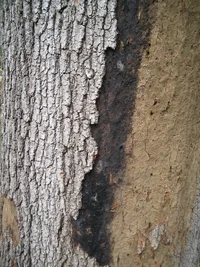
Hypoxylon canker

Identification is not always necessary but understanding of ecological role and point in the continuum of decay is necessary.

All the crust and paint fungi are hard to ID and there are few good resources in North America, often you need to look at the European literature and see if anything is close.

What you can do is see if the fungi is on dead or live wood and what state the wood is in. Sometimes throwing a line over the limb and seeing if it snaps off will give you a lot of information without the need for a name. If you are thinking of retaining the tree next look at the tree response, there is a huge difference between trees producing wound wood and no response at all.
 
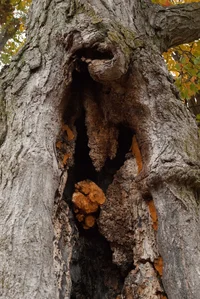
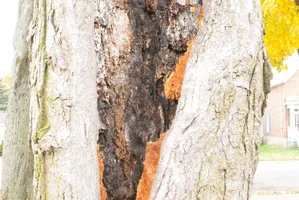
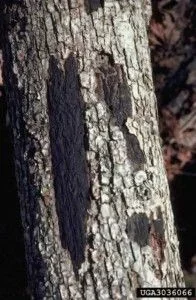
The pictures by CaPowell are a close example of what I see in oak. In maple and pecan the mats would be black. It may be different things but the progression and prognosis is the same. It starts out as a few spots of spore mats on otherwise healthy tissue. If you cut the branch back there will be heart rot quite a ways back from the mat. As the disease progresses the fungal mats expand and the bark flakes off around them. There is no attempt for callouses to wall off the disease. 3 years in large branches begin to fall off from severely weakened wood. By this time some of the heartwood is usually rotted out in the stump. If the diseased wood is not pruned out the tree early the tree will always die.
 
Seen similiar black to dark brown mats on maple. Usually dying trees with major trunk issues that werent readily apparent to the HO until the big nasty crud shows up.
 
I think that you guys are talking about multiple things.

Black Mats on decayed (sugar) maple are likely to be demarkation or zone lines, perhaps even CODIT walls with lots of secondary metabolites.

Mats starting on otherwise healthy tissue are not all that common. I have no idea what you are looking at but species such as Perrinoporia can shif from dead to live tissue.

As for black mats are you really talking about black mats of fungal hyphae? I cannot think of anything that meets this description, you may be looking at fruiting bodies rather than hyphae.
 
Fruiting bodies and mats are different but I still cannot picture this in my head. Photos!!!

Clearly mycology is an area where most arborists are lacking. We need to have far better resources, Luley, Mattheck, Schwarze and Watson and Green are aimed for the arborist but little else, you need a pretty strong background to jump to the scientific literature and ID monographs.
 
"If you are thinking of retaining the tree next look at the tree response, there is a huge difference between trees producing wound wood and no response at all."

Well worth repeating.
 
Hypoxylon deustun syn. Kretzschmaria deusta

Xylaria polymorpha is dead-man's finger

The other thing I do not know.

Still have no idea what you are thinking
 
Yeah it's often lumped into Hypox canker.
I seem to remember the dark area being poofy dusty sporey too though
 
Is there a question on the table here? Several folks have uploaded images of very different and unrelated fungi. Are these just being grabbed from the internet because they are sorta kinda like what you've seen in your work? Most of the images have been inadequate for identification beyond a broad group. That's fine, broad group is good enough for some purposes. And even good snapshots are inadequate for identification to species....especially without knowing the host.
 

New threads New posts

Back
Top Bottom