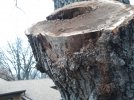
How would you make this cut?

Lupin_IV

Participating member
Location
St Paul
Just hoping to pick your brains on if there is a better way to make this cut or not.

I was pruning a magnificent red oak for a side job recently. There was what looked like an old, large lead that broke off many years ago leaving a rotting nub that was pretty large, about 15 feet up from the base. An irregular collar was forming around the bottom of the nub, so I went to cut it as close to flush with the outside of the collar as i could (it was an odd shape and I never have to make nice cuts with a rear handle aloft, so it was questionable) and noticed a good bit of decay. I dug out what I could to see how far it went in to discover it didnt go all the way into the trunk, or at least seem to. That got me thinking on if I should cut further in, past the formed(forming?) collar and past the decay in hopes it would heal over that and prevent further decay, or if I've done all I could and should just leave it. I haven't gotten a chance to read much pruning literature, leading me to this post. Luckily I'm working at the house next door for a few weekends now and could easily hop up and adjust the cut if it would be better for the tree.

The photos aren't great but weigh in if you can. If ya gotta rip into me for my cutting skill so be it :b Thanks all.
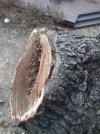
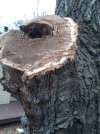
20201220_143933.jpg20201220_144021.jpg20201220_144031.jpg
 
It looks like you cut a little of the collar still? I would say that you want to cut as close to the collar without cutting it. That may be pan irregular shape when finished but will be better for the tree.
Yeah, it was a tough angle for me. I should have took a before photo as well as I was quite confused, the collar was much taller on the left side. Lesson learned.
 
On oaks where the limb has died and has started to heal I like to leave a tiny stub 1/2" less maybe and let the tree compartmentalize over that.
 
Looks like you tried to do everything right, yes it looks like you nipped the wound wood or collar a bit. I don’t really ever get a chance to work with oaks. But I do work with a lot of madrones those buggers can have very discreet collars very far out from the trunk on live limbs, to the extent when making proper pruning cuts it looks like you left stubs all over the place.
A slight Nick on the collar or wound wood can arguably be beneficial, but I still ALWAYS avoid it at all costs without solid justification
 
That got me thinking on if I should cut further in, past the formed(forming?) collar and past the decay in hopes it would heal over that and prevent further decay, or if I've done all I could and should just leave it.
Part of the problem with Shigo's teaching on target pruning is that he never meaningfully addressed the issue of the size of the cut. On a cut that size there is no chance of compartmentalization, nor that the wound wood will grow over the cut. Note that just because a cut does seal with callous growth does not necessarily mean it will compartmentalize. Shigo showed that compartmentalization is optimal and more important than how quickly the callous grows over the cut.

The Europeans have published research that claims that 4" cuts are about the limit of a tree's ability to compartmentalize, even on species that compartmentalize well. There is no way that cut is going to compartmentalize. It's simply too large a cut. The idea that cutting past the existing collar would somehow help that tree is mistaken. Likely the best thing you could do for that tree would be to leave the stub untouched. If there is an aesthetic concern, you may have to trim a big stub like that, but most clients will listen when you tell them, the tree is better off if you just leave that as it is. When you cut into the new wound wood, as you clearly have done here, you are likely doing damage. Best to make sure that the cut doesn't violate the newly forming growth as Mark said.
 
A good axiom to keep in mind: Don't cut live wood when cutting deadwood.

Recutting leads to a larger diameter wound. I had a sample of a cut like yours from a smaller tree. The sample came out when the tree was removed. I saw the original torn limb, jagged stub and collar growth like you found. Then someone came along and recut closer to the original branch collar. I took the sample back to my shop and sliced it in half to dissect. When I looked at the discoloration/decay lines I could see two very distinct decay lines. Rewounding the tree by making the second cut enlarged the decay volume.

When I saw that the CODIT model finally sunk in. The tree had two wounds. One from the original torn stub and the second from the recut.
 
A good axiom to keep in mind: Don't cut live wood when cutting deadwood.

Recutting leads to a larger diameter wound. I had a sample of a cut like yours from a smaller tree. The sample came out when the tree was removed. I saw the original torn limb, jagged stub and collar growth like you found. Then someone came along and recut closer to the original branch collar. I took the sample back to my shop and sliced it in half to dissect. When I looked at the discoloration/decay lines I could see two very distinct decay lines. Rewounding the tree by making the second cut enlarged the decay volume.

When I saw that the CODIT model finally sunk in. The tree had two wounds. One from the original torn stub and the second from the recut.
Oof, that's got me anxious for the tree. Hoping I didn't do major irreparable damage here. Do you recall what reason the tree in your sample cut had to be removed? Did it look like active decay? If that's even something you can tell
 
Back
Top Bottom