How to assess worn Rope?

A 24 strand is a rope within a rope, with the core and jacket sharing the load fairly equally... very strong. Look carefully at the stand that is picked, frayed, cut, or whatever. Even if it's completely severed it's probably ok as long as it's only in one spot... the surrounding stands will keep it locked in. If it were my rope, I would trim the frayed fibers off with very sharp scissors. That way it's easier to tell if it gets worse. As Steve pointed out, changes in diameter are of more concern, and will be easier to detect if the frayed fibers are trimmed. I agree, this is a great rope... my go to for a work on a system virtually identical to yours.

Great post...
 
Cougar is super tough rope. I would like to know how this happened. Regardless,it is still stronger than strong enough, the only thing this may effectis performance. A hitch or mechanical may not feel the same when running over this defect.

Reed Wortley
CTSP #01739
ISA CA #SO-6953A

I wish I had an answer in how it happened. I only do rec climbing/cat rescue, and on my last rescue I looked up and saw this. No idea how it happened, the only place on my rope like this and I scanned it thoroughly. I am going to keep a close watch on my rope for new spots.
 
To me, this is not a worn rope. This is a fairly new rope that had an encounter with a handsaw, pole saw, chainsaw, etc. Hopefully, you know the history of the nick and can remedy. Your question is really, how serious, right? Know your line. Cougar is 24 strand double braid, load is shared between core and cover. The damage appears to be only to the cover. You have twenty four separate strands comprising the braided cover. It appears from your photo one red strand is fully severed, one yellow strand has been picked, and maybe a black strand too, I can't tell from here. If that's true, 23/24 strands are intact on your cover. Presumably the core is fully intact. This damage doesn't hit "cut me now so no one ever climbs on me again" threshold. However, that spot should be monitored. It's easily monitored by feel; every time you pull that line out, put it away, or run a hitch or mechanical over it, you'll get a feel. Then visually inspect. If you know the history of your line, and you know the reason it all works, you'll be able to answer this question for every different type of line you employ.
Make a clean cut with a sharp scissors. Burning the fray will leave a hard spot, for me this is worse than the nicked strand.
I believe the generally accepted guideline (I'm sure I'll be corrected if wrong!) is retire or cut a db 24 strand if four strands in a row are all completely severed. Four strands spread out is not an issue.

Thanks for the awesome advice!
 
I lean towards the person on the rope being comfortable with it. If it gets in your head that it may not be safe and that's what you start focusing on....... then it may be the other thing you are not focused on that bites you in the a$$.

Maybe a little off topic, but not completely, when talking about the number of strands cut vs. retiring the line - how much consideration is given if you are climbing single rope vs. doubled? My next question would be a rescue scenario where both climbers weight will be put on to one system? I know there are 100 different what if and could have scenarios, and they will all be answered as differently as can be imagined.
 
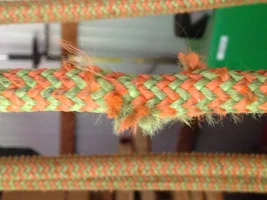
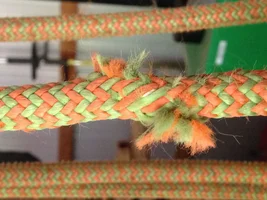
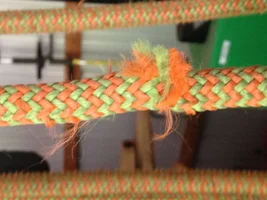
Very good posts and information here. I also have a rope situation that I would like you guys to see, check out the pictures below(3 pics from 3 angles). It's tropical poison ivy rope, cuts were from polesaw catching on it. I'm generally not too worried about nicks and small frays, but the fact that the core is visible and the rope is no longer symmetrically round, understandably due to the different tension on the strands, makes me wonder. It's about 30 foot from the end of the spliced eye, and I climb multiple times a week. What would you do?
 

Attachments

  • image.webp
    image.webp
    270.5 KB · Views: 114
  • image.webp
    image.webp
    294.5 KB · Views: 107
  • image.webp
    image.webp
    251.3 KB · Views: 100
Very good posts and information here. I also have a rope situation that I would like you guys to see, check out the pictures below(3 pics from 3 angles). It's tropical poison ivy rope, cuts were from polesaw catching on it. I'm generally not too worried about nicks and small frays, but the fact that the core is visible and the rope is no longer symmetrically round, understandably due to the different tension on the strands, makes me wonder. It's about 30 foot from the end of the spliced eye, and I climb multiple times a week. What would you do?
Looks to me like that rope is toast. Every time your hitch slides over that spot it will displace the fibers further, so why struggle with it? Tape the bad spot and cut the rope. You'll have a 30' piece with a spliced eye for use as a long lanyard or base anchor. Send the remaining portion to have a stitched eye made, leaving you with a short climb line suitable for ornamentals and and small prunes.
 
I've been climbing with it damaged for about a month now, but just today i was descending from 40' and my VT caught hard on it, which is a first. That's especially what made me question it now. I'll totally use the short spliced eye end for a long lanyard. Not sure where to send the rest to get a new eye stitched or grizzly-spliced. I'll have to do some checking around...
 
I've been climbing with it damaged for about a month now, but just today i was descending from 40' and my VT caught hard on it, which is a first. That's especially what made me question it now. I'll totally use the short spliced eye end for a long lanyard. Not sure where to send the rest to get a new eye stitched or grizzly-spliced. I'll have to do some checking around...

Ever tried splicing? Perfect time to try it out!
 
Treestuff will do it. I'd cut it too. I have an 80' rope for small stuff in the box. I never use it but it's there. You can even use it for a retrieval leg for a canopy tie. Spliced eye is great for that. I did that for a while then went to tech cordage and a small dmm bag for retrieval on tall trees where I don't have enough tail with my 200' line.
 
Ever tried splicing? Perfect time to try it out!

I haven't yet, either, but I've always read that worn ropes can be really tough to splice, sometimes, and that it's better to learn on newer rope. Maybe even more simply constructed rope, like Tenex, for instance. It looks like it could get really frustrating really quickly.

I guess I'm just thinking that the first few attempts at the process should be as easy and as fun as possible, in order to encourage further exploration. Having a really tough time the first time out might discourage someone from wanting to try the process again. Just my thoughts.

Tim
 
Cougar is super tough rope. I would like to know how this happened. Regardless,it is still stronger than strong enough, the only thing this may effectis performance. A hitch or mechanical may not feel the same when running over this defect.

Reed Wortley
CTSP #01739
ISA CA #SO-6953A

Thanks for the comment on Cougar's toughness. That is good to know, and it is a quality of a rope that is important to me. To find out that one of the best ropes for the Bulldog Bone (and the Rope Runner, too?) is really tough is great news to hear.

Thanks again.

Tim
 
@Steve Connelly said: " Also the saw pics. Brand new rope on the crane job and I tore it up. Just trying to climb around with a big saw and a rope bag was awful The line kept catching on the chain. Really pissed but it looks worse than it is. Just some pics, no cuts."

I had this happen to my Vortex rope, and I don't even use a chainsaw in the tree all that often. I just had the saw hanging down off its lanyard for a couple of minutes while I messed with something, if I'm recalling the sequence of events correctly. I later discovered the pics in the rope. Just maddening, as it was really a small task I was trying to accomplish at the time.

I guess I realized at that time that it is tough to avoid having the chain bump into the rope in that situation, as both the rope and the chainsaw want to hang straight down off of your harness.

I'm not a fast guy to start with, and my use of the saw is infrequent; only to cut through deadwood limbs that my silky would take too long to cut. After this incident I took to putting my bar cover back on every time, just to avoid the pics.

I guess another solution would be to use one of these, which can be adjusted so that you could hang the saw up close to you.

http://www.treestuff.com/store/catalog.asp?category_id=140&item=51

This item would take weight off of your saddle, help prevent picking of the rope, and save the need to put the bar cover back on, in situations where you are using the saw frequently. This assumes that there is a branch or stem nearby from which to hang it.

Maybe it already exists, but it seems like a bar cover with some kind of snap-clasp, which opens from the side of the bar, and has a short bungee to keep it attached to the body of the chainsaw, would be nice. Quick on/quick off.

I hope these ideas don't sound too impractical to have merit.

Tim
 
Tim I recall Eric ( oceans ) using his scabbard on his 201 a couple years back doing large structural prunes..he was very efficient with it..I however would get annoyed with this...it would be more a preference thing..never really have problems with saw grabbing my rope....rope management takes thought and is a learned skill just like most things in the arb world..takes repitition and planning
 
S
It's not so easy dragging a 28" bar about the canopy. It doesn't happen to me on a regular basis. Just that day. It was a mess of suckers and such. Painful climb at best
Steve my post was not directed at you..and the crane climb...but new ropes are better suited to prunes..older ropes for removals and sappy trees..my 2 cents
 

New threads New posts

Back
Top Bottom