












Navigation
Install the app
How to install the app on iOS
Follow along with the video below to see how to install our site as a web app on your home screen.
Note: This feature may not be available in some browsers.
More options
You are using an out of date browser. It may not display this or other websites correctly.
You should upgrade or use an alternative browser.
You should upgrade or use an alternative browser.
Hitch Hiker
- Thread starter bonner1040
- Start date


Jehinten
Been here much more than a while
- Location
- Evansville
I have recently done away with the holster and fixed pulley with the HH and took a wrap off of my friction hitch. It is so smooth right now that I am not seeing a need for either, as my bridge termination pulls the HH up the rope on ascent. There is still some tweaking to do, as on occasion I have to set the hitch by hand or it may sit back about 2 inches before grabbing. I am just slowly creeping the stopper knot tighter towards the hitch until I get the consistency that I want in it setting itself. For what its worth I am using Vortex and a 4 wrap hitch with 9mm Arbpro.
That is a great combination!... For what its worth I am using Vortex and a 4 wrap hitch with 9mm Arbpro.
TimBr
Official Well Known Greeter
- Location
- Northern Virginia
@Jehinten; @AshWilliams; Forgive me if you've already heard about or already do what it is I'm about to mention.
I was told somewhere, somehow that it was necessary to tie the hitch really tight, really short when using the Hitch Hiker. I make it so tight & short that I need to use a good amount of pressure just to get the hitch to push up and over to the top of the Hitch Hiker. Before this point it's basically flopped over onto the back side of the Hitch Hiker, as I'm trying to tie it. Once the hitch is rolled up to the top of the Hitch Hiker, I try to tend it by pulling up on the rope. If I've tied the hitch tight enough, it is nearly impossible to get it to tend just by pulling up on the rope at this point.
Here's the key to getting the Hitch Hiker to tend easily: you have to sit back hard into your saddle a few times. I'll sit back hard in my saddle while I'm on the ground, then walk forward and tend slack by pulling up on the rope as I move forward towards the trunk of the tree. Once I get as far as I can go without actually having to start climbing, I press down on the hitch and walk back about 10 or 15 feet, and then sit hard in the saddle a second time. Then I walk forward, tending slack again by pulling up on the rope all the way back to the trunk of the tree again. I do this whole process a third time again, and by that point in time the Hitch Hiker's hitch is tending very easily and very smoothly, with almost no resistance. Plus it has zero setback; it just grabs the rope instantly, no problem.
It also keeps the distance between the top of the Hitch Hiker and the bottom of the hitch to a minimum, which is what the inventor Paul Cox wants to see, I think. I don't have access to the owner's manual at the moment, but I thought I recalled Paul Cox as saying that the space between the top of the Hitch Hiker and the bottom of the hitch should be less than two inches. Someone can correct me if I'm wrong on this. So that is the technique I was taught on the forums, and it has worked very well for me.
I don't know why sitting hard in the harness has such an amazing effect on the climbing hitch, but it does.
Hopefully, if this post is old news to you, it might help out some climber who has just recently acquired the Hitch Hiker and is trying to make it work. Thanks for listening.
Tim
I was told somewhere, somehow that it was necessary to tie the hitch really tight, really short when using the Hitch Hiker. I make it so tight & short that I need to use a good amount of pressure just to get the hitch to push up and over to the top of the Hitch Hiker. Before this point it's basically flopped over onto the back side of the Hitch Hiker, as I'm trying to tie it. Once the hitch is rolled up to the top of the Hitch Hiker, I try to tend it by pulling up on the rope. If I've tied the hitch tight enough, it is nearly impossible to get it to tend just by pulling up on the rope at this point.
Here's the key to getting the Hitch Hiker to tend easily: you have to sit back hard into your saddle a few times. I'll sit back hard in my saddle while I'm on the ground, then walk forward and tend slack by pulling up on the rope as I move forward towards the trunk of the tree. Once I get as far as I can go without actually having to start climbing, I press down on the hitch and walk back about 10 or 15 feet, and then sit hard in the saddle a second time. Then I walk forward, tending slack again by pulling up on the rope all the way back to the trunk of the tree again. I do this whole process a third time again, and by that point in time the Hitch Hiker's hitch is tending very easily and very smoothly, with almost no resistance. Plus it has zero setback; it just grabs the rope instantly, no problem.
It also keeps the distance between the top of the Hitch Hiker and the bottom of the hitch to a minimum, which is what the inventor Paul Cox wants to see, I think. I don't have access to the owner's manual at the moment, but I thought I recalled Paul Cox as saying that the space between the top of the Hitch Hiker and the bottom of the hitch should be less than two inches. Someone can correct me if I'm wrong on this. So that is the technique I was taught on the forums, and it has worked very well for me.
I don't know why sitting hard in the harness has such an amazing effect on the climbing hitch, but it does.
Hopefully, if this post is old news to you, it might help out some climber who has just recently acquired the Hitch Hiker and is trying to make it work. Thanks for listening.
Tim
Last edited:
Jehinten
Been here much more than a while
- Location
- Evansville
@Jehinten; @AshWilliams; Forgive me if you've already heard about or already do what it is I'm about to mention.
I was told somewhere, somehow that it was necessary to tie the hitch really tight, really short when using the Hitch Hiker. I make it so tight & short that I need to use a good amount of pressure just to get the hitch to push up and over to the top of the Hitch Hiker. Before this point it's basically flopped over onto the back side of the Hitch Hiker, as I'm trying to tie it. Once the hitch is rolled up to the top of the Hitch Hiker, I try to tend it by pulling up on the rope. If I've tied the hitch tight enough, it is nearly impossible to get it to tend just by pulling up on the rope at this point.
Here's the key to getting the Hitch Hiker to tend easily: you have to sit back hard into your saddle a few times. I'll sit back hard in my saddle while I'm on the ground, then walk forward and tend slack by pulling up on the rope as I move forward towards the trunk of the tree. Once I get as far as I can go without actually having to start climbing, I press down on the hitch and walk back about 10 or 15 feet, and then sit hard in the saddle a second time. Then I walk forward, tending slack again by pulling up on the rope all the way back to the trunk of the tree again. I do this whole process a third time again, and by that point in time the Hitch Hiker's hitch is tending very easily and very smoothly, with almost no resistance. Plus it has zero setback; it just grabs the rope instantly, no problem.
It also keeps the distance between the top of the Hitch Hiker and the bottom of the hitch to a minimum, which is what the inventor Paul Cox wants to see, I think. I don't have access to the owner's manual at the moment, but I thought I recalled Paul Cox as saying that the space between the top of the Hitch Hiker and the bottom of the hitch should be less than two inches. Someone can correct me if I'm wrong on this. So that is the technique I was taught on the forums, and it has worked very well for me.
I don't know why sitting hard in the harness has such an amazing effect on the climbing hitch, but it does.
Hopefully, if this post is old news to you, it might help out some climber who has just recently acquired the Hitch Hiker and is trying to make it work. Thanks for listening.
Tim
I had heard that before, but it is still a good reminder. I have tried that technique in the past and was never quite happy with my setup. since getting the HH2 I have tried variations in my climbing line, and which hitch cord I am using. Up until recently with my current setup I was using 5 wraps and it would not tend easily. If I spiked up a section of trunk, it was almost a two hand process to coax the slack through the system. now that it is looser and with 1 less wrap it eases up the rope, with the consequence that it may sit back a bit before grabbing. I believe that has always been a correlation with hitches, their either tight and grab right away or loose and may need help grabbling, at least until you hit that sweet spot on the adjustments.
My current setup always grabs, it just sits back a bit further than I would prefer. But thank you for the reminder, and I am sure someone who has just purchased the HH will benefit from the description on how to set the hitch up.
I have been using a Hitch Hiker on all my removals from the last couple of months and I got to say this thing is one of the most bullet proof, cave man simple, non shiny/blingy, kicks ass, get some wood on the ground tools I have ever had the privilege of using. Thanks you PC for making an amazing working mans tool at an affordable price.
Where the heck do I find another one? No one has them in stock. (Gee, I wonder why)
Where the heck do I find another one? No one has them in stock. (Gee, I wonder why)
Last edited:
TimBr
Official Well Known Greeter
- Location
- Northern Virginia
@pctree; See the above post! Thanks.

Barc Buster
Branched out member
- Location
- The land shaped like a hand
I had heard that before, but it is still a good reminder. I have tried that technique in the past and was never quite happy with my setup. since getting the HH2 I have tried variations in my climbing line, and which hitch cord I am using. Up until recently with my current setup I was using 5 wraps and it would not tend easily. If I spiked up a section of trunk, it was almost a two hand process to coax the slack through the system. now that it is looser and with 1 less wrap it eases up the rope, with the consequence that it may sit back a bit before grabbing. I believe that has always been a correlation with hitches, their either tight and grab right away or loose and may need help grabbling, at least until you hit that sweet spot on the adjustments.
My current setup always grabs, it just sits back a bit further than I would prefer. But thank you for the reminder, and I am sure someone who has just purchased the HH will benefit from the description on how to set the hitch up.
Kinda sounds like you're to the point where you need fine adjustment on the hitch to eliminate some of the set back you mentioned. I've found that twisting the hitch cord as you make your wraps can provide that.
If you twist toward the rope as you make your wraps it makes it tighter if you twist away from the rope it makes for a looser hitch. If that makes sense.
For example I'm at 5 wraps and 4 twists tighter using 9mm epi on tachyon ash. I weigh around 200 geared up. I didn't come up with this, but I can't remember where I saw it.
Jehinten
Been here much more than a while
- Location
- Evansville
Kinda sounds like you're to the point where you need fine adjustment on the hitch to eliminate some of the set back you mentioned. I've found that twisting the hitch cord as you make your wraps can provide that.
If you twist toward the rope as you make your wraps it makes it tighter if you twist away from the rope it makes for a looser hitch. If that makes sense.
For example I'm at 5 wraps and 4 twists tighter using 9mm epi on tachyon ash. I weigh around 200 geared up. I didn't come up with this, but I can't remember where I saw it.
I have seen that with eye to eyes, your saying that it keeps the twist even with just the stopper knots through the dog bone? I figured the cord would just realign itself.
Barc Buster
Branched out member
- Location
- The land shaped like a hand
I have seen that with eye to eyes, your saying that it keeps the twist even with just the stopper knots through the dog bone? I figured the cord would just realign itself.
I haven't found it to loosen the way the hitch hiker knots rest against the side of the hitchhiker II body.
Rico thanks for the kind words, yes they are built for cave men like me. Mine was driven over by a truck and pushed in the sod, I pulled it out and went up the next tree. Shoot that bitch and I will still climb on it after inspection, bullet proof steel literally.I have been using a Hitch Hiker on all my removals from the last couple of months and I got to say this thing is one of the most bullet proof, cave man simple, non shiny/blingy, kicks ass, get some wood on the ground tools I have ever had the privilege of using. Thanks you PC for making an amazing working mans tool at an affordable price.
Where the heck do I find another one? No one has them in stock. (Gee, I wonder why)
PM me I got a living room full of them and my 12 year old son is happy buying a new game with his money from building them. We ain't a big company but I like to think a good one. I treat everyone that helps me and the people I sell to as I would be treated and try to keep our products at relatively affordable prices. Sure doesn't pay as good as trees though.

AshWilliams
New member
- Location
- West Coast
@Jehinten; @AshWilliams; Forgive me if you've already heard about or already do what it is I'm about to mention.
I was told somewhere, somehow that it was necessary to tie the hitch really tight, really short when using the Hitch Hiker. I make it so tight & short that I need to use a good amount of pressure just to get the hitch to push up and over to the top of the Hitch Hiker. Before this point it's basically flopped over onto the back side of the Hitch Hiker, as I'm trying to tie it. Once the hitch is rolled up to the top of the Hitch Hiker, I try to tend it by pulling up on the rope. If I've tied the hitch tight enough, it is nearly impossible to get it to tend just by pulling up on the rope at this point.
Here's the key to getting the Hitch Hiker to tend easily: you have to sit back hard into your saddle a few times. I'll sit back hard in my saddle while I'm on the ground, then walk forward and tend slack by pulling up on the rope as I move forward towards the trunk of the tree. Once I get as far as I can go without actually having to start climbing, I press down on the hitch and walk back about 10 or 15 feet, and then sit hard in the saddle a second time. Then I walk forward, tending slack again by pulling up on the rope all the way back to the trunk of the tree again. I do this whole process a third time again, and by that point in time the Hitch Hiker's hitch is tending very easily and very smoothly, with almost no resistance. Plus it has zero setback; it just grabs the rope instantly, no problem.
It also keeps the distance between the top of the Hitch Hiker and the bottom of the hitch to a minimum, which is what the inventor Paul Cox wants to see, I think. I don't have access to the owner's manual at the moment, but I thought I recalled Paul Cox as saying that the space between the top of the Hitch Hiker and the bottom of the hitch should be less than two inches. Someone can correct me if I'm wrong on this. So that is the technique I was taught on the forums, and it has worked very well for me.
I don't know why sitting hard in the harness has such an amazing effect on the climbing hitch, but it does.
Hopefully, if this post is old news to you, it might help out some climber who has just recently acquired the Hitch Hiker and is trying to make it work. Thanks for listening.
Tim
Thanks for sharing some advice, I'm all ears all the time!

southsoundtree
Been here much more than a while
- Location
- Olympia, WA
Tim, I think that you are working the knots tighter when you sit hard, which will give some small amount of slack, possibly not the same, on the two legs of cord, transferring past the dogbone into the (short) legs of your friction hitch. As you work the hitch cord back and forth along the rope a few times, everything settles into the most balanced position.
I pull my hitch pretty much as tight as I can when tying, bending the rope over into a U-shape. By the time I set the knots and twist the hitch cord manually to advance the cord into a more balanced position on the rope, then a little back and forth, the hitch settles in. If its too tight/grabby, it won't advance as well. If its too slack/ loose, it won't grab dependably. I've always been able to find a sweet spot (barring a sappy pine job, then workable). I just tightened it after I don't know how long. It had gotten pretty loose. Easy to hang a throw weight on the standing end of the rope and just cruise up a ladder of a doug-fir, HH tending itself. If I'm flipping back up a spar, the HH when slightly loose, would just tend itself, possibly with a little leg-bump 'english', provided there was enough tail-weight, no tether required.
I inspect by rolling my hitch cord around, but rarely ever take my HH off. The hitch cord doesn't hardly wear.
I pull my hitch pretty much as tight as I can when tying, bending the rope over into a U-shape. By the time I set the knots and twist the hitch cord manually to advance the cord into a more balanced position on the rope, then a little back and forth, the hitch settles in. If its too tight/grabby, it won't advance as well. If its too slack/ loose, it won't grab dependably. I've always been able to find a sweet spot (barring a sappy pine job, then workable). I just tightened it after I don't know how long. It had gotten pretty loose. Easy to hang a throw weight on the standing end of the rope and just cruise up a ladder of a doug-fir, HH tending itself. If I'm flipping back up a spar, the HH when slightly loose, would just tend itself, possibly with a little leg-bump 'english', provided there was enough tail-weight, no tether required.
I inspect by rolling my hitch cord around, but rarely ever take my HH off. The hitch cord doesn't hardly wear.
Barc Buster
Branched out member
- Location
- The land shaped like a hand
I recently switched to a rope bridge harness and can finally try a tending pulley with the Hitchhiker. If you're running a rope bridge and a Hitchhiker, this set up is worth a try. The ISC fixed plate pulley works great. I'm running the hitch described in the hitchhiker instructions but with 6 wraps and no braids. I'm around 240# with equipment. Thanks for the inspiration Fireman33!
Is that tachyon? How do you like the rit on there? I wondered if the isc pulley would work. I just ordered a petzl fix for my HH2.
AshWilliams
New member
- Location
- West Coast
Does the pulley help to alleviate some of the binding the hh gets when attempting to tend slack without the biner and hh being anatomoly correct?

- Location
- Northern CA
Yes, I think. What do you mean tend slack without the biner?Does the pulley help to alleviate some of the binding the hh gets when attempting to tend slack without the biner and hh being anatomoly correct?
AshWilliams
New member
- Location
- West Coast
When the hh and biner are kinked or not lined up adequately, the rope gets bound up and you can't tend slack.
southsoundtree
Been here much more than a while
- Location
- Olympia, WA
Some people use a second , non-life-support biner on their ring, in place of the pulley, riding below the steel life-support HH biner.
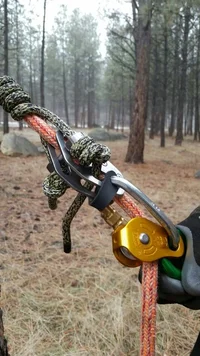
Those of you running the original HH can further improve its tending by running the tail of the hitch cord through the lower slot. It will limit the throw and tighten up the tending. The HH2 has shorter slots designed in already so this will not work with it.
- Location
- Northern CA
Ok, I read your first question incorrectly. Must have been tired. Yes, it helps keep everything aligned if you don't mind the extra hardware.When the hh and biner are kinked or not lined up adequately, the rope gets bound up and you can't tend slack.












New threads New posts
-
test
-
 Free CEUs: February 05 & March 05 - 'Urban Forestry Today' Webcasts @ Noon (Eastern)
- Started by UFT
- Replies: 0
-

-

-
-
-








