[ QUOTE ]
Oceans, so you are basically asking what are the virtues of the shackle vs. biner.
Here are some:
The pin of the shackle is round and the orientation of the shackle does not change the profile of the contact with the rope. The biner is not only curved but also simi flat on the sides, every time the biner moves the shape that is contacting the rope changes, this impacts the friction and function, binding, doing traverses the shape of the biner can go from the flat side to the curved side and is also exasperated by the curvature of the biner.
A round pin (the shackle is smooth and consistent)
For the smaller shackle it is much lighter.
The shackle always stays oriented.
The shackle is easier to tend.
The pin is round and sits nicely on the plates of the HH without scaring. Thus the frame could be aluminum.
I'm probably missing some but the point is that that friction surface needs to be round just like the dogbone.
[/ QUOTE ]
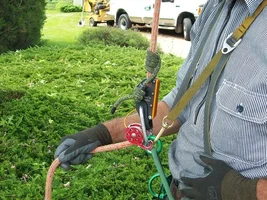
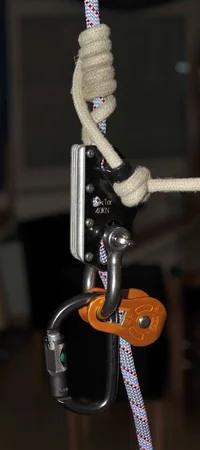
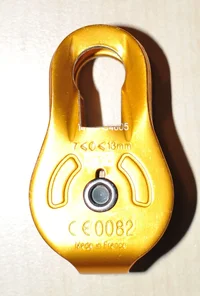
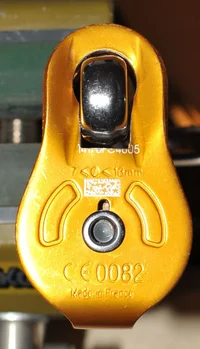
This is my point, and I remember stating the reorientation issue of the biner quite some time ago. What struck me about Adam P's and JonTreeHI's setups was that the biner would actually stay parallel (if not parallel, at least maintain one fixed angle) to the climb line at all times, regardless of overall rope angle (vertical, zipline, etc...). The HH frame captures and holds the top of the biner in place, and the Pinto captures the bottom of the biner and holds it in place. I have tried this system, however not in a zipline, and found it quite simple and functional. If you've tried it as configured in that photo and it does not work, please say so and I'll shut up. Another possible difference from my perspective is that zip lines are for wood on Monday through Friday, and for people on Saturday and Sunday.

Whenever I've tried to dial in any system I've climbed on, one of my goals is to simplify and reduce the number connections, and maintain the closest possible proximity to my bridge. While your system is well thought out, I see what appears to be redundant connections (IMO).
Respectfully...
Oceans, so you are basically asking what are the virtues of the shackle vs. biner.
Here are some:
The pin of the shackle is round and the orientation of the shackle does not change the profile of the contact with the rope. The biner is not only curved but also simi flat on the sides, every time the biner moves the shape that is contacting the rope changes, this impacts the friction and function, binding, doing traverses the shape of the biner can go from the flat side to the curved side and is also exasperated by the curvature of the biner.
A round pin (the shackle is smooth and consistent)
For the smaller shackle it is much lighter.
The shackle always stays oriented.
The shackle is easier to tend.
The pin is round and sits nicely on the plates of the HH without scaring. Thus the frame could be aluminum.
I'm probably missing some but the point is that that friction surface needs to be round just like the dogbone.
[/ QUOTE ]
This is my point, and I remember stating the reorientation issue of the biner quite some time ago. What struck me about Adam P's and JonTreeHI's setups was that the biner would actually stay parallel (if not parallel, at least maintain one fixed angle) to the climb line at all times, regardless of overall rope angle (vertical, zipline, etc...). The HH frame captures and holds the top of the biner in place, and the Pinto captures the bottom of the biner and holds it in place. I have tried this system, however not in a zipline, and found it quite simple and functional. If you've tried it as configured in that photo and it does not work, please say so and I'll shut up. Another possible difference from my perspective is that zip lines are for wood on Monday through Friday, and for people on Saturday and Sunday.
Whenever I've tried to dial in any system I've climbed on, one of my goals is to simplify and reduce the number connections, and maintain the closest possible proximity to my bridge. While your system is well thought out, I see what appears to be redundant connections (IMO).
Respectfully...