
Navigation
Install the app
How to install the app on iOS
Follow along with the video below to see how to install our site as a web app on your home screen.
Note: This feature may not be available in some browsers.
More options
You are using an out of date browser. It may not display this or other websites correctly.
You should upgrade or use an alternative browser.
You should upgrade or use an alternative browser.
Here's a question
- Thread starter cory
- Start date
Re: Here\'s a question
There's no MA.
With the natch crotch, the load leg is supporting the 100lb log, and if you just hold the piece instead of letting it run for example, then the other leg which is being held by gloved hands is supporting 100lbs (cuz that is the "pull" required by the groundie to hold the log in the air). So therefore the natch crotch is supporting two 100lb legs = 200lbs pulling down on the NC.
If you use a pulley in place of the NC, it also has 100+100=200lbs of force pulling down on it, but the porty has 100lb of force pulling on it.
So when the load is allowed to run down to the ground, the porty has less force to deal with so less heat generated than in the NC which has twice as much force to deal with so more heat is created ....
There's no MA.
With the natch crotch, the load leg is supporting the 100lb log, and if you just hold the piece instead of letting it run for example, then the other leg which is being held by gloved hands is supporting 100lbs (cuz that is the "pull" required by the groundie to hold the log in the air). So therefore the natch crotch is supporting two 100lb legs = 200lbs pulling down on the NC.
If you use a pulley in place of the NC, it also has 100+100=200lbs of force pulling down on it, but the porty has 100lb of force pulling on it.
So when the load is allowed to run down to the ground, the porty has less force to deal with so less heat generated than in the NC which has twice as much force to deal with so more heat is created ....

- Location
- Connecticut
Re: Here\'s a question
thats a good explination cory, get rid of the friction at the highest load point by using the pulley, which should generate basically no friction on the rope. More the friction to the point where theres less load. I like it.
thats a good explination cory, get rid of the friction at the highest load point by using the pulley, which should generate basically no friction on the rope. More the friction to the point where theres less load. I like it.
- Location
- Connecticut
Re: Here\'s a question
your totally right cory, there are a ton of factors involved here... load, surface area, surface roughness, material type, heat dissapating ability, more to rigging than meets the eye sometimes.
your totally right cory, there are a ton of factors involved here... load, surface area, surface roughness, material type, heat dissapating ability, more to rigging than meets the eye sometimes.

TC
Participating member
Re: Here\'s a question
[ QUOTE ]
Why does the rope get glazed when using a smooth hard metal-like natural crotch, but it doesnt when using the porty with pulley?
[/ QUOTE ]
I have 1st hand experience of seeing a rigging rope melt solid onto the barrell of a mini porty........we were stupidly using a carabiner instead of a pulley!
Had to use a blow torch to melt the line off the porty.
I think the mini porty is a pathetic piece of equipment.
[ QUOTE ]
Why does the rope get glazed when using a smooth hard metal-like natural crotch, but it doesnt when using the porty with pulley?
[/ QUOTE ]
I have 1st hand experience of seeing a rigging rope melt solid onto the barrell of a mini porty........we were stupidly using a carabiner instead of a pulley!
Had to use a blow torch to melt the line off the porty.
I think the mini porty is a pathetic piece of equipment.

- Location
- Haddonfield, nj
Re: Here\'s a question
I think the mini porty is a pathetic piece of equipment.
[/ QUOTE ]
i agree with you on the mini porty, way too small, i thought it was a toy when i saw it
ive burnt up some ropes with the best of 'em, but never to a portawrap, now thats rigging

I think the mini porty is a pathetic piece of equipment.
[/ QUOTE ]
i agree with you on the mini porty, way too small, i thought it was a toy when i saw it
ive burnt up some ropes with the best of 'em, but never to a portawrap, now thats rigging
- Location
- Chattanooga
Re: Here\'s a question
Guys we're forgetting that the potential energy of the 'log' must be absorbed regardless of where the friction is or how much it is. All the PE must be absorbed - that's where the heat comes from.
The load on the crotch will not be twice the weight of the log being lowered. If that were true then you would have to hold the weight of the log with your hand. E.g. a log weighs 200 lbs. A rope is tied to the log, run through a crotch and you are holding the free end in your hand. First, assume no friction at the crotch. How much weight do you have to hold? You have to hold the entire weight of the log - 200 lbs. What's the force on the crotch? 200 lbs of the log plus 200 lbs that you're holding for a total of 400 lbs.
Now let's add friction. The crotch now has a lot of friction so that we can hold a 200 lb log with only 50 lbs of force on us. Rememeber the whole purpose of friction devices be it crotches, etc. or portys, etc. is to reduce the amount of weight we have to hold to lower a heavy log.
So we're holding 50 lbs and the log weighs 200 lbs. How much force on the crotch? 200 lbs + 50 lbs = 250 lbs. So friction through the crotch reduces loading on the crotch.
Another example would be where the crotch provides so much friction that it holds the load without us holding any load at all. How much weight on the crotch? Just the weight of the log. So as friction reduces the weight we have to hold, it also reduces the force on the crotch.
But, that really doesn't matter a whole lot because what heats the friction device is how much PE it absorbs. The crotch has to absorb the same amount of PE as the porty which is the weight of the log times the height of the log. The same amount of PE will produce the same amount of heat. How hot a friction device gets depends on how well it can get rid of the heat.
Guys we're forgetting that the potential energy of the 'log' must be absorbed regardless of where the friction is or how much it is. All the PE must be absorbed - that's where the heat comes from.
The load on the crotch will not be twice the weight of the log being lowered. If that were true then you would have to hold the weight of the log with your hand. E.g. a log weighs 200 lbs. A rope is tied to the log, run through a crotch and you are holding the free end in your hand. First, assume no friction at the crotch. How much weight do you have to hold? You have to hold the entire weight of the log - 200 lbs. What's the force on the crotch? 200 lbs of the log plus 200 lbs that you're holding for a total of 400 lbs.
Now let's add friction. The crotch now has a lot of friction so that we can hold a 200 lb log with only 50 lbs of force on us. Rememeber the whole purpose of friction devices be it crotches, etc. or portys, etc. is to reduce the amount of weight we have to hold to lower a heavy log.
So we're holding 50 lbs and the log weighs 200 lbs. How much force on the crotch? 200 lbs + 50 lbs = 250 lbs. So friction through the crotch reduces loading on the crotch.
Another example would be where the crotch provides so much friction that it holds the load without us holding any load at all. How much weight on the crotch? Just the weight of the log. So as friction reduces the weight we have to hold, it also reduces the force on the crotch.
But, that really doesn't matter a whole lot because what heats the friction device is how much PE it absorbs. The crotch has to absorb the same amount of PE as the porty which is the weight of the log times the height of the log. The same amount of PE will produce the same amount of heat. How hot a friction device gets depends on how well it can get rid of the heat.

TheTreeSpyder
Branched out member
- Location
- Florida>>> USA
Re: Here\'s a question
[ QUOTE ]
There's no MA.
With the natch crotch, the load leg is supporting the 100lb log, and if you just hold the piece instead of letting it run for example, then the other leg which is being held by gloved hands is supporting 100lbs (cuz that is the "pull" required by the groundie to hold the log in the air). So therefore the natch crotch is supporting two 100lb legs = 200lbs pulling down on the NC.
If you use a pulley in place of the NC, it also has 100+100=200lbs of force pulling down on it, but the porty has 100lb of force pulling on it.
So when the load is allowed to run down to the ground, the porty has less force to deal with so less heat generated than in the NC which has twice as much force to deal with so more heat is created ....
[/ QUOTE ]
The Natural crotch or even the steel one gives friction; this reduces the load on the control leg. Therefore, less than 100# on the hands or porty. And less than 200# on the redirect.
At a run; the system is not holding all of the weight of the load, some is falling. But, the rope racing through whatever friction will produce more heat than at a static hang.
i'll say there is MA; it is just not usually realized; as it is not on the load; but rather on the support/redirect.
As shown directly above; the control leg tension equals the load leg tension - friction force at the redirect/support. The support/redirect as a pivot inherits the sum of both of these forces - deflection from Zer0/pairallell lines. As the lines deflect from Zero the load lessens; but stays greater than a single leg until 120 degrees spread(where with a pulley redirect load is equal to half the sum). Farther than 120 spread (60 degrees deflection each) the redirect load is less than half at the pulley point.
Or in other words; before 120 spread with a pulley, the load has leverage over the redirect; but farther than 120 the pulley/bend has leverage over the load. For this works all ways and all ways; as a load being picked up through the pulley, by the pulley or by the same bend in a sling picking up a crate (where half the load of the crate is on each leg of the sling). The same math backwierds and forwards.
[ QUOTE ]
There's no MA.
With the natch crotch, the load leg is supporting the 100lb log, and if you just hold the piece instead of letting it run for example, then the other leg which is being held by gloved hands is supporting 100lbs (cuz that is the "pull" required by the groundie to hold the log in the air). So therefore the natch crotch is supporting two 100lb legs = 200lbs pulling down on the NC.
If you use a pulley in place of the NC, it also has 100+100=200lbs of force pulling down on it, but the porty has 100lb of force pulling on it.
So when the load is allowed to run down to the ground, the porty has less force to deal with so less heat generated than in the NC which has twice as much force to deal with so more heat is created ....
[/ QUOTE ]
The Natural crotch or even the steel one gives friction; this reduces the load on the control leg. Therefore, less than 100# on the hands or porty. And less than 200# on the redirect.
At a run; the system is not holding all of the weight of the load, some is falling. But, the rope racing through whatever friction will produce more heat than at a static hang.
i'll say there is MA; it is just not usually realized; as it is not on the load; but rather on the support/redirect.
As shown directly above; the control leg tension equals the load leg tension - friction force at the redirect/support. The support/redirect as a pivot inherits the sum of both of these forces - deflection from Zer0/pairallell lines. As the lines deflect from Zero the load lessens; but stays greater than a single leg until 120 degrees spread(where with a pulley redirect load is equal to half the sum). Farther than 120 spread (60 degrees deflection each) the redirect load is less than half at the pulley point.
Or in other words; before 120 spread with a pulley, the load has leverage over the redirect; but farther than 120 the pulley/bend has leverage over the load. For this works all ways and all ways; as a load being picked up through the pulley, by the pulley or by the same bend in a sling picking up a crate (where half the load of the crate is on each leg of the sling). The same math backwierds and forwards.
- Location
- Chattanooga
Re: Here\'s a question
[ QUOTE ]
...As shown directly above; the control leg tension equals the load leg tension - friction force at the redirect/support. The support/redirect as a pivot inherits the sum of both of these forces
[/ QUOTE ]
The control leg tension and the load leg tension are the same ONLY if the redirect is completely frictionless. When there is friction, the control leg has less tension than the load side.
[ QUOTE ]
...As shown directly above; the control leg tension equals the load leg tension - friction force at the redirect/support. The support/redirect as a pivot inherits the sum of both of these forces
[/ QUOTE ]
The control leg tension and the load leg tension are the same ONLY if the redirect is completely frictionless. When there is friction, the control leg has less tension than the load side.
- Location
- Connecticut
Re: Here\'s a question
I need to change the conversation for a second... What do we know about Paulownia trees ? Money Value and laws ?? Reason I am asking I had to clear a piece today and happen to run up on about 35 Paulownia Trees previously I heard they are worth alot of money if they are good size. After asking around to another company around here he told me it was illegal to cut them at all any help..
I need to change the conversation for a second... What do we know about Paulownia trees ? Money Value and laws ?? Reason I am asking I had to clear a piece today and happen to run up on about 35 Paulownia Trees previously I heard they are worth alot of money if they are good size. After asking around to another company around here he told me it was illegal to cut them at all any help..
Re: Here\'s a question
[ QUOTE ]
So we're holding 50 lbs and the log weighs 200 lbs. How much force on the crotch? 200 lbs + 50 lbs = 250 lbs. So friction through the crotch reduces loading on the crotch.
That is key when drop crotching a top where the base maybe weak; using the NC instead of a pulley reduces the loading.
[ QUOTE ]
So we're holding 50 lbs and the log weighs 200 lbs. How much force on the crotch? 200 lbs + 50 lbs = 250 lbs. So friction through the crotch reduces loading on the crotch.
That is key when drop crotching a top where the base maybe weak; using the NC instead of a pulley reduces the loading.
Re: Here\'s a question
OK, its official, now I'm gettin a little confused.
Ron are you saying that what Gord said about the NC having close to 2x the load on it but the porty only has 1x the load on it, doesn't really matter? What glazes the rope mainly is the fact that wood doesn't dissipate heat as fast as steel?
OK, its official, now I'm gettin a little confused.
Ron are you saying that what Gord said about the NC having close to 2x the load on it but the porty only has 1x the load on it, doesn't really matter? What glazes the rope mainly is the fact that wood doesn't dissipate heat as fast as steel?
- Location
- Chattanooga
Re: Here\'s a question
[ QUOTE ]
OK, its official, now I'm gettin a little confused.
Ron are you saying that what Gord said about the NC having close to 2x the load on it but the porty only has 1x the load on it, doesn't really matter? What glazes the rope mainly is the fact that wood doesn't dissipate heat as fast as steel?
[/ QUOTE ]
First, if there is friction in the crotch, the crotch cannot have 2x the load on it. That 2x thing is only true if the redirect is frictionless AND, as TheTreeSpyder pointed out, the ropes are parallel. Although the angle of the control rope has no effect on the tension in the rope IF the redirect/pulley is frictionless, and not very much effect on the force on the redirect/pulley.
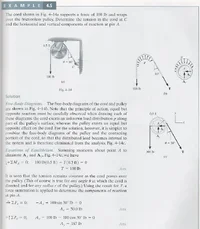
BTW, in Treelearnin's example in his attachment, they didn't calculate the total load on the pulley, just the x and y components or the horizontal and vertical loads. The total force on the pulley would be 194 lbs at an angle of 15° from vertical. But remember, that's for a frictionless pulley.
My thinking is that because a set amount of PE is converted to heat, it is the PE that controls how much heat is produced. Plus, I think that if a certain amount of friction is required to lower a load at a given speed, it makes little difference where the friction occurs in the system.
Here's another thought. Let's consider lowering a 200 lb load. If we accept that the loading at a crotch is higher than the load, but due to friction, it is not twice the load, then we have this: say the friction at the crotch reduces the load on the control line to 50 lbs and the log weighs 200 lbs, then there is a total downward force of 250 lbs (assuming parallel load and control lines).
Now let's consider the loading on the porty. We assume that because the porty is in the control line side that it only has the load of the log, 200 lbs. But is that really true? It isn't true, there still has to be load on the control end of the line. Let's say we have wrapped the porty with enough turns to generate the same friction as the crotch. How much load would there be on the control line? Fifty lbs. We have the rope being pulled by the 200 lb lead and the friction of the porty is the same as the crotch, so the load on the control line has to be the same - 50 lbs.
For sake of discussion, let's say we are pulling straight up on the control line coming out of the porty. How much force is pulling upward on the porty? Two hundred lbs due to the load plus the 50 lbs we are exerting for a total of 250 lbs pulling upward on the porty - the exact same as the crotch! I beleive TheTreeSpyder alluded to this in a previous post.
But I want to end with I THINK. I got confused about PE and some other issues a while back and had to do a lot of thinkin' to get it sorted out. So I could be wrong. But based on correcting that misconception, I think I'm seeing this correctly. BUT, I will run this by a colleague that helped me get my thinking straightened out and see what he says. BUT, it may be Monday before I can catch him in his office.
[ QUOTE ]
OK, its official, now I'm gettin a little confused.
Ron are you saying that what Gord said about the NC having close to 2x the load on it but the porty only has 1x the load on it, doesn't really matter? What glazes the rope mainly is the fact that wood doesn't dissipate heat as fast as steel?
[/ QUOTE ]
First, if there is friction in the crotch, the crotch cannot have 2x the load on it. That 2x thing is only true if the redirect is frictionless AND, as TheTreeSpyder pointed out, the ropes are parallel. Although the angle of the control rope has no effect on the tension in the rope IF the redirect/pulley is frictionless, and not very much effect on the force on the redirect/pulley.
BTW, in Treelearnin's example in his attachment, they didn't calculate the total load on the pulley, just the x and y components or the horizontal and vertical loads. The total force on the pulley would be 194 lbs at an angle of 15° from vertical. But remember, that's for a frictionless pulley.
My thinking is that because a set amount of PE is converted to heat, it is the PE that controls how much heat is produced. Plus, I think that if a certain amount of friction is required to lower a load at a given speed, it makes little difference where the friction occurs in the system.
Here's another thought. Let's consider lowering a 200 lb load. If we accept that the loading at a crotch is higher than the load, but due to friction, it is not twice the load, then we have this: say the friction at the crotch reduces the load on the control line to 50 lbs and the log weighs 200 lbs, then there is a total downward force of 250 lbs (assuming parallel load and control lines).
Now let's consider the loading on the porty. We assume that because the porty is in the control line side that it only has the load of the log, 200 lbs. But is that really true? It isn't true, there still has to be load on the control end of the line. Let's say we have wrapped the porty with enough turns to generate the same friction as the crotch. How much load would there be on the control line? Fifty lbs. We have the rope being pulled by the 200 lb lead and the friction of the porty is the same as the crotch, so the load on the control line has to be the same - 50 lbs.
For sake of discussion, let's say we are pulling straight up on the control line coming out of the porty. How much force is pulling upward on the porty? Two hundred lbs due to the load plus the 50 lbs we are exerting for a total of 250 lbs pulling upward on the porty - the exact same as the crotch! I beleive TheTreeSpyder alluded to this in a previous post.
But I want to end with I THINK. I got confused about PE and some other issues a while back and had to do a lot of thinkin' to get it sorted out. So I could be wrong. But based on correcting that misconception, I think I'm seeing this correctly. BUT, I will run this by a colleague that helped me get my thinking straightened out and see what he says. BUT, it may be Monday before I can catch him in his office.
- Location
- Connecticut
Re: Here\'s a question
Here's another thought. Let's consider lowering a 200 lb load. If we accept that the loading at a crotch is higher than the load, but due to friction, it is not twice the load, then we have this: say the friction at the crotch reduces the load on the control line to 50 lbs and the log weighs 200 lbs, then there is a total downward force of 250 lbs (assuming parallel load and control lines).
Good points Ron. Heres my new thoughts. The tension on the control leg is only 50 lbs. Take the above example: 200 lb load, only 50 lbs on the control leg. so youre saying that the friction reduces the needed force on the control leg, by 150 lbs, assuming parallel rope set up. If you had taken a wrap or two, and were pulling straight up on the other side of the porty, the force would not be that high. Once the friction reduced the load at the crotch, whats left would be the load from then on out. So if coming down the control leg you had 50 lbs tension, and the wrapped around the porty creating more friction, the line the hands are pulling up would be under less than 50 lbs of tension, and the most force there could be on the porty would be 100 lbs. Again I'll stand by newtons law: for every action there is an equal and opposite reaction. 50 lbs one way means 50 lbs the other, less if theres friction.
This discussion has gotten pretty in depth and interesting. I'm an engineering student at a pretty large university, if I get a chance Im going to take this scenario to a teacher of mine and get another opinion on it, I'll post when I do.
Here's another thought. Let's consider lowering a 200 lb load. If we accept that the loading at a crotch is higher than the load, but due to friction, it is not twice the load, then we have this: say the friction at the crotch reduces the load on the control line to 50 lbs and the log weighs 200 lbs, then there is a total downward force of 250 lbs (assuming parallel load and control lines).
Good points Ron. Heres my new thoughts. The tension on the control leg is only 50 lbs. Take the above example: 200 lb load, only 50 lbs on the control leg. so youre saying that the friction reduces the needed force on the control leg, by 150 lbs, assuming parallel rope set up. If you had taken a wrap or two, and were pulling straight up on the other side of the porty, the force would not be that high. Once the friction reduced the load at the crotch, whats left would be the load from then on out. So if coming down the control leg you had 50 lbs tension, and the wrapped around the porty creating more friction, the line the hands are pulling up would be under less than 50 lbs of tension, and the most force there could be on the porty would be 100 lbs. Again I'll stand by newtons law: for every action there is an equal and opposite reaction. 50 lbs one way means 50 lbs the other, less if theres friction.
This discussion has gotten pretty in depth and interesting. I'm an engineering student at a pretty large university, if I get a chance Im going to take this scenario to a teacher of mine and get another opinion on it, I'll post when I do.
TheTreeSpyder
Branched out member
- Location
- Florida>>> USA
Re: Here\'s a question
Great thoughts and exercise!
Once again, to stir the pot; we must recognize these are static rules. As we go to dynamic movemeant; the length of rope in the system able to deform; gives lower forces; even if double at a pulley and equal to load at Porty, rather than friction redirect/support. Then, also the friction to Steel rather than wood at the run doesn't let the rope glaze as much; on top of the lower dynamic loading of the forgiveness/elasticity of the system. And the such running means we aren't holding all the weight of the load... Also, more slow flexing of the load on the hinge; for less dynamic input/hit into the system. In overhead support; sometimes even pretightening line; then slowly hinging over into the line to further serve as pretighteing the line before tearoff (as well as less input of dynamic force). This is usually done by not dutching face, giving wide face and ground control pulling on i line to upper part of load. But also, climber can wedge, push, prybar; or even better push and prybar as equal opposites for a 2handing input effect.
Sometimes even hinging over slightly left; to let a tighter line (by this self tightening) pull the load back right on the hinge (and tighter line). For, folding towards the upper right support; and keeping high can relieve some of the essential pretightening of the line as a load ballast. But, folding away from the upper right support (to the left) tightens line more. Rock around the Clock strategy
These types of methods (self tighteing line as hinge flexes) is where the rules can shift again IMLHO! Whereby; by giving overhead friction; we limit the elastic length of line; and thereby can more selftighten the line; as there is less elastic length to stretch before higher tension pre-tensioning is achieved. This; can make what seemed like most assuredly a setup that would take a dynamic hit; into one that would take more of a static one; by the pretensioning ballast force, to more closely match the load. Ballast equal to the loading; giving no shock impact... The problem here is stage one pretightening is resisted by the friction. But with sweating the line can usually pretighten fairly well.
Once again, all situation dependent; no blanket answers. Even some of the total answer depending on gear and team skill. For, these systems and practices are a symphonic orchestration of all of these things; with no i in team! Whose purer and higher tones can all ways and always be tweaked to higher and higher levels. For, if there were an easier end; anyone could do this thing that we do like no other; the toughest job you'll ever love!!
Great thoughts and exercise!
Once again, to stir the pot; we must recognize these are static rules. As we go to dynamic movemeant; the length of rope in the system able to deform; gives lower forces; even if double at a pulley and equal to load at Porty, rather than friction redirect/support. Then, also the friction to Steel rather than wood at the run doesn't let the rope glaze as much; on top of the lower dynamic loading of the forgiveness/elasticity of the system. And the such running means we aren't holding all the weight of the load... Also, more slow flexing of the load on the hinge; for less dynamic input/hit into the system. In overhead support; sometimes even pretightening line; then slowly hinging over into the line to further serve as pretighteing the line before tearoff (as well as less input of dynamic force). This is usually done by not dutching face, giving wide face and ground control pulling on i line to upper part of load. But also, climber can wedge, push, prybar; or even better push and prybar as equal opposites for a 2handing input effect.
Sometimes even hinging over slightly left; to let a tighter line (by this self tightening) pull the load back right on the hinge (and tighter line). For, folding towards the upper right support; and keeping high can relieve some of the essential pretightening of the line as a load ballast. But, folding away from the upper right support (to the left) tightens line more. Rock around the Clock strategy
These types of methods (self tighteing line as hinge flexes) is where the rules can shift again IMLHO! Whereby; by giving overhead friction; we limit the elastic length of line; and thereby can more selftighten the line; as there is less elastic length to stretch before higher tension pre-tensioning is achieved. This; can make what seemed like most assuredly a setup that would take a dynamic hit; into one that would take more of a static one; by the pretensioning ballast force, to more closely match the load. Ballast equal to the loading; giving no shock impact... The problem here is stage one pretightening is resisted by the friction. But with sweating the line can usually pretighten fairly well.
Once again, all situation dependent; no blanket answers. Even some of the total answer depending on gear and team skill. For, these systems and practices are a symphonic orchestration of all of these things; with no i in team! Whose purer and higher tones can all ways and always be tweaked to higher and higher levels. For, if there were an easier end; anyone could do this thing that we do like no other; the toughest job you'll ever love!!
- Location
- Chattanooga
Re: Here\'s a question
Treelearnin,
I stated my cases poorly. The two cases were one, a rope just over the crotch forming a load line and a control line, and the second case, the rope is running through a frictionless pulley as a redirect forming the load line and control line. But the way I stated it, I guess it sounded like the rope was run through the crotch and then the porty.
------------------------------------------------------------
TheTreeSpyder,
True, but the issue I was focusing on is whether there is more heat produced at a crotch because the load is doubled, and less heat is produced at the porty because the load is not doubled. Well, as I stated earlier, admittedly with a tiny degree of uncertainity, under uniform conditions, the load at the crotch is not doubled as it would be in a frictionless system.
------------------------------------------------------------
Even under dynamic conditions, the only energy source is the PE of the log. I got really confused about this a while back and I had to really dig to understand this and I hope I've got this straight now. But the quantity of heat produced is limited to the amount of PE converted to heat. To get the log to the ground, all the PE has to be converted to heat. So even if you let the log jerk around and speed up and slow down, still PE is the only energy source that can make the friction devices heat up.
So that should raise the question, why does a device get hotter if the log is dropped faster or suddenly for a short distance? The answer is because potential energy is converted to heat in the friction device at a faster rate than the device can transfer the heat to the air. When more heat goes in than comes out, then the temperature goes up.
But, again, I'm gonna stick a qualifier on here of I THINK. I should be able to get comfirmation, or correction, from a colleague of mine Monday.
Treelearnin,
I stated my cases poorly. The two cases were one, a rope just over the crotch forming a load line and a control line, and the second case, the rope is running through a frictionless pulley as a redirect forming the load line and control line. But the way I stated it, I guess it sounded like the rope was run through the crotch and then the porty.
------------------------------------------------------------
TheTreeSpyder,
True, but the issue I was focusing on is whether there is more heat produced at a crotch because the load is doubled, and less heat is produced at the porty because the load is not doubled. Well, as I stated earlier, admittedly with a tiny degree of uncertainity, under uniform conditions, the load at the crotch is not doubled as it would be in a frictionless system.
------------------------------------------------------------
Even under dynamic conditions, the only energy source is the PE of the log. I got really confused about this a while back and I had to really dig to understand this and I hope I've got this straight now. But the quantity of heat produced is limited to the amount of PE converted to heat. To get the log to the ground, all the PE has to be converted to heat. So even if you let the log jerk around and speed up and slow down, still PE is the only energy source that can make the friction devices heat up.
So that should raise the question, why does a device get hotter if the log is dropped faster or suddenly for a short distance? The answer is because potential energy is converted to heat in the friction device at a faster rate than the device can transfer the heat to the air. When more heat goes in than comes out, then the temperature goes up.
But, again, I'm gonna stick a qualifier on here of I THINK. I should be able to get comfirmation, or correction, from a colleague of mine Monday.


