Here's a question

Re: Here\'s a question

Hello,
I'll add that even devices like the Porty have limits as to how much heat they can dissipate. In this case it is taking half the load that the block is, but if that load is high enough, and you are slacking fast enough, you'll still get glazing, or worse. Racing sailors discovered this when they went to slack very highly loaded lines, like running backstays, very quickly. Result: slag. This led, as I understand it, to the development of heat-resistant lines, with Nomex, Teflon, Kevlar, and other high-melting point filaments in the ropes' covers. Now every major ropemaker has at least one variation on this theme.
 
Re: Here\'s a question

Thanks Brion; nice point.

Hammer; i agree that the pic is right; with Zer0 friction the Porty takes half the redirect load. But, that is just because; the Porty only takes the control leg loading; which is the load leg - friction (friction being Zer0 in this case). We can't just globally say Porty gets half the pulley load; because any friction (which there all ways is), reduces the control leg load. And any spread angle of the lines from pairallell reduces the pulley load but not Porty.

With impacting dynamics, these things are magnified. Also the melt resistant fibers tend to be less elastic i believe; increasing the loading of the system(as well as have a little higher bend radius for same efficiency i think(?)). So, this bears ou Brion's point that they still don't melt; but at same time increases loading in our life on the line systems.

Edit:
i maid this chart fromt he Sherrill/Arbormaster Rigging Caslculator. The calculator is devised for under load pulley only; but i think we can kinda expand it to some examples of overhead rigging. But, we have to assume there is total/ or lock off friction on the overhead support. i raised the load to 400 to exemplify.

The chart shows how higher tensiles of the same rope (StableBraid) give higher loading to the same impact; because they are stretched less; by the same load. Also, how a more elastic line, really softens the blow (ProMaster). Then finally, how high friction limits the elastic potential, by limiting the length of the line taking the hit. And of course with pulley and Porty, we then have much less loading (even though doubled on support); but then we can run the load to, for even less loading. There are many considerations in this orchestration to me.

Also, notice that if we place a drop eye pulley on overhead support to give 2:1 support to load; we get 1 1/2x loading on support in a static system(not 2x). But counter intuitively; if we were to impact into that system hard; each leg of line bears less load(1/2 load) than on a single line, therefore less elastic buffering; so more loading to the system and support.

Click for more rigging force charts
 

Attachments

  • 112593-riggingChart_5-60ropeLengths.webp
    112593-riggingChart_5-60ropeLengths.webp
    135.5 KB · Views: 67
Re: Here\'s a question

Edited to re-word:

I think, we may have lost sight of something. A piece of timber has potential energy (PE) depending on its weight and height. Friction devices, portys, etc., use friction to convert the PE into heat. What causes the temperature rise in the friction device is heat-in versus heat-out. The heat-in is produced by the friction device absorbing PE. The temperature rise depends only on how much of the absorbed PE, or heat, can be transferred from the device to the air.

So if there's a pulley and a porty in the system, then friction required to lower the timber divided between the pulley and the porty. The more efficient the pulley, the more PE the porty has to absorb because the pulley absorbs less.

While it is true that the pulley can theoretically have twice as much load as the porty, the amount of total friction required to absorb the PE remains the same. If the pulley is a ball bearing pulley, say 95% efficient, the porty will have to provide almost all of the friction to absorb the PE of the timber. If the pulley is a bushing type and say 65% efficient, then the pulley will absorb a little more of the PE and the porty a little less.

The temperature rise of friction devices is totally dependent on how well they can transfer heat into the air. The friction device has to absorb the same amount of PE, or in effect, heat, regardless of lowering speed. So why does a friction device get hotter if the load is lowered faster? Because when the load is lowered faster, there is less time to conduct heat into the surrounding air so the temperature of the friction device rises.
 
Re: Here\'s a question

Great responses guys.

Yes Gord, I finally get that point and your example is a good one. And perhaps instead of a steel crotch in your example, if the porty itself was put up in the tree, you might get some glazing too, again because the porty up in the tree as the redirect is taking approx 2x the load whereas the porty when used on the ground is taking only approx 1x the load.

Also Ron, nice clear explanation of exactly why a friction device gets hotter when a pc is lowered faster as opposed to being cooler when it is lowered slower, despite the same amount of friction being present in either case.
 
Re: Here\'s a question

[ QUOTE ]
...And perhaps instead of a steel crotch in your example, if the porty itself was put up in the tree, you might get some glazing too, again because the porty up in the tree as the redirect is taking approx 2x the load whereas the porty when used on the ground is taking only approx 1x the load.

[/ QUOTE ]
Not quite. If the porty is the only friction device in the system, i.e. it has enough friction so that an ungloved hand can lower the piece without getting burned, then the porty is essentially absorbing all of the PE given up by lowering the piece. It doesn't matter if it's up in the tree or at the base of the tree, or if it has 1x the load or 2x the load. The energy it has to absorb can be no more and no less than the energy given up by the piece due to the load moving to a lower position. That means the temperature rise in the porty is totally dependent on heat absorption vs heat dissipated into the air.
 
Re: Here\'s a question

Well then maybe Gord's example is better: a steel crotch same shape as the wooden crotch, then use gloved hands to slow the piece slightly...I would think that could cause some glazing the same way glazing was caused by the wood crotch...?
 
Re: Here\'s a question

[ QUOTE ]
Well then maybe Gord's example is better: a steel crotch same shape as the wooden crotch, then use gloved hands to slow the piece slightly...I would think that could cause some glazing the same way glazing was caused by the wood crotch...?

[/ QUOTE ]

A steel crotch the same shape as a wooden crotch???? Hypothetically speaking here??? Actually, that's a good case to consider. If the friction were the same for the wooden crotch and the steel crotch, glazing would occur quicker on the wooden crotch because the wood cannot disperse the heat as well or as fast as the steel and the temperature at the point of contact would be higher for the wood than the steel.

In other words, given equal friction, the material that can move heat away from the contact point better won't heat up as much.

Then there's the case, where a steel crotch has the same shape as the wooden crotch, but the steel has less friction than the wooden crotch. In this case, two things differ. One, since the steel has less friction than the wood, it absorbs less energy/heat than the wood. Two, as before, the steel can disperse the heat faster than wood. So there are two reasons why the steel wouldn't heat up as much as the wood in this case.

But, since the steel has less friction, some other device, a gloved hand, something, has to provide some additional friction.
 
Re: Here\'s a question

[ QUOTE ]


A steel crotch the same shape as a wooden crotch???? Hypothetically speaking here??? Actually, that's a good case to consider. If the friction were the same for the wooden crotch and the steel crotch, glazing would occur quicker on the wooden crotch because the wood cannot disperse the heat as well or as fast as the steel and the temperature at the point of contact would be higher for the wood than the steel.

In other words, given equal friction, the material that can move heat away from the contact point better won't heat up as much.


[/ QUOTE ]

Hey Ron you are almost saying word for word what I posted back in the 10th posting in this thread.

"Wood does not transfer hear nearly as well as the steel in a porty. What this may mean in practice is that the surface of the wood that is touching the rope gets to a much higher temperature than the surface of the porty....hence the melting or glazing of the rope."
 
Re: Here\'s a question

Dan: Do you need a pat on the back?
tongue.gif
 
Re: Here\'s a question

[ QUOTE ]
Hey Ron you are almost saying word for word what I posted back in the 10th posting in this thread.

"Wood does not transfer hear nearly as well as the steel in a porty. What this may mean in practice is that the surface of the wood that is touching the rope gets to a much higher temperature than the surface of the porty....hence the melting or glazing of the rope."

[/ QUOTE ]
Yep - it proves the old saying, "Great minds think alike." Unfortunately, not so great minds think alike too. Hmmm, so which category do we fall in?
grin.gif
 
Re: Here\'s a question

[ QUOTE ]
Hello,
I'll add that even devices like the Porty have limits as to how much heat they can dissipate. In this case it is taking half the load that the block is, but if that load is high enough, and you are slacking fast enough, you'll still get glazing, or worse.

[/ QUOTE ]

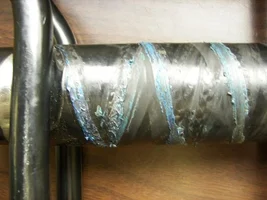
Oh yeah! Can you guess what rope was used? Check out the attachment.
This rope had to be peeled off the Porty.
 

Attachments

  • 112735-100_0832.webp
    112735-100_0832.webp
    35.7 KB · Views: 117
Re: Here\'s a question

Great discussion!

Another source of glazing comes from the first slam dunk drop onto the rope using a natural crotch, NC.

With a NC and the friction device downstairs locked off there is X amount of rope in the system. But, when the load drops onto the rope a high percentage of the load is taken by the leg of rope between the load and the NC. The rope will stretch a bit with a high load at the NC rather than the solid lock off at the friction device. This causes a very concentrated 'rug burn'.

Uinsg a pulley for the redirect allows all of the rope to stretch a bit and doesn't concentrate any heat dissipation anywhere. There will be no heat generated until the load is lowered as long as there's no rope movement. In Norm's picture there could have been some rope movement from the large stretch load generated by a slam dunk drop.
 
Re: Here\'s a question

i think the stretch without purposeful lowering can give movement/creep of line, and subsequent glazing for sure on Porty after pulley.

i don't see it so much as wood transfers heat slowly, but rather that it is an outright insulator/holds heat there to build and concentrate/prevents evacuation of heat. But metal/ especially aluminum, copper even gold and silver(very excellent heat conductor) are conductors of heat because they let the electrons move more freely than the bound electrons of insulators. Thus, heat conductors are also generally better electrical conductors(diamond crystals being one notable exception of being a thermal conductor, but an electrical insulator). Steel isn't the best thermal conductor; so you can more safely pick up the non-heated end, than that of aluminum etc.

Sometimes it can feel like someone missed what ya said; if they say it several posts later. Or sometimes it can be like it wasn't right when you said it, but now it is; at any rate it can make ya question some things and lengths of threads etc...
 
Re: Here\'s a question

Yes there's alot of good info here, and yes some of it didn't make sense to me until other posts came in and shed more or different light on the question.

And now I have a good understanding of the answer to the question, and I'm a little surprised I couldn't have figured it out on my own given the basic HS science I've taken and understanding the rudiments of pulleys in treework. But I couldn't.

Long Live TreeBuzz!!!

Funny, I remember a long time ago having used pulleys up in trees for awhile and then reading I believe it was Mark Chisolm's article on pulleys and how they cause 2x the load on the leader that is supporting them and I was like "wtf?", I had no idea that was the case and I quit using them for awhile basically thinking who needs to go causing 2x the load on rigging point??, but after thinking about it over time and perhaps reading more, I eventually of course realized pulleys used with understanding are indispensible for efficient treework.
 
Re: Here\'s a question

[ QUOTE ]
But metal/ especially aluminum, copper even gold and silver(very excellent heat conductor) are conductors of heat because they let the electrons move more freely than the bound electrons of insulators.

[/ QUOTE ]

It's time they make a golden porty!
bling.gif
 
Re: Here\'s a question

First few times i used one; i thought it was golden! Silver would be the best metal for heat dissipation(then the other 'tarnisher' copper) i believe, and cheaper too!

i think 65% efficiency for a bushing pulley is low(?); especially for a sheave of any real size. Just like a bearing pulley can be a fair bit less than 95%; if the ratio of sheave to axle leverage was very slight/ sheave very small. The steel crotch would need round turn type forces; to let the choke action give enough friction. To remotely release a round turn(on wooden crotch), i've placed a krab (with rope to it) on the 'center' turn. Then, also used it to sweat the rig line to pretighten. Such close overhead friction, is kinda like the bearing pulley; not for impact forces; but just for laying the load into line softly. Such high friction overhead/close to load; makes it easier to use the load flexing over on the hinge slowly as final/last minute pretightening the rope as a load ballast.

That is quite a paradigm shift story Cory. Takes quiet an open mind wanting to advance to set everything aside; to get out of the cave and reach into the light!

i 2nd the great discussion comment, even if Tom jest said it!
propeller.gif
 
Re: Here\'s a question

Nice call on the surface area contact treetime. Going back to the original scenerio, and the Potential energy example, heres the low down as I see it, and from what my engineering books can help with. The load is being slowed by the friction of the rope on a device (natural crotch, pulley, porta). Using just a natural crotch, there is a relatively small (assumption) surface area of which has to generate a lot of friction to slow the piece down, along with the hands of the groundie. The bottom line here is the piece is only being slowed down by friction - which in turn causes heat, screws with ropes etc. Although the NC mentioned may have been very smooth, there is still a LARGE difference between the coefficient of friction between a rope and the NC and the rope and a porta. Thus more heat will be generated. For the purposes of furhter discussion lets take the groundies hands out of the equation. So, one loop over a NC: lotsa friction, not a lot of contact area = high temps. Pully with porta: basically 0 friction at the pully, more surface area between the rope and porta to spread the friction out on a smoother surface causing less build up of heat between it and the rope. And the influence of the material: aluminum disipates heat better than wood.
 
Re: Here\'s a question

Ahh...I guess before the porty came into play this is why we'd wrap around a big tree. More SA wood to rope, vs rope to hand. Ouch. From what I am reading the same PE (mass of wood) turns into heat through friction over different mediums (trunk of tree, natural crotch, block, porty and leather gloves) causes the rope to respond differently. Choose your own ending...
Great thread ppl.
smile.gif
 
Re: Here\'s a question

Good job explaining Treelearnin Pretty much its surface area contact spread over larger areas dispersing the heat. Within a crotch the rope lays in the same area and with a pully it continuously rotates ( so we are hoping) If it locks up for some reason dirt debris or grime same senario surface area contact which in turn heats both items ropes and pully.
 

New threads New posts

Back
Top Bottom