Here's a question

cory

Branched out member
Here\'s a question

Say you are cutting and letting down 200 lb. pieces on a half inch braided line, using a natural crotch and no friction device, just the friction of the crotch and your gloved hands, and the pcs are coming down fairly fast as a result, causing real warm palms and some glazing/melting on the line. Say the natural crotch is very hard and smooth wood, like either a smooth non-gnarly portion of hickory or maybe a crotch where the bark has already been burned off from previous runs of the rope and what's left is smooth hard wood.

Now say the same scenario except a pulley is used aloft for a crotch and a porty is used for friction, and the pcs are coming down fast as above. Now your palms are not heated and there is no glazing of the rope where it ran on the porty.

Why does the rope get glazed when using a smooth hard metal-like natural crotch, but it doesnt when using the porty with pulley?
 
Re: Here\'s a question

Because the natural crotch is static. where the pulley is dynamic. It moves.
 
Re: Here\'s a question

I know but the porty is taking all the friction and it is static.
 
Re: Here\'s a question

Good question, Iam not too sure about this but i think it might have something to do with heat. Your generating more heat at the natual croth than you are on your porty.(If aluminum it will dissipate the heat better)
I would also contribute it to the way the rope is being pulled through a natual crotch. There is alot of force being pulled DOWN on that crotch from both ends of the rope. (The end entering the crotch, working end, as well as the rope exiting the crotch, running end)
Just my thoughts on this!!!!
 
Re: Here\'s a question

The glazing is caused from friction. By incorporating a pulley and a porty, the friction in your scenario is drastically reduced.
 
Re: Here\'s a question

[ QUOTE ]
I know but the porty is taking all the friction and it is static.

[/ QUOTE ]

But the pulley isn't.
 
Re: Here\'s a question

Yes but if the pcs are coming down at the same speed in both scenarios then the same amount of heat/friction must exist, yet one glazes the rope and one does not.
 
Re: Here\'s a question

The only answer I can think of is the friction is concentrated in a smaller area in a natural crotch but in the porty the friction is spread along a larger area (the circumference of the porty tube) so it results in the heat being in a less concetrated area, so there is lower temp on the rope so no glazing.

But I've NEVER seen glazing when using a pully and porty and you'd think on some large cuts there would have to be enough heat to glaze.
 
Re: Here\'s a question

[ QUOTE ]
Say you are cutting and letting down 200 lb. pieces on a half inch braided line, using a natural crotch and no friction device, just the friction of the crotch and your gloved hands, and the pcs are coming down fairly fast as a result, causing real warm palms and some glazing/melting on the line.

[/ QUOTE ]

From this description, I can't think that both pieces would be coming down at the same speed, unless you were to let it run on the porty. I think you have a point with the load being spread over a larger area on the porty. But the pulley has Alot to do with it IMO. I've experience glazing using this same scenario with just a steel biner in place of the pulley.
 
Re: Here\'s a question

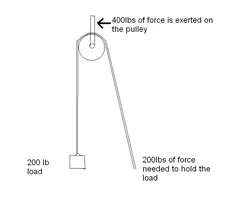
The main issue is that the natural crotch would experience almost twice the load (2 times the force of the rigged piece less friction) while the porty is only supporting one half of the rigging force, being only on one leg of the system.

I would think also the the crotch would also be subject to a higher rate of acceleration than would the porty, there being much less rope in the system between the load and the crotch than there would between the load and the porty.

A third thing would be that the specific heat capacity (the amount of energy needed to raise the temperature of a substance) of wood is higher than that of steel, meaning that the porty will dissipate the heat much better than the wood will, as well as cool down a lot faster.
 
Re: Here\'s a question

Assume both pcs are coming down at the same (high) speed, so that they can swing over into a spot and be let down in one motion without any swing back.

Interesting about the "specific heat capacity," but I'm still not totally understanding.
 
Re: Here\'s a question

Wood does not transfer hear nearly as well as the steel in a porty.

What this may mean in practice is that the surface of the wood that is touching the rope gets to a much higher temperature than the surface of the porty....hence the melting or glazing of the rope.

I'm going to throw some made up number out there. Let's suppose the surface of the porty gets to no higher than 170 degrees due to the high heat conducting ability of steel. The surface of wood in the same situation may get to a surface temperature of 350 degress F due to the heat not being conducted away from the contacting surfaces nearly as fast as the steel.


Just a theory from a working arborist.
 
Re: Here\'s a question

Are you saying that no matter how the rigging is done that there will be the same amount of heat generated?
As Masterblaster said, the pulley moves. So instead of the rope sliding over the natural crotch which causes a lot friction which generates a lot of heat which glazes the rope, the rope moves over a pulley which moves. The pulley moving probably generates a small amount of heat as it spins, but this heat is dissipated quickly, same at the portawrap.
Seems like the rope is going to have to work harder to lower at the same speed over natural crotch as opposed to thru a pulley.
 
Re: Here\'s a question

[ QUOTE ]
Are you saying that no matter how the rigging is done that there will be the same amount of heat generated?
...

[/ QUOTE ]
Basically yes. The same amount of energy has to be dissipated which produces heat via friction. Temperature rise is produced when more heat/energy is absorbed than can be transferred into the air. Hence, it is normal that one device can get hotter than another device.

What makes the difference is how much of the heat produced by friction can be dissipated into the air. If we have two devices lowering the same load at the same speed, the temperature each device rises to depends on how fast it can transfer the heat to the air. Hence devices, such as wood, that don't transfer heat well, cause more of a temperature rise than a device, such as AL or steel.

The amount of surface area absorbing the heat, the surface area exposed to air, and the nature of the material all play a role in how hot the device will get.

In the case of the pulley, it absorbs very little energy because it has very little friction, so the porty has to absorb all the energy/heat.

When a tree crotch is used and a gloved hand, both the crotch and the glove absorb energy/heat.
 
Re: Here\'s a question

Wood is going to be a thermal insulator, the metal; especially a "jealous" metal like aluminum(that will want to grab and disperse heat evenly along itself, thus be better for cooking etc.)will be a conductor. (Just as they are insulator and conductor for electrical as well as thermal energy).

Even though, there will be less force on the redirect position. 2x with closed legs/sharp teepee and no friction. But, will be 1x on load leg + 1x - friction of brake force on the control leg ( for a total of <2x).

So that; as the flipside; a pulley in the pivot/redirect postion (that gives more force at that position and on the control leg) will give much less friction there; so will avail the whole length of the system for deforming elastically to take the hit/dynamic impacts; to lessen the forces before the frictions of the Porty. If the block/redirect position is real close to the hitch on load; and this is all high in the air(placing Porty farther away) the effect of the friction/non-friction choice of the redirect will be much more pro-nounced.

So even though the frictional redirect and leather frictions are spaced apart(for some heat dissipation between friction points for less concentrated heat); and the Porty is a single friction(no heat dissipation between friction points); the Porty will get less force and dissipate heat better; and win out.

Notice also, even though smooth; the round turns choking on the Porty give more brakeforce than a single turn on the textured wood; even if both have the same total amount of frictional contact area/footprint (IMLHO). Most seem to just consider the frictional texture x distance of said texture. And it is brakeforce, as a force that is helping you hold loadforces; the byproduct/conversion/conservation of forces of no energy ever lost or gained(just converted) is heat. The elasticity can store,absorb and convert some energy to heat(internal frictions from extension and contraction)

The new diode flashlights burn cooler; so less battery energy is used for heat, so batteries last much,much (8x?)longer (and the flashlight parts are less 'heat deteriorated'/aged too).
 
Re: Here\'s a question

Well thanks for the responses.

Seems like the factors involved are: steel dissipates heat much faster than wood (both into the air and into adjacent unheated (steel) material); greater surface area of the porty vs. the natural crotch so the heat won't be as concentrated; the wood's texture causes more friction than steel; and the greater amount of rope in the pulley/porty system helps absorb some energy so less porty friction is required so less heat is generated.
 
Re: Here\'s a question

I'd still point out that the crotch is subject to twice (approx) the force as the porty would be. If you built a steel crotch shaped just like the natural one, and attached it up in the tree and rigged off of it, there's a good chance you'd get some glazing with it as well.
 
Re: Here\'s a question

If the Brake force is Zer0 (pulley redirect); then Porty gets about half force in static loading. We say half, but it is really pulley force -1x. So, if lots of friction (80% co-efficiency example) then; pulley would get 120%; and Porty would get 120% - 100%; or 1/6th of pulley load statically. Dynamic loading would give more variables by the higher redirect friction limiting the amount of line taking the dynamic hit; thereby possibly raising the force immensely into the crotch, that holds heat.

My answer is to lay load into the prestretched line, and use high friction on overhead rigging. In fact, to use the load for final prestretch of the line as it load is laid over into line. And/or flex load on hinge for softer hand off to line; thinking of hinge as a tight disposable second hitch; to cut free after it is used to deliver load to line with proper speed (or lack there of) and direction. Or as load comes around horizontally some; even sometimes taking the long way around to the left and down; to go right, just to do so on a tighter line.

When rigging under load though, all we can do is pretighten and flex hinge by pushing with hand; ground control pulling over, wedging or with a short lever. 1 strategy i like is a small lever of a semi trailer tire spoon that i lean on, and push off on the top of the block/load too for a 2 handing type of double return to flex the hinge stronger into a wide face. The spoon fits the kerf nicely, and has about no give. but, even with this, might have to use pulley, that raises forces on support i'm sharing, but then lessens them by elasticity and run, if orchestrated right.
crazy.gif
 

New threads New posts

Back
Top Bottom