
Navigation
Install the app
How to install the app on iOS
Follow along with the video below to see how to install our site as a web app on your home screen.
Note: This feature may not be available in some browsers.
More options
You are using an out of date browser. It may not display this or other websites correctly.
You should upgrade or use an alternative browser.
You should upgrade or use an alternative browser.
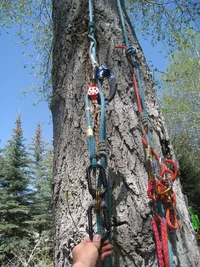
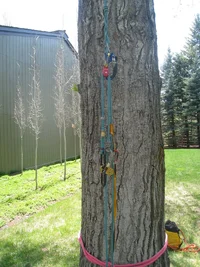
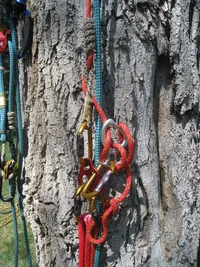
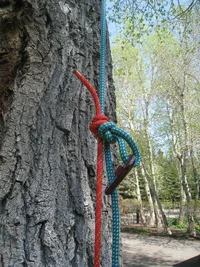
help me check my SRT work positioning system
- Thread starter treeguyID
- Start date


Raven
Branched out member
- Location
- Northwoods
I like the floating false crotch idea, if you can kep your ascent pretty smooth without sideloading stuff or loosening your friction hitch, maybe throw a stopper knot in your fall line for backup.
Your anchor seems a bit complicated for my taste - I just use a trunk wrap secured w/Klemheist and use a long enough rope, but to each their own, as long as your groundsie knows how to run the Pirhana.
Your anchor seems a bit complicated for my taste - I just use a trunk wrap secured w/Klemheist and use a long enough rope, but to each their own, as long as your groundsie knows how to run the Pirhana.

- Location
- Retired in Minneapolis
I've never been a fan of having a friction hitch above a handled ascender. There are many other ways to provide a second attachment point that are more dependable.
My preference is to use SRT to access and have your DdRT system tailing along. When you get to a point that you want to work tie a mid-line loop knot below your SRT connection then clip in your DdRT system. Transfer over and continue working. Sure, this takes a bit more time but it is MUCH easier to maintain two secure attachment points during ascent.
Your anchor system is WAY too complicated. If you're counting on someone who has no rope access understanding to lower you I think that you are stuck.
A simple trunk wrap tie off is one that non-rope people can figure out. I've tested this and it works. Another option is to use a proper belay/lowering tool like an I'd, rack or double wrap figure eight.
You want to have enough friction in your anchor device to consider the fact that your rescuer may let go of the anchor line. You MUST have lots of friction so that the climber isn't dropped.
My preference is to use SRT to access and have your DdRT system tailing along. When you get to a point that you want to work tie a mid-line loop knot below your SRT connection then clip in your DdRT system. Transfer over and continue working. Sure, this takes a bit more time but it is MUCH easier to maintain two secure attachment points during ascent.
Your anchor system is WAY too complicated. If you're counting on someone who has no rope access understanding to lower you I think that you are stuck.
A simple trunk wrap tie off is one that non-rope people can figure out. I've tested this and it works. Another option is to use a proper belay/lowering tool like an I'd, rack or double wrap figure eight.
You want to have enough friction in your anchor device to consider the fact that your rescuer may let go of the anchor line. You MUST have lots of friction so that the climber isn't dropped.

I agree with Tom on the anchor point. There is too much going on. I like the grigri and a sling set up at the base and then lock it off. The marlin spike below the system is good. As far as the friction hitch above the ascender, that's the way I do it but before you start to work I undo the cam and make sure the rope will hold and use the friction hitch while working off it only.
- Location
- Retired in Minneapolis
THe GG isn't a preferred belay tool in my book. If someone isn't VERY familiar with it's operation it's too easy to use it wrong and drop the climber.
I can't even count how many arbos I've seen who flip the black handle over on the GG to give them more leverage. That isn't why the handle is there. The proper way to belay/lower is to squeeze the cam. The black handle is there to unlock the cam in the case of a hard leader-fall. Once the rope is freed the proper belay is with the black handle folded over.
The Eddy or I'd have a panic stop which will lock off the rope if it's pulled too far. They are MUCH better for ground anchor belays. A rack is nice too...cheap and strong.
I can't even count how many arbos I've seen who flip the black handle over on the GG to give them more leverage. That isn't why the handle is there. The proper way to belay/lower is to squeeze the cam. The black handle is there to unlock the cam in the case of a hard leader-fall. Once the rope is freed the proper belay is with the black handle folded over.
The Eddy or I'd have a panic stop which will lock off the rope if it's pulled too far. They are MUCH better for ground anchor belays. A rack is nice too...cheap and strong.

Fairfield
Participating member
- Location
- Bucks County pa USA
I am very much with Tom on this one. It's seems to be a very busy system. You can still have a system that you can have a change over fast without all the extra fluff in there. Then again if that is what you like and are comfortable with by all means thats what you should use.
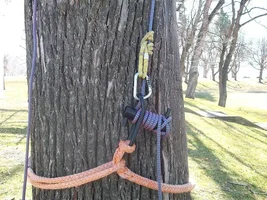
Thanx for the feed back, I agree that the anchor is over complicated and would like to further trouble-shoot this system. I would like to explain how this all came about. When I first began working with SRT I would just footlock up the single line advancing the false crotch with each lock. The anchor was just a running bowline choking the base of the tree, a system I still use to this day. One of the first problems I encountered was the amount rope required to run the work positioning system off the same rope as your SRT access line. I kept having to go back and retrieve the false crotch witch waists time and the over all goal here is to build a system that is efficient and maintains all the benefits of SRT and DRT in one system. Now for the anchor, it seems like quite the set up but in actuality it is simple. Everything attached to the paw stays on there you simply toss a sling around the tree, clip the paw to the sling, and tie a fishermans knot above the spike you placed on the access line. There is 120' in the bag below the anchor. I had to train the crew on how to lower/raise but it only took a few minutes. As for someone that knows nothing of ropes or tree work I would prefer them not to touch my system at all... that to me is a good way to end up on the ground fast not to mention I just don't trust tree wraps if the person drops the rope after reducing friction you are on the ground.
So one of the problem is the rope weight closing the work positioning (DRT) system. I suppose I could place a spike below to hitch but the system is bulky enough. Any Ideas?
If anyone has a good SRT work positioning system I would love to see it
So one of the problem is the rope weight closing the work positioning (DRT) system. I suppose I could place a spike below to hitch but the system is bulky enough. Any Ideas?
If anyone has a good SRT work positioning system I would love to see it

treebing
Been here much more than a while
- Location
- Detroit, Mi.
I agree with you that your tree tie off is functional, but it seems that you have a loose biner in there that has the potential for side loading. Girth hitch it at least. Its the lower biner in the picture attached to the trunk sling. I dont think the paw is necesary. But I like the eight backed up by a friction hitch, that is very user friendly.
As for how many lines you have to work with, that is an issue as far as time and tangles. Using one rope in and out the bag is best.
I would say ditch trying to go ddrt all together and work single line the whole tree. There is no reason to use both. If your going up SRT, why go down ddrt? trying to do both brings in too much gear, change overs and hassles. stick to one or the other. Working the tree SRT is a real treat too.
As for how many lines you have to work with, that is an issue as far as time and tangles. Using one rope in and out the bag is best.
I would say ditch trying to go ddrt all together and work single line the whole tree. There is no reason to use both. If your going up SRT, why go down ddrt? trying to do both brings in too much gear, change overs and hassles. stick to one or the other. Working the tree SRT is a real treat too.

- Location
- Hawaii
[ QUOTE ]
As for someone that knows nothing of ropes or tree work I would prefer them not to touch my system at all...
[/ QUOTE ]
In an emergency you would want the closest person available to be able to lower you to the ground; having a complicated system may hinder a potential rescue.
I think you've got some innovative setups there though, just need to streamline and find what works best for you. Personally I use SRT to access the top of the canopy and then the ground guys pull the rope out of the tree while I'm setting up a DdRT setup I've got ready to go off my harness. It does depend on the situation though.
jp

As for someone that knows nothing of ropes or tree work I would prefer them not to touch my system at all...
[/ QUOTE ]
In an emergency you would want the closest person available to be able to lower you to the ground; having a complicated system may hinder a potential rescue.
I think you've got some innovative setups there though, just need to streamline and find what works best for you. Personally I use SRT to access the top of the canopy and then the ground guys pull the rope out of the tree while I'm setting up a DdRT setup I've got ready to go off my harness. It does depend on the situation though.
jp
- Location
- Retired in Minneapolis
If I ever needed a rescue while climbing I sure would prefer that a skilled rope tech is involved. But, the practical consideration is that won't be the case. Using a trunk wrap system has been my solution. IN four different situations I had people lower me even though they had no clue what to do. It only took them a few seconds to understand my system. The lower was very slow and controlled like I would expect from an experienced rope tech.
One of the reasons that I like this system is that it goes back decades to when I started in the profession. At the time all we had for rigging out trees was three strand natural fiber ropes and tree friction. It didn't take me long to have a good understanding of how much tree wrapping I needed to lower the chunks without jerking my boss off his hooks. There are certainly better lowering devices available now but they have a technological learning curve. With enough trunk wrap friction anyone can lower a load safely.
If there is an emergency there is a natural devolution in skills. The simpler a process can be [generally] the safer it will be.
At some time I'm going to run a trunk-wrap lowering test where I have a non-rope tech figuring out how to lower me and then I'll start into my freak out mode. With a little shouting and carrying on the rescuer will get anxious and their skill level will devolve to, what...? The test will NOT be done with a live 'victim' but I will use a large log or rescue dummy.
This is just my way of solving the issue of a ground based SRT lower. I realize that there are lots of ways to do this safely and I really like seeing that other climbers are solving the issue in creative ways. Keep it up!
One of the reasons that I like this system is that it goes back decades to when I started in the profession. At the time all we had for rigging out trees was three strand natural fiber ropes and tree friction. It didn't take me long to have a good understanding of how much tree wrapping I needed to lower the chunks without jerking my boss off his hooks. There are certainly better lowering devices available now but they have a technological learning curve. With enough trunk wrap friction anyone can lower a load safely.
If there is an emergency there is a natural devolution in skills. The simpler a process can be [generally] the safer it will be.
At some time I'm going to run a trunk-wrap lowering test where I have a non-rope tech figuring out how to lower me and then I'll start into my freak out mode. With a little shouting and carrying on the rescuer will get anxious and their skill level will devolve to, what...? The test will NOT be done with a live 'victim' but I will use a large log or rescue dummy.
This is just my way of solving the issue of a ground based SRT lower. I realize that there are lots of ways to do this safely and I really like seeing that other climbers are solving the issue in creative ways. Keep it up!
treebing
Been here much more than a while
- Location
- Detroit, Mi.
i agree with that. it also wins as far as how much gear you have to take in and out of your bag which for economical as well as logistical reasons should be kept to a minimum.
The more I take out gear from the safety of the zipped bag, the more I am likely to lose or damage something expensive. Keeping track of lots of gear on an intense job site is one of the big challenges of the trade, at least for me. The less there is, the less I have to worry about.
The more I take out gear from the safety of the zipped bag, the more I am likely to lose or damage something expensive. Keeping track of lots of gear on an intense job site is one of the big challenges of the trade, at least for me. The less there is, the less I have to worry about.

Tom, if you go through that test with the trunk wraps, maybe you could also set up what I use and see which one the non-professional rescuer would evaluate as more comfortable.
Obviously, I have used trunk wraps a lot in my career. I know they are easy to set and easy to use. But every once in awhile, depending on the tree and the bark, they can pose problems such as with smooth-barked trees like young eucs and rough-barked trees like sugar and silver maples. In the first case the wraps can slide up the tree losing their friction. In the latter case, friction can get locked in a cleat of bark. As the lowering person tries removing the wraps, when the cleat breaks free they will all of the sudden be holding more weight than they thought, and perhaps more than they can handle.
Side note: I'm using SRT a lot more and I think I may have to start eating some humble pie. I never would have believed that a system could replace doubled-rope completely, but with the Unicender I'm not finding anything I cannot do in a very simple and efficient manner off the single rope. Also incorporating the Unicender in the frog system, I am not as paranoid about having a lowering system tied onto my anchor rope because the change over from going up to going down is very quick and safe.
Dave
Obviously, I have used trunk wraps a lot in my career. I know they are easy to set and easy to use. But every once in awhile, depending on the tree and the bark, they can pose problems such as with smooth-barked trees like young eucs and rough-barked trees like sugar and silver maples. In the first case the wraps can slide up the tree losing their friction. In the latter case, friction can get locked in a cleat of bark. As the lowering person tries removing the wraps, when the cleat breaks free they will all of the sudden be holding more weight than they thought, and perhaps more than they can handle.
Side note: I'm using SRT a lot more and I think I may have to start eating some humble pie. I never would have believed that a system could replace doubled-rope completely, but with the Unicender I'm not finding anything I cannot do in a very simple and efficient manner off the single rope. Also incorporating the Unicender in the frog system, I am not as paranoid about having a lowering system tied onto my anchor rope because the change over from going up to going down is very quick and safe.
Dave
Attachments
- Location
- Retired in Minneapolis
Dave,
Using a friction device has merit of course. TB's point about trunk wraps being less gear intensive tips the scales for me too.
Getting the right balance between too much and not enough friction in a trunk wrap takes good judgment and experience.
Most of the time I try to have my down rope redirect under a limb or two. The change of direction adds a lot more friction than the same amount of rope contact on a trunk.
Using a friction device has merit of course. TB's point about trunk wraps being less gear intensive tips the scales for me too.
Getting the right balance between too much and not enough friction in a trunk wrap takes good judgment and experience.
Most of the time I try to have my down rope redirect under a limb or two. The change of direction adds a lot more friction than the same amount of rope contact on a trunk.
treebing
Been here much more than a while
- Location
- Detroit, Mi.
DSMC, what i do not like about your system is not the use and safety of it, but rather the weight of the portawrap. That weight will pull down everytime you take tension off the rope which you have to then pull up everytime you sit back on the rope.
I also think there is no need for that prussic on the rope. I would think a tied off portawrap would be plenty secure.
Your right about SRT, what is weird to me is that Ddrt has been used for so long. SRT just makes more sense. I suppose it is the gear involved. its hard to go SRT with just a rope.
I also think there is no need for that prussic on the rope. I would think a tied off portawrap would be plenty secure.
Your right about SRT, what is weird to me is that Ddrt has been used for so long. SRT just makes more sense. I suppose it is the gear involved. its hard to go SRT with just a rope.
[ QUOTE ]
it seems that you have a loose biner in there that has the potential for side loading.
As for how many lines you have to work with, that is an issue as far as time and tangles. Using one rope in and out the bag is best.
[/ QUOTE ]
thanx for the great input I'm very glad there is a place like this to turn to, it helps tremendously. As for the loose biner thanx for the heads up I didn't see that as being an issue, but slack does drop when your working close to or above you SRT crotch. As for as the one rope thing I have been using a variation of your F8 system, which is great I might ad! But a lot of the time the limb I'm working can't support my weight on the return trip (hence the DRT false crotch in my system) so I've just been setting up a Z-rig before I walk out the branch. Which works great I just need to work with it some more, it's such a new system for me. I use to think SRT was so gear intensive and complicated compared to DRT and now I'm beginning to think its the other way around.
Thanx everyone
p.s. I could use some more Ideas for a functional anchor/stream lining this one
it seems that you have a loose biner in there that has the potential for side loading.
As for how many lines you have to work with, that is an issue as far as time and tangles. Using one rope in and out the bag is best.
[/ QUOTE ]
thanx for the great input I'm very glad there is a place like this to turn to, it helps tremendously. As for the loose biner thanx for the heads up I didn't see that as being an issue, but slack does drop when your working close to or above you SRT crotch. As for as the one rope thing I have been using a variation of your F8 system, which is great I might ad! But a lot of the time the limb I'm working can't support my weight on the return trip (hence the DRT false crotch in my system) so I've just been setting up a Z-rig before I walk out the branch. Which works great I just need to work with it some more, it's such a new system for me. I use to think SRT was so gear intensive and complicated compared to DRT and now I'm beginning to think its the other way around.
Thanx everyone
p.s. I could use some more Ideas for a functional anchor/stream lining this one
treebing
Been here much more than a while
- Location
- Detroit, Mi.
treebing
Been here much more than a while
- Location
- Detroit, Mi.
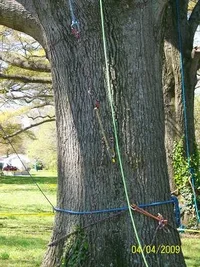
sorry if its hard to see.
I brought in the 16 strand in a rope bag with the hitch under the eight all set up and ready. Kind of like the f8 revolver but with the eight set right.
I threw the the 20' length of rope around the tree and put the eye splice through the rings of that cambium saver that is prussiced to that rope. Being in a competition rush, i didnt tighten it up very well.
I clipped the hitch climber to the eye splice. Then I took the eye splice of my poison ivy which was my climbing line and clipped it to the lowering rope in the bag.
I started up the rope.
to lower me, the ground guy would only have to untie the couple of butterflies under the hitchclimber and work the prussic,. pretty fool safe. and fast. Hopefully the lowering line just stays in the bag with the eight and hitch all set to go. The cambium saver rings was a last minute thought but you can make a nice little ring on a prussic for that purpose. that prussic should be backed up by stopper knots too.
I brought in the 16 strand in a rope bag with the hitch under the eight all set up and ready. Kind of like the f8 revolver but with the eight set right.
I threw the the 20' length of rope around the tree and put the eye splice through the rings of that cambium saver that is prussiced to that rope. Being in a competition rush, i didnt tighten it up very well.
I clipped the hitch climber to the eye splice. Then I took the eye splice of my poison ivy which was my climbing line and clipped it to the lowering rope in the bag.
I started up the rope.
to lower me, the ground guy would only have to untie the couple of butterflies under the hitchclimber and work the prussic,. pretty fool safe. and fast. Hopefully the lowering line just stays in the bag with the eight and hitch all set to go. The cambium saver rings was a last minute thought but you can make a nice little ring on a prussic for that purpose. that prussic should be backed up by stopper knots too.
New threads New posts
-
test2
-

-

-

-
 Industry related Spanish language podcasts
- Latest: Mick Dempsey!
-


