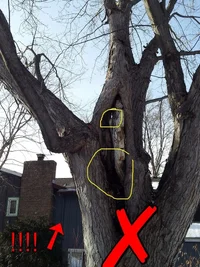
Hazard Tree evaluation

What's the goal? Big tree fast? Smaller tree? Just make safe? St aged removal? Leave for the next guy.
In case priority number one should always be no one dies. I have shown over the yrs trees that many in the industry have condemned can be made safe even in the worst of any season type storm.
Prune like it is your son or daughter that will work this tree next.
Be this thoughtful and also with your observations

'I have shown over the yrs trees that many in the industry have condemned, can be made safe'

How did you do this? Did you do a thorough assessment and have some guide lines (rules of thumb) that you followed? Or did you convince people you were right, did the job and the tree's still there?

I'm sure if one arborist says she's toast and the next says no way it's fine you had to answer to both sides of that coin for them to reach an informed decision?
 
What's the goal? Big tree fast? Smaller tree? Just make safe? St aged removal? Leave for the next guy.
In case priority number one should always be no one dies. I have shown over the yrs trees that many in the industry have condemned can be made safe even in the worst of any season type storm.
Prune like it is your son or daughter that will work this tree next.
Be this thoughtful and also with your observations

Last thing with 'What's the goal? Big tree fast?' if dealing with defect/ hazard mitigation when would this be advantageous?
Ethically unless they choose to go with someone else voiding you of responsibility this shouldn't be an option
 
More value in a big tree, more tangible and intangibles. Most people have no trouble understanding that a perceived hazard if positively and scientifically assessed as med to low or with greater risk are willing to throw dough at it. Believe me I have walked away from plenty removals and told the ho that a removal is stupid.
Can you imagine how much work there is and could be if many of the trees were assessed with a thoughfullness leaning towards preservation. We will get there
 
More value in a big tree, more tangible and intangibles. Most people have no trouble understanding that a perceived hazard if positively and scientifically assessed as med to low or with greater risk are willing to throw dough at it. Believe me I have walked away from plenty removals and told the ho that a removal is stupid.
Can you imagine how much work there is and could be if many of the trees were assessed with a thoughfullness leaning towards preservation. We will get there

If we could standardize a civilized standard to approach hazards or defects then maybe removals would go down and assessments like you and guy talk about would be on the rise.

This is where I'm trying to get our company to but getting a handle on cavity/defect size to weakness and mitigation is a huge part to this and if you can't justify what you do how can you do it.
 
I dunno Kevin everything and answer is present. we put a man on the moon. Solutions and answers abound. I decided when Donelli died that my life would not end in that same vain. Trees first if possible. Beer a close second followed by wine and women.
Seriously it all circles back to the fact we are an unregulated and voluntary trade. Why is the industry so hard to change. It's are nature. I think of all the shoulders we stand on. Harris, shigo, Matt heck, guy, Beranek
At this point in time I must say are schools, industry leaders, associations and associated are Fuckinmeowch us around... Excuse the analogy didn't want to bring it up AGAIN but why is it cool to throw people into trees with out the
fundamentals
 
"I totally understand the principal of taking the sway out of it and agree with that but with a defect like this..."

Like what?? We have NO idea about strength loss from hollows, just wild guesses and junk science based on Wagener's very limited study. Trees are not pipes.

"... If I understand it right strength loss of ~1/3 or more in a stem put's it into a hazardous category." The suspicion is that 2/3 hollow = 1/3 strength loss. SWAG

You don't understand it right. Neither do I or anybody. Why keep pretending that we do?

"If we could standardize a civilized standard to approach hazards or defects then maybe removals would go down and assessments like you and guy talk about would be on the rise." Well they are on the rise. I tried to get inspections into the Risk Standard, but those in control did not want that bar raised off the mud it's still stuck in. Same dominant group kept Inspection and Diagnosis out of TRAQ. Inspection did get into A300 Part 8:
83.2 General
83.2.1
If a condition is observed requiring attention beyond the original scope of the work, the condition should be reported to an immediate supervisor, the owner, or the person responsible for authorizing the work.
83.2.2 Root management practices should include, but are not limited to, one or more of the following:
Inspection of the tree, including the trunk, flare, root collar, root crown, and detectable roots;
Selective root pruning and non-selective root cutting; and,
Directing roots to areas favorable to growth and function.

83.2.3 Tools should be maintained according to manufacturer’s recommendations.
83.2.4Equipment, tools, and work practices that damage living tissue, bark or soil beyond the scope of work shall be avoided.
83.2.5 When conditions beyond the original scope of work are identified, further work shall be recommended
83.3 Trunk, flare and root inspection
83.3.1
Objectives of inspections shall be established.
83.3.2 The method, area, and depth of inspection shall be specified.
83.3.3 Tools and equipment of inspection shall be specified.
83.3.4 Inspection should include, but is not limited to, one or more of the following:

Functional tissue connecting the crown and the roots; KEY
Girdling of the buttress roots or stems by roots or foreign objects, and the tree’s response;
Tree association with beneficial and harmful insects;
Tree association with pathogenic and beneficial microorganisms (e.g. mycorrhizae);
Wounds, and the tree’s response to wounds;
Damage to detectable roots, and response;
Indications of root disease, and response, and
Graft unions in grafted trees;

83.3.5 Soil and foreign material and organisms should be removed to allow inspection.

83.3.6 Wound treatments that are damaging to tree tissues should not be used.
83.3.7 Bark tracing of wounds shall remove only dead, loose, foreign and damaged tissue.
83.3.8 Monitoring for callus and woundwood growth and for decay shall be considered
83.3.9 Wound sealants shall not be used to cover wounds, except to manage dessication or pests, or for aesthetic purposes.
83.4 Root collar examination
83.4.1
Root collar examination objectives shall be established.
83.4.2 The method, area, and depth of excavation shall be specified.
83.4.3 Tools and equipment used in excavation shall be specified.
83.4.4 Small adventitious roots that interfere with excavation or examination should be moved or pruned.
83.4.4.1 Adventitious roots greater than 3/8 inch (1 cm) diameter should be considered for retention.
83.4.5 Temporary protection of root and stem tissue newly exposed to sunlight shall be considered.
83.4.6 Detectable flare and root diseases and disorders should be diagnosed.
83.4.7 If significant structural defects are observed, a risk assessment should be recommended, see ANSI A300 (Part 9) Tree Risk Assessment.
83.4.8 The flare shall remain visible after excavation.

"This is where I'm trying to get our company to but getting a handle on cavity/defect size to weakness and mitigation is a huge part to this and if you can't justify what you do how can you do it"
Kevin, that's not huge. It's seldom relevant. We've all been trained to be defect-centric. Stinking thinking. The antidote is the list above. Look at strengths, not just weaknesses. Start with "Functional tissue connecting the crown and the roots."
NONE of you commented when this standard was written. If you want to make a difference, pay attention when Part 9 gets revised, and Part 8 after that. There will probably be yet another corporate push to weaken the above, or toss it in the Annex/Irrelevant Pile. If I'm dead or not by then I hope SOMEONE conserves and builds on the above details.

 
"I totally understand the principal of taking the sway out of it and agree with that but with a defect like this..."

Like what?? We have NO idea about strength loss from hollows, just wild guesses and junk science based on Wagener's very limited study. Trees are not pipes.

"... If I understand it right strength loss of ~1/3 or more in a stem put's it into a hazardous category." The suspicion is that 2/3 hollow = 1/3 strength loss. SWAG

You don't understand it right. Neither do I or anybody. Why keep pretending that we do?

"If we could standardize a civilized standard to approach hazards or defects then maybe removals would go down and assessments like you and guy talk about would be on the rise." Well they are on the rise. I tried to get inspections into the Risk Standard, but those in control did not want that bar raised off the mud it's still stuck in. Same dominant group kept Inspection and Diagnosis out of TRAQ. Inspection did get into A300 Part 8:
83.2 General
83.2.1
If a condition is observed requiring attention beyond the original scope of the work, the condition should be reported to an immediate supervisor, the owner, or the person responsible for authorizing the work.
83.2.2 Root management practices should include, but are not limited to, one or more of the following:
Inspection of the tree, including the trunk, flare, root collar, root crown, and detectable roots;
Selective root pruning and non-selective root cutting; and,
Directing roots to areas favorable to growth and function.

83.2.3 Tools should be maintained according to manufacturer’s recommendations.
83.2.4Equipment, tools, and work practices that damage living tissue, bark or soil beyond the scope of work shall be avoided.
83.2.5 When conditions beyond the original scope of work are identified, further work shall be recommended
83.3 Trunk, flare and root inspection
83.3.1
Objectives of inspections shall be established.
83.3.2 The method, area, and depth of inspection shall be specified.
83.3.3 Tools and equipment of inspection shall be specified.
83.3.4 Inspection should include, but is not limited to, one or more of the following:

Functional tissue connecting the crown and the roots; KEY
Girdling of the buttress roots or stems by roots or foreign objects, and the tree’s response;
Tree association with beneficial and harmful insects;
Tree association with pathogenic and beneficial microorganisms (e.g. mycorrhizae);
Wounds, and the tree’s response to wounds;
Damage to detectable roots, and response;
Indications of root disease, and response, and
Graft unions in grafted trees;

83.3.5 Soil and foreign material and organisms should be removed to allow inspection.

83.3.6 Wound treatments that are damaging to tree tissues should not be used.
83.3.7 Bark tracing of wounds shall remove only dead, loose, foreign and damaged tissue.
83.3.8 Monitoring for callus and woundwood growth and for decay shall be considered
83.3.9 Wound sealants shall not be used to cover wounds, except to manage dessication or pests, or for aesthetic purposes.
83.4 Root collar examination
83.4.1
Root collar examination objectives shall be established.
83.4.2 The method, area, and depth of excavation shall be specified.
83.4.3 Tools and equipment used in excavation shall be specified.
83.4.4 Small adventitious roots that interfere with excavation or examination should be moved or pruned.
83.4.4.1 Adventitious roots greater than 3/8 inch (1 cm) diameter should be considered for retention.
83.4.5 Temporary protection of root and stem tissue newly exposed to sunlight shall be considered.
83.4.6 Detectable flare and root diseases and disorders should be diagnosed.
83.4.7 If significant structural defects are observed, a risk assessment should be recommended, see ANSI A300 (Part 9) Tree Risk Assessment.
83.4.8 The flare shall remain visible after excavation.

"This is where I'm trying to get our company to but getting a handle on cavity/defect size to weakness and mitigation is a huge part to this and if you can't justify what you do how can you do it"
Kevin, that's not huge. It's seldom relevant. We've all been trained to be defect-centric. Stinking thinking. The antidote is the list above. Look at strengths, not just weaknesses. Start with "Functional tissue connecting the crown and the roots."
NONE of you commented when this standard was written. If you want to make a difference, pay attention when Part 9 gets revised, and Part 8 after that. There will probably be yet another corporate push to weaken the above, or toss it in the Annex/Irrelevant Pile. If I'm dead or not by then I hope SOMEONE conserves and builds on the above details.
Callus wood and such is the answer by the sounds of things. But how is a defect not a source of a problem?
I don't pretend to come across like I know even half of everything. Most of my posts here on the buzz have question marks behind them, I definitely take more than I give back.
 
Last edited:
"I totally understand the principal of taking the sway out of it and agree with that but with a defect like this..."

Like what?? We have NO idea about strength loss from hollows, just wild guesses and junk science based on Wagener's very limited study. Trees are not pipes.

"... If I understand it right strength loss of ~1/3 or more in a stem put's it into a hazardous category." The suspicion is that 2/3 hollow = 1/3 strength loss. SWAG

You don't understand it right. Neither do I or anybody. Why keep pretending that we do?

"If we could standardize a civilized standard to approach hazards or defects then maybe removals would go down and assessments like you and guy talk about would be on the rise." Well they are on the rise. I tried to get inspections into the Risk Standard, but those in control did not want that bar raised off the mud it's still stuck in. Same dominant group kept Inspection and Diagnosis out of TRAQ. Inspection did get into A300 Part 8:
83.2 General
83.2.1
If a condition is observed requiring attention beyond the original scope of the work, the condition should be reported to an immediate supervisor, the owner, or the person responsible for authorizing the work.
83.2.2 Root management practices should include, but are not limited to, one or more of the following:
Inspection of the tree, including the trunk, flare, root collar, root crown, and detectable roots;
Selective root pruning and non-selective root cutting; and,
Directing roots to areas favorable to growth and function.

83.2.3 Tools should be maintained according to manufacturer’s recommendations.
83.2.4Equipment, tools, and work practices that damage living tissue, bark or soil beyond the scope of work shall be avoided.
83.2.5 When conditions beyond the original scope of work are identified, further work shall be recommended
83.3 Trunk, flare and root inspection
83.3.1
Objectives of inspections shall be established.
83.3.2 The method, area, and depth of inspection shall be specified.
83.3.3 Tools and equipment of inspection shall be specified.
83.3.4 Inspection should include, but is not limited to, one or more of the following:

Functional tissue connecting the crown and the roots; KEY
Girdling of the buttress roots or stems by roots or foreign objects, and the tree’s response;
Tree association with beneficial and harmful insects;
Tree association with pathogenic and beneficial microorganisms (e.g. mycorrhizae);
Wounds, and the tree’s response to wounds;
Damage to detectable roots, and response;
Indications of root disease, and response, and
Graft unions in grafted trees;

83.3.5 Soil and foreign material and organisms should be removed to allow inspection.

83.3.6 Wound treatments that are damaging to tree tissues should not be used.
83.3.7 Bark tracing of wounds shall remove only dead, loose, foreign and damaged tissue.
83.3.8 Monitoring for callus and woundwood growth and for decay shall be considered
83.3.9 Wound sealants shall not be used to cover wounds, except to manage dessication or pests, or for aesthetic purposes.
83.4 Root collar examination
83.4.1
Root collar examination objectives shall be established.
83.4.2 The method, area, and depth of excavation shall be specified.
83.4.3 Tools and equipment used in excavation shall be specified.
83.4.4 Small adventitious roots that interfere with excavation or examination should be moved or pruned.
83.4.4.1 Adventitious roots greater than 3/8 inch (1 cm) diameter should be considered for retention.
83.4.5 Temporary protection of root and stem tissue newly exposed to sunlight shall be considered.
83.4.6 Detectable flare and root diseases and disorders should be diagnosed.
83.4.7 If significant structural defects are observed, a risk assessment should be recommended, see ANSI A300 (Part 9) Tree Risk Assessment.
83.4.8 The flare shall remain visible after excavation.

"This is where I'm trying to get our company to but getting a handle on cavity/defect size to weakness and mitigation is a huge part to this and if you can't justify what you do how can you do it"
Kevin, that's not huge. It's seldom relevant. We've all been trained to be defect-centric. Stinking thinking. The antidote is the list above. Look at strengths, not just weaknesses. Start with "Functional tissue connecting the crown and the roots."
NONE of you commented when this standard was written. If you want to make a difference, pay attention when Part 9 gets revised, and Part 8 after that. There will probably be yet another corporate push to weaken the above, or toss it in the Annex/Irrelevant Pile. If I'm dead or not by then I hope SOMEONE conserves and builds on the above details.

'We have NO idea about strength loss from hollows, just wild guesses and junk science based on Wagener's very limited study. Trees are not pipes.'

I get trees aren't pipes but why is it junk science?

It's not exact but he did something, every study has to have a base of something. What would you tell us if he hadn't started with something. So while it's not right maybe why is it junk especially from a guy who thinks the big man is keeping things out of the main stream and not letting things come out, isn't it kind of blasphemous?
 
"Hi Travis,

Thanks for the update - and for sharing the forum post. I appreciate your expert assistance in helping us explore our options. My wife and I took another look at the tree today in daylight. Our primary goal is avoiding the roof hazard while maintaining as much of the tree as we safely can. We’ve watched this tree for over 18 years (including in some strong wind storms) and feel like it is amazingly strong and resilient despite it’s defect. However, we do see how precarious the rotting heartwood appears under the two limbs you show in scenario C. If you have alternatives, I’d love to hear them. I’ve got another busy schedule tomorrow, but will be around much of the weekend if you want to talk by phone or in person. Email works, too.

Thanks,

Scott"
 
Thanks Guy. I really appreciate it, the criticism just as much as the compliments. Guy, are you saying I shouldn't refer to adventitious shoots as a good thing? Or just in certain cases? I do see what you mean about light being shed to 'existing' buds in the inner crown as oppose to adventitious buds. And another question, regarding retrenchment vs reduction. To me they are two different tools and I have a hard time with the definitions and usage in certain contexts. Correct me if I'm wrong. Retrenchment is heavy crown reduction in order to reduce stress significantly in trees or stems with significant decay and structural issues. Retrenchment is applied with the purpose of making the tree much smaller (15-30 feet in crown radius) and keeping it smaller. Crown reduction is the light to medium reduction of a structurally incorrect tree with little to no decay, but displaying over extension and vulnerability. Crown reduction is applied to temporarily reduce the size, like a storm keeping it in check ( 5-12 feet crown radius reduction) and the tree is meant to get bigger but not as fast as if the reduction was not applied.
I really think these terms should both be used and by these definitions, are both useful. I also think some arborists think we should use one or the other. I think either could work with light medium or heavy put in front of the term used. But are their purposes are different enough, maybe both could be used so that a heavy reduction is almost the same as a light retrenchment.
Unfortunately, I don't know the politics like Guy does. It sounds like the typical situation where progress and change are repelled by fear and possibly other things? Anyway politics don't apply to arborists as strongly as they apply to other trades? Is that stupid to say? Anyway, the point is forget what the rules are at least for a minute. We set the bar every time we consult on trees like this and I use another language with clients altogether. Not really different just slightly. But they trust me and they trust other arborists. So we set the 'standard' ar far as arbor i culture is concerned. It's a culture, and we make it what we want as long as it makes sense and people can understand and it and even demand it. I love it when my clients demand reduction or mitigation/preservation.
Mangoes, that's the easy button again. No offence, I can agree to disagree, we can still joke about it over a beer later. The tree in that condition, I'd remove it as well. But after reduction isn't it good enough until the replanted tree is established, or beyond that, especially if it held up before reduction with 'defects' like that. Pull tests and or cable usage may also show reason to retain. And what if the client said they wanted a price for reduction and removal was not an option. I know, you might say 'I can't assume that kind of liability'. Guess what, like Guy has said, you don't. You give the advice and the HOMEOWNER makes the decision and therefore carries the liability. You even say (or notify in writing) after you leave 'this tree may fail and the work done does not guarantee the tree will not fail'. Along with that you may say 'annual inspection in a tree with this level of decay is wise but after this significant reduction the tree is under less force during storm events. If the tree fails the real risk is property value. It's a can of worms but human injury is extremely unlikely. Better chance of getting injured working on it. I might even install the strap for free just to double as a safety while climbing to the ends. More can of worms I know. The straps not a cable but way better than nothing. I've never seen or heard of a case where a person was injured due to the poor decision of an arborist. Please tell me these stories as I'm sure they exist. More often I'd guess that clients get advice and do nothing and failure occurs due to neglect. This I've heard of but only to cause property damage.
And the weight thing. Guy was there too when we took a measured 680 lbs out of a poplar on the second medium application reduction. The biggest cut around 2 inches. Still a lot of weight even though no large Woundage. The poplar was requested removed but was on the southwest corner perfectly shading the house. The species is known to be weak and drop limbs but after reduction, especially twice, the superstructure (the root flare, main stem, and main crotches) will always be over built and tapered better. I even wonder if the tree has now taken a turn in habit as I did see with a small poplar I once turned into a shrub. Does it actually now grow with less extension? Temporarily I suspect, until it goes back to old ways like a white spruce shooting out of a dwarf Alberta, or a Norway maple shooting out of the dwarfed columnar variety. Is white the parent species of the dwarf Alberta? I have seen it happen though, like the opposite of a witches broom.
By the defenitions above I think to satisfy retain the tree pessimists, the silver maple in this thread could be heavily retrenched above the points of significant decay and a medium reduction for the stems that show no decay. Again a funny looking tree at first but in the long run not bad. I'd also be ok with the lighter yet more frequently applied, more sympathetic, more pro morphology progressive retrenchment suggested by Guy. I'd give the client the options, including removal, which would not be my suggestion, and they'd make the decision and live with the risks happily cause they love the tree that much.
Damn it. Im up late on tree buzz again writing a speech. goodnight.
 
We do a ton of reduction pruning - I am a proponent. But I'd never let my kids sleep under that tree. It's too close to the house and too defective to garner assurance.

I never pull the trigger on a tree - client does. "Removals are a one time pay cheque, I'd rather care for this tree for 30 years and generate $10k than cut it down for $3k" I frequently explain to customers after giving them their options. Based on the familytrees note client wants to prune, so I would give best mitigation prescriptions based on their tolerance for risk.

But if it were mine it would be gone next week.
 
Mangoes, what makes it 'too defective'? The owners have watched it 18 years hold up in big storms, and in walks The Arborist, gonna teach em all rotten heartwood and other Chicken Little concepts.

Who do we think we are? When can we 'garner assurance' for anything, except "Dead Trees Kill No Babies"??

Please establish the severity of that feature aka 'defect' before and after the specified crown reduction pruning. If you cannot, you're saying things that you know are not true.

O and Ryan no sweat; there's confusion between adventitious growth (good) and adventitious buds (bad).
 
Mangoes, what makes it 'too defective'? The owners have watched it 18 years hold up in big storms, and in walks The Arborist, gonna teach em all rotten heartwood and other Chicken Little concepts.

Who do we think we are? When can we 'garner assurance' for anything, except "Dead Trees Kill No Babies"??

Please establish the severity of that feature aka 'defect' before and after the specified crown reduction pruning. If you cannot, you're saying things that you know are not true.

O and Ryan no sweat; there's confusion between adventitious growth (good) and adventitious buds (bad).

What are the levels of defect before you start to be concerned then? I know yo say the 1/3 rule is out the window but what if it was 1/2 gone 2/3, 7/8, etc. When is a cavity or defect big enough for you to say 'ah shit, that isn't good'?
 
"I totally understand the principal of taking the sway out of it and agree with that but with a defect like this..."

Like what?? We have NO idea about strength loss from hollows, just wild guesses and junk science based on Wagener's very limited study. Trees are not pipes.

"... If I understand it right strength loss of ~1/3 or more in a stem put's it into a hazardous category." The suspicion is that 2/3 hollow = 1/3 strength loss. SWAG

You don't understand it right. Neither do I or anybody. Why keep pretending that we do?

"If we could standardize a civilized standard to approach hazards or defects then maybe removals would go down and assessments like you and guy talk about would be on the rise." Well they are on the rise. I tried to get inspections into the Risk Standard, but those in control did not want that bar raised off the mud it's still stuck in. Same dominant group kept Inspection and Diagnosis out of TRAQ. Inspection did get into A300 Part 8:
83.2 General
83.2.1
If a condition is observed requiring attention beyond the original scope of the work, the condition should be reported to an immediate supervisor, the owner, or the person responsible for authorizing the work.
83.2.2 Root management practices should include, but are not limited to, one or more of the following:
Inspection of the tree, including the trunk, flare, root collar, root crown, and detectable roots;
Selective root pruning and non-selective root cutting; and,
Directing roots to areas favorable to growth and function.

83.2.3 Tools should be maintained according to manufacturer’s recommendations.
83.2.4Equipment, tools, and work practices that damage living tissue, bark or soil beyond the scope of work shall be avoided.
83.2.5 When conditions beyond the original scope of work are identified, further work shall be recommended
83.3 Trunk, flare and root inspection
83.3.1
Objectives of inspections shall be established.
83.3.2 The method, area, and depth of inspection shall be specified.
83.3.3 Tools and equipment of inspection shall be specified.
83.3.4 Inspection should include, but is not limited to, one or more of the following:

Functional tissue connecting the crown and the roots; KEY
Girdling of the buttress roots or stems by roots or foreign objects, and the tree’s response;
Tree association with beneficial and harmful insects;
Tree association with pathogenic and beneficial microorganisms (e.g. mycorrhizae);
Wounds, and the tree’s response to wounds;
Damage to detectable roots, and response;
Indications of root disease, and response, and
Graft unions in grafted trees;

83.3.5 Soil and foreign material and organisms should be removed to allow inspection.

83.3.6 Wound treatments that are damaging to tree tissues should not be used.
83.3.7 Bark tracing of wounds shall remove only dead, loose, foreign and damaged tissue.
83.3.8 Monitoring for callus and woundwood growth and for decay shall be considered
83.3.9 Wound sealants shall not be used to cover wounds, except to manage dessication or pests, or for aesthetic purposes.
83.4 Root collar examination
83.4.1
Root collar examination objectives shall be established.
83.4.2 The method, area, and depth of excavation shall be specified.
83.4.3 Tools and equipment used in excavation shall be specified.
83.4.4 Small adventitious roots that interfere with excavation or examination should be moved or pruned.
83.4.4.1 Adventitious roots greater than 3/8 inch (1 cm) diameter should be considered for retention.
83.4.5 Temporary protection of root and stem tissue newly exposed to sunlight shall be considered.
83.4.6 Detectable flare and root diseases and disorders should be diagnosed.
83.4.7 If significant structural defects are observed, a risk assessment should be recommended, see ANSI A300 (Part 9) Tree Risk Assessment.
83.4.8 The flare shall remain visible after excavation.

"This is where I'm trying to get our company to but getting a handle on cavity/defect size to weakness and mitigation is a huge part to this and if you can't justify what you do how can you do it"
Kevin, that's not huge. It's seldom relevant. We've all been trained to be defect-centric. Stinking thinking. The antidote is the list above. Look at strengths, not just weaknesses. Start with "Functional tissue connecting the crown and the roots."
NONE of you commented when this standard was written. If you want to make a difference, pay attention when Part 9 gets revised, and Part 8 after that. There will probably be yet another corporate push to weaken the above, or toss it in the Annex/Irrelevant Pile. If I'm dead or not by then I hope SOMEONE conserves and builds on the above details.

TRAQ if I'm not wrong is the hazard tree course? If the 'Same dominant group kept Inspection and Diagnosis out of TRAQ.' how can you know it's a hazard tree if you don't inspect it? I thought half of that course was about knowing how bad what you're looking at is.

Sorry there's so many replies, I told you I have to read it a few times.
 
Thanks Guy. I really appreciate it, the criticism just as much as the compliments. Guy, are you saying I shouldn't refer to adventitious shoots as a good thing? Or just in certain cases? I do see what you mean about light being shed to 'existing' buds in the inner crown as oppose to adventitious buds. And another question, regarding retrenchment vs reduction. To me they are two different tools and I have a hard time with the definitions and usage in certain contexts. Correct me if I'm wrong. Retrenchment is heavy crown reduction in order to reduce stress significantly in trees or stems with significant decay and structural issues. Retrenchment is applied with the purpose of making the tree much smaller (15-30 feet in crown radius) and keeping it smaller. Crown reduction is the light to medium reduction of a structurally incorrect tree with little to no decay, but displaying over extension and vulnerability. Crown reduction is applied to temporarily reduce the size, like a storm keeping it in check ( 5-12 feet crown radius reduction) and the tree is meant to get bigger but not as fast as if the reduction was not applied.
I really think these terms should both be used and by these definitions, are both useful. I also think some arborists think we should use one or the other. I think either could work with light medium or heavy put in front of the term used. But are their purposes are different enough, maybe both could be used so that a heavy reduction is almost the same as a light retrenchment.
Unfortunately, I don't know the politics like Guy does. It sounds like the typical situation where progress and change are repelled by fear and possibly other things? Anyway politics don't apply to arborists as strongly as they apply to other trades? Is that stupid to say? Anyway, the point is forget what the rules are at least for a minute. We set the bar every time we consult on trees like this and I use another language with clients altogether. Not really different just slightly. But they trust me and they trust other arborists. So we set the 'standard' ar far as arbor i culture is concerned. It's a culture, and we make it what we want as long as it makes sense and people can understand and it and even demand it. I love it when my clients demand reduction or mitigation/preservation.
Mangoes, that's the easy button again. No offence, I can agree to disagree, we can still joke about it over a beer later. The tree in that condition, I'd remove it as well. But after reduction isn't it good enough until the replanted tree is established, or beyond that, especially if it held up before reduction with 'defects' like that. Pull tests and or cable usage may also show reason to retain. And what if the client said they wanted a price for reduction and removal was not an option. I know, you might say 'I can't assume that kind of liability'. Guess what, like Guy has said, you don't. You give the advice and the HOMEOWNER makes the decision and therefore carries the liability. You even say (or notify in writing) after you leave 'this tree may fail and the work done does not guarantee the tree will not fail'. Along with that you may say 'annual inspection in a tree with this level of decay is wise but after this significant reduction the tree is under less force during storm events. If the tree fails the real risk is property value. It's a can of worms but human injury is extremely unlikely. Better chance of getting injured working on it. I might even install the strap for free just to double as a safety while climbing to the ends. More can of worms I know. The straps not a cable but way better than nothing. I've never seen or heard of a case where a person was injured due to the poor decision of an arborist. Please tell me these stories as I'm sure they exist. More often I'd guess that clients get advice and do nothing and failure occurs due to neglect. This I've heard of but only to cause property damage.
And the weight thing. Guy was there too when we took a measured 680 lbs out of a poplar on the second medium application reduction. The biggest cut around 2 inches. Still a lot of weight even though no large Woundage. The poplar was requested removed but was on the southwest corner perfectly shading the house. The species is known to be weak and drop limbs but after reduction, especially twice, the superstructure (the root flare, main stem, and main crotches) will always be over built and tapered better. I even wonder if the tree has now taken a turn in habit as I did see with a small poplar I once turned into a shrub. Does it actually now grow with less extension? Temporarily I suspect, until it goes back to old ways like a white spruce shooting out of a dwarf Alberta, or a Norway maple shooting out of the dwarfed columnar variety. Is white the parent species of the dwarf Alberta? I have seen it happen though, like the opposite of a witches broom.
By the defenitions above I think to satisfy retain the tree pessimists, the silver maple in this thread could be heavily retrenched above the points of significant decay and a medium reduction for the stems that show no decay. Again a funny looking tree at first but in the long run not bad. I'd also be ok with the lighter yet more frequently applied, more sympathetic, more pro morphology progressive retrenchment suggested by Guy. I'd give the client the options, including removal, which would not be my suggestion, and they'd make the decision and live with the risks happily cause they love the tree that much.
Damn it. Im up late on tree buzz again writing a speech. goodnight.

So are you seperating your definitions by dosage or that one is temporary and one is more permanent?
 
"I totally understand the principal of taking the sway out of it and agree with that but with a defect like this..."

Like what?? We have NO idea about strength loss from hollows, just wild guesses and junk science based on Wagener's very limited study. Trees are not pipes.

"... If I understand it right strength loss of ~1/3 or more in a stem put's it into a hazardous category." The suspicion is that 2/3 hollow = 1/3 strength loss. SWAG

You don't understand it right. Neither do I or anybody. Why keep pretending that we do?

"If we could standardize a civilized standard to approach hazards or defects then maybe removals would go down and assessments like you and guy talk about would be on the rise." Well they are on the rise. I tried to get inspections into the Risk Standard, but those in control did not want that bar raised off the mud it's still stuck in. Same dominant group kept Inspection and Diagnosis out of TRAQ. Inspection did get into A300 Part 8:
83.2 General
83.2.1
If a condition is observed requiring attention beyond the original scope of the work, the condition should be reported to an immediate supervisor, the owner, or the person responsible for authorizing the work.
83.2.2 Root management practices should include, but are not limited to, one or more of the following:
Inspection of the tree, including the trunk, flare, root collar, root crown, and detectable roots;
Selective root pruning and non-selective root cutting; and,
Directing roots to areas favorable to growth and function.

83.2.3 Tools should be maintained according to manufacturer’s recommendations.
83.2.4Equipment, tools, and work practices that damage living tissue, bark or soil beyond the scope of work shall be avoided.
83.2.5 When conditions beyond the original scope of work are identified, further work shall be recommended
83.3 Trunk, flare and root inspection
83.3.1
Objectives of inspections shall be established.
83.3.2 The method, area, and depth of inspection shall be specified.
83.3.3 Tools and equipment of inspection shall be specified.
83.3.4 Inspection should include, but is not limited to, one or more of the following:

Functional tissue connecting the crown and the roots; KEY
Girdling of the buttress roots or stems by roots or foreign objects, and the tree’s response;
Tree association with beneficial and harmful insects;
Tree association with pathogenic and beneficial microorganisms (e.g. mycorrhizae);
Wounds, and the tree’s response to wounds;
Damage to detectable roots, and response;
Indications of root disease, and response, and
Graft unions in grafted trees;

83.3.5 Soil and foreign material and organisms should be removed to allow inspection.

83.3.6 Wound treatments that are damaging to tree tissues should not be used.
83.3.7 Bark tracing of wounds shall remove only dead, loose, foreign and damaged tissue.
83.3.8 Monitoring for callus and woundwood growth and for decay shall be considered
83.3.9 Wound sealants shall not be used to cover wounds, except to manage dessication or pests, or for aesthetic purposes.
83.4 Root collar examination
83.4.1
Root collar examination objectives shall be established.
83.4.2 The method, area, and depth of excavation shall be specified.
83.4.3 Tools and equipment used in excavation shall be specified.
83.4.4 Small adventitious roots that interfere with excavation or examination should be moved or pruned.
83.4.4.1 Adventitious roots greater than 3/8 inch (1 cm) diameter should be considered for retention.
83.4.5 Temporary protection of root and stem tissue newly exposed to sunlight shall be considered.
83.4.6 Detectable flare and root diseases and disorders should be diagnosed.
83.4.7 If significant structural defects are observed, a risk assessment should be recommended, see ANSI A300 (Part 9) Tree Risk Assessment.
83.4.8 The flare shall remain visible after excavation.

"This is where I'm trying to get our company to but getting a handle on cavity/defect size to weakness and mitigation is a huge part to this and if you can't justify what you do how can you do it"
Kevin, that's not huge. It's seldom relevant. We've all been trained to be defect-centric. Stinking thinking. The antidote is the list above. Look at strengths, not just weaknesses. Start with "Functional tissue connecting the crown and the roots."
NONE of you commented when this standard was written. If you want to make a difference, pay attention when Part 9 gets revised, and Part 8 after that. There will probably be yet another corporate push to weaken the above, or toss it in the Annex/Irrelevant Pile. If I'm dead or not by then I hope SOMEONE conserves and builds on the above details.

'It's seldom relevant. We've all been trained to be defect-centric. Stinking thinking. The antidote is the list above. Look at strengths, not just weaknesses. Start with "Functional tissue connecting the crown and the roots." '

Strength is to be looked at not just weakness but finding the balance of the 2 is the aim
 
Last edited:

New threads New posts

Back
Top Bottom