Growth Ring Variation Example

mdvaden

Participating member
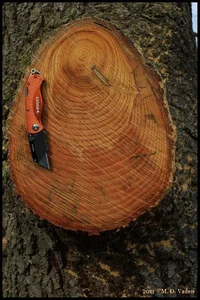
We had to remove an ailing grand fir and a deodar cedar in our yard that were planted too close to each other and the power lines overhead in the back. The deodar was about 60 feet tall. About 7' above ground, a branch became another stem. It extended horizontal about 10 feet and then hooked upward straight for about 45 feet. The photo below shows the typical growth ring cross-section along any part of the horizontal stretch of the limb the shot skyward. Quite the difference between the bottom and top.

275496-deodar_stem600.jpg
 

Attachments

  • 275496-deodar_stem600.webp
    275496-deodar_stem600.webp
    134.5 KB · Views: 26
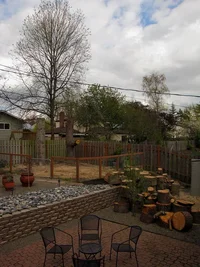
The deodar was the one in the corner. About an 8' remnant of the extra leader remains in the image. Trunk in far back corner.

I knew that the growth rings would show variation. But it still raised my eyebrows a bit for how much difference there was.

275497-landscape_tree2_600.jpg
 

Attachments

  • 275497-landscape_tree2_600.webp
    275497-landscape_tree2_600.webp
    113.9 KB · Views: 22
Looks consistent with what I've seen for growth on even leaning trees. Typically being much more wood being put on on the compression side. Funny to see some stumps on leaners, there will sometimes be as much as 90% of the wood on compression side of the pith.

Reminds me of this really neat sourwood I've worked on, one of the low limbs is maybe 3" wide and 6" tall in cross section. Would love to see a slice out of that limb.
 
That is a very cool image. Shows how well trees can build themsleves for the situation they find themselves in.
Do I have this the right way around or not - deciduous trees put reaction wood on the compression side and conifers put it on the tension side. Or other way round?
Also - there are apparently ways to evaluate a leaner by looking at the bark for signs that the tree is dealing with the lean. Anyone know anything about this?
 
[ QUOTE ]
The deodar was the one in the corner. About an 8' remnant of the extra leader remains in the image. Trunk in far back corner.

I knew that the growth rings would show variation. But it still raised my eyebrows a bit for how much difference there was.

[/ QUOTE ]

Please don't take this as me being rude:

but, I don't see anything unordinary there. Typical compression wood.

although, it is always cool to see; and cut for that matter, cool to have your chainsaw pinched, where normally it shouldn't be pinched.
 
[ QUOTE ]
That is a very cool image. Shows how well trees can build themsleves for the situation they find themselves in.
Do I have this the right way around or not - deciduous trees put reaction wood on the compression side and conifers put it on the tension side. Or other way round?
Also - there are apparently ways to evaluate a leaner by looking at the bark for signs that the tree is dealing with the lean. Anyone know anything about this?

[/ QUOTE ]

Other way around Nora, but in actual practice there seems to be lots of variation.
 

New threads New posts

Back
Top Bottom