good load bearing knot for joining two lines???

Re: good load bearing knot for joining two lines??

[ QUOTE ]

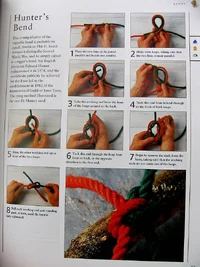
Frankly, I find that too-clever-by-half tying method shown above
(from Budworth's <u>Ultimate (!) Encyclopedia of Knots...</u>)
to be a waste of effort (in learning &amp; fiddling); just form one Overhand
and reeve the other end through it appropriately.


[/ QUOTE ]

I'd like to stick up for that method. The pics make two steps look like five. It's actually fast and fiddle-free.
 
Re: good load bearing knot for joining two lines??

&gt; It's actually fast and fiddle-free.

Well, if you're good with it, great. It just seems to me that it entails
more careful positioning etc. compared with first making one Overhand
and then knowing how to reeve the other rope through that (and at
which point one have various choices of what interlocked-overhands
bend to make). (Even more complicated is the similar method for Ashley's
(#1452) &amp; SmitHunter's Bends, esp. re the former as the positioning
of the ends makes for different characteristics in the knot--easy to
untie, or near-jammingly secure-when-slack.)

One can bring the ends back around and through the central nips
for added security/stability and more material for the mainlines to
crunch upon (in Rosendahl's).

*kN*
 
Re: good load bearing knot for joining two lines??

I vote for Norm's double bowline. I've tied the Zep many times, now after a little time has past, I couldn't tie it if I had too.

Norm's offering works with different sized ropes, is easy to tie and untie and with the looped 'end' in the connector it's about as secure as a knot can get. The two ropes can be separated and rejoined without untying/retying either.
 
Re: good load bearing knot for joining two lines??

[ QUOTE ]
Tom, good idea but if a major load is being put on the rope makes me wonder what if the rope breaks and there is a metal fid flying somewhere with the rope, like back at the pullee in the truck or tractor.

[/ QUOTE ]

Take alook: http://en.wikipedia.org/wiki/Fid

You're thinking of a marlinspike but most times the two terms are [sloppily] interchanged.

If there is a large enough load put on a rope to break it there are plenty of other things to worry about. Never get to that place in time.
 
Re: good load bearing knot for joining two lines??

Thanks for such good input and references. Somewhat overwhelming with the very informative replies. Goes to show that there is a great deal of detail in everyday items that few people know about.

I've used the "European Death Knot" adopted from rappelling from rock climbing routes. At first I was concerned, as the name might suggest, but found it to work great under bodyweight applications. Using a Maasdam Rope Puller with it, it was good as well.

Any ideas on the strength loss of this knot, as well as others? Anybody know of an efficiency chart?

Anyone know of printable web resources for knots that can be used for training purposes?


Thanks again! Keep Safe!
 
Re: good load bearing knot for joining two lines??

[ QUOTE ]
I've used the "European Death Knot" adopted from rappelling from rock climbing routes. At first I was concerned, as the name might suggest, but found it to work great...

[/ QUOTE ]

There is a reason for the name.


[ QUOTE ]
Any ideas on the strength loss of this knot, as well as others? Anybody know of an efficiency chart?


[/ QUOTE ]


Some info here:

http://www.xmission.com/~tmoyer/testing/EDK.html
 
Re: good load bearing knot for joining two lines??

[ QUOTE ]
"European Death Knot"


[/ QUOTE ]

I know that the EDK (probably listed as a different name) is highly recommended in <u>On Rope</u> for situations when a bend is laying on a solid surface (like rock) because the knot stays opposite the surface, rather than abrading against it.
 
Re: good load bearing knot for joining two lines??

I thought a sheepshank was for bypassing a damaged section of rope. It was taught to me as a last resort kind of thing.
 
Re: good load bearing knot for joining two lines??

I suppose it could work for that too, but only if the damaged section was in one of the loops - the other three "legs" in the middle are under tension.

800px-Sheepshank_knot.jpg


It'd be much safer to cut the rope and bend it back together. Check that - just isolate the damaged area using an "inline figure of 8". The loop is not under tension, but will not capsize the knot. It can also be used as a strong, but directional, midline haul point.

http://www.iland.net/~jbritton/inlinefigure8loop.htm

Inline_6.jpg
 
Re: good load bearing knot for joining two lines??

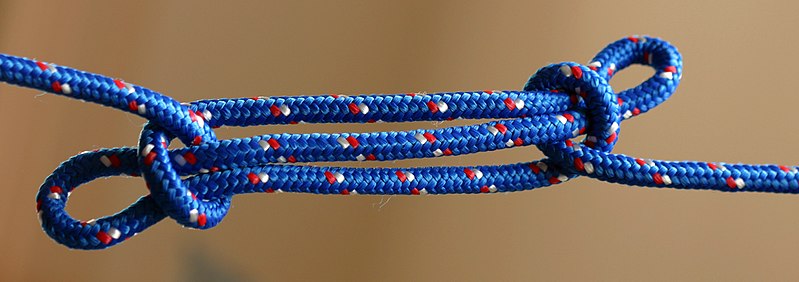
I learned the knot you are calling a zeppelin form mountaineer Wilie Unsoeld back in 1973. He called it the Hunter's Bend. Regardless of the name it is a great knot.

I showed this to Rip and Ken (Arbormaster) years ago and they had never seen it at that time. Showed them the Yosemite tie off for bowline which was also new to them at that time.

A warning is that I think it can be a tricky tie for a novice.

I like to use a stick in a knot that will be loaded. Break the stick when done and you have room to move...
 
Re: good load bearing knot for joining two lines??

ummmmmm; What i meant was that the twin bowline bend shown; kinda looks to me like a locked version of the sheepshank; with the ends cut. So, i repectfully question it's security when tension isn't constant and maintained; especially at intermittent pulls in varied directions; especially in mixed materials.....
 
Re: good load bearing knot for joining two lines??

[ QUOTE ]
I learned the knot you are calling a zeppelin form mountaineer Wilie Unsoeld back in 1973. He called it the Hunter's Bend. Regardless of the name it is a great knot.

I showed this to Rip and Ken (Arbormaster) years ago and they had never seen it at that time. Showed them the Yosemite tie off for bowline which was also new to them at that time.

A warning is that I think it can be a tricky tie for a novice.

I like to use a stick in a knot that will be loaded. Break the stick when done and you have room to move...

[/ QUOTE ]

You're a resourceful man. Thanks
 
Re: good load bearing knot for joining two lines??

I made a youtube vid of one method of tyeing the Zeppelin. Sorry I didn't have two different colored ropes.

http://www.youtube.com/watch?v=7O7PgfkqskA

Scott there's a similar knot to the Zeppelin that is called the Hunter's Bend. I attached a photo.
 

Attachments

  • 116195-IMG_1664.webp
    116195-IMG_1664.webp
    107 KB · Views: 54
Re: good load bearing knot for joining two lines??

That definitely looks faster than the way I tie the zeppelin, I just got to wrap my mind around it.
 
Re: good load bearing knot for joining two lines??

[ QUOTE ]
Anybody know of an efficiency chart?

[/ QUOTE ]
Beware such things! They typically apply to some exact knot that is NOT
revealed (how oriented, dressed, &amp; set), and in materials different from what
you're using. There remains a world of better testing to be done in order
to get a good understanding of knot strengths. (But, as remarked by Tom
above, you should be working well shy of any reasonable break point.)

Yes, there is a reason for the name "EDK"--American fear. And some, thinking
"more is better", took the offset idea to the Figure 8 bend (vs. the Ring Bend)
and got a knot more deserving of the appelation! Now, the Offset Fig.8 is
broadly discredited (with a little exageration). Yes, offset knots are great
for moving over a surface; there might be instances where arborists need
to haul a bent line over a limb, and these would work well?

But for the OP's needs, one wants strength &amp; ease of untying, and many good
solutions have been presented here.

Regarding the interlocked eyes with a fid, one can substitute some rope
that is run back'n'forth through the eye brought up through the other (and
this rope might be a long end of a bowline forming one of the eyes!).

SmitHunter's Bend (presented first? by Phil Smith's <u>Knots for Mountaineering</u>
ca. 1959) has some resemblance to Rosendahl's Bend; moreover, if one flips
one of the ropes around in the latter, it more resembles the former (and yet
is a lousy knot--unstable).

*knudeNoggin*
 
Re: good load bearing knot for joining two lines??

There's some tests done by Tom Moyers that examine the double overhand bend and the flat figure 8 bend. His tests show the double overhand bend or flat bend, whatever the heck it's proper name is, to be a good, secure, bend, but recommends the tails be left long and as a second precaution to simply tie another one in the tails of the first.

he found that the flat F8 would capsize and roll and continue to do that until it rolls right off the end of the ropes.
 
Re: good load bearing knot for joining two lines??

[ QUOTE ]
There's some tests done by Tom Moyers that examine the double overhand bend and the flat figure 8 bend.

[/ QUOTE ]


I think you're referring to the link I provided above:


http://www.xmission.com/~tmoyer/testing/EDK.html


But note this is not a 'double' overhand, but a 'doubled', single overhand (two ropes forming a single overhand).

Moyer calls it a 'flat overhand bend', and 'Euro Death-Knot'.

The February issue of Arborist News magazine has an article that discusses (among other knots) the double overhand.
 

New threads New posts

Back
Top Bottom