
going ultralight....a radical paradigm shift

[ QUOTE ]
I would talk to a manufacturer directly and ask if they recommend using a hollow braid for an ascending line. Being that there is no core, it will flatten out. It will also be very prone to 'picking'. Most static lines have at minimum a 24 strand cover and are a kernmantle construction.

[/ QUOTE ]

I did talk to the manufacturer of the line in question.qoute" this line is suitable for ascending/descending, smooth cam devices, pulleys, rappel racks and friction knots." unqoute. was also told it was suitable for winches, water rescue, ziplines and aerial load transportation use.


I'm well versed in Kernmantle construction, having spent thousands of hours and many years rescuing, doing industrial high angle work, rigging and SRT on many different Kernmantle lines.

anyways all, thanks for the feedback, i managed to get some testing time at a local university that has a rope bollard test machine and a rigging beam. I'm going to test out various setups (ddrt/srt drt/srt hybrids), 4:1 pulley systems and load test them all with the Technora line.

I wonder if the guy that first tried ArborPlex instead of the "normal" 3 Strand got ostracized as well......? /forum/images/graemlins/crazy.gif
 
SRT, I don't think you're getting ostracised, more so it's perspective. Try to keep the general direction, paying heed to the potholes that the passengers are able to see from the back seat.
 
SRT,

Come on, you're not getting dumped on :) Your ideas all have merit but there are some limitations that some of the gang are seeing. Not a bad idea to ponder what's being tossed around.

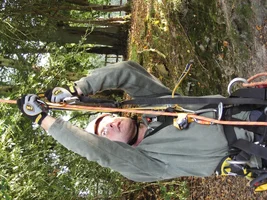
Since most of us carry our gear from the curb to the back yard the issue of weight and bulk isn't really an issue. If the climbs were more remote then saving weight and bulk would be a bigger factor. Saving grams on a big wall rack can add up quickly. Saving an odd pound or so here and there is inconsequential for most arbos.

Keep your ideas coming. The more lateral thinking that is brought to the discussion the easier our vertical work is. Over the years many ideas from other rope disciplines have found their way into arbo work. Some were discounted as dangerous but have become a bit more standard practice.

when you do the rope testing be sure to take lots of pictures of the test bench. Keep good records and share them with us if you would. Arbos are in great need of more engineering in the use of our tools.
 
^ not here no...the words flew elsewhere (other forums) :)

i had an ulterior motive when i started this post. I spend a lot of time hiking in remote areas with an already heavy pack. i want to build a micro treeclimber "kit" that i can stow in the top pocket of the pack, hence why i wanted everything "downsized". I will freely admit i went a bit far with the whole 1/4" line idea...but my mindset was "downsize everything" :)

As you said Tom, 99% of the time we go from car to tree, so its not an issue. (heck my regular treekit is two 5 gallon pails for the gear, and the harness slung over my back, or i move it with a custom wheeled bin.)
 
SRTTech,
Your idea of using fishing weights and fire line & sling shot seems like a good idea on paper or for smaller trees but...
My experiance with taller trees is this;
Using a fishing weight and fishing line to access taller trees has it's own problems, you cant really see the weight or the line when you shoot it 100' or more up into the canopy. And pulling up an access line means having 100' or more of line suspended in the air, coupled with the added resistance of yanking it through the brush of the canopy means ALOT of shock loading. Smaller 100 lb. test line usually breaks.
I use a heavier throw bag and the thinner zing-it line. And I use a big shot to get it up there. I can shoot fairly accurately over 100' using a pulley system on the big shot. When you have so much throw line in the air, the weight of it does not let the throw bag descend easily, especially when the weight is caught up in the branches and twigs. So a heavier weight is better to bring it down more easily. And the weight is easier to see.

Seeing the weight is critical so you know what limb you are over and if it is safe to set your access line on.
What may seem safe from the ground sure looks different when you have ascended up 80'-100', dangling there and you look up and realize that your access line is over a weak limb!

The sling shot/wrist rocket is considered a 'weapon' and so is the bow and arrow. Even if the arrows have rubber tips. Any park ranger, police or the general public are leerly of seeing a person carry weapons around.
So no way around it, the big shot really does work better than any other tool for this application.
Carrying the big shot into the woods is a hassle. My pack when loaded weighs enough so I try to get someone else to carry it :) That way I can carry my food and water.
 
[ QUOTE ]
SRTTech,
Your idea of using fishing weights and fire line & sling shot seems like a good idea on paper or for smaller trees but...
My experiance with taller trees is this;
Using a fishing weight and fishing line to access taller trees has it's own problems, you cant really see the weight or the line when you shoot it 100' or more up into the canopy. And pulling up an access line means having 100' or more of line suspended in the air, coupled with the added resistance of yanking it through the brush of the canopy means ALOT of shock loading. Smaller 100 lb. test line usually breaks.
I use a heavier throw bag and the thinner zing-it line. And I use a big shot to get it up there. I can shoot fairly accurately over 100' using a pulley system on the big shot. When you have so much throw line in the air, the weight of it does not let the throw bag descend easily, especially when the weight is caught up in the branches and twigs. So a heavier weight is better to bring it down more easily. And the weight is easier to see.

Seeing the weight is critical so you know what limb you are over and if it is safe to set your access line on.
What may seem safe from the ground sure looks different when you have ascended up 80'-100', dangling there and you look up and realize that your access line is over a weak limb!

The sling shot/wrist rocket is considered a 'weapon' and so is the bow and arrow. Even if the arrows have rubber tips. Any park ranger, police or the general public are leerly of seeing a person carry weapons around.
So no way around it, the big shot really does work better than any other tool for this application.
Carrying the big shot into the woods is a hassle. My pack when loaded weighs enough so I try to get someone else to carry it :) That way I can carry my food and water.

[/ QUOTE ]

seems to work just fine, but your milage may vary ;)

pretty much anything over 50 feet and i carry/use my regular slickline or zingit throline and heavy shotbags.

Of course the whole idea of going ultralight just got thrown out the window.......I just got an all terrain garden cart/box on big wide wheels........ /forum/images/graemlins/grin.gif /forum/images/graemlins/grin.gif /forum/images/graemlins/grin.gif /forum/images/graemlins/laugh.gif
 
>> melting point Dyneema *297 ^F

But, according to a Cordage Inst. Tech.Man.,
High Temp. Working Limit for HMPE = 150^F !

Whoever thought rapping down Black Widow was just dandy
might want to reflect on this.

Tom, I'm surprised that the Technora was cut through more
easily than anything else!? I've heard that the hi-mod stuff
was hard to cut, wearing down knives; maybe it was Brion
Toss who opined that some riggers prefer to use cheaper
knives and keep sharpening them!? Maybe HMPE's tougher?

*kN*
 
[ QUOTE ]

Of course the whole idea of going ultralight just got thrown out the window.......I just got an all terrain garden cart/box on big wide wheels........ /forum/images/graemlins/grin.gif /forum/images/graemlins/grin.gif /forum/images/graemlins/grin.gif /forum/images/graemlins/laugh.gif

[/ QUOTE ]

Your ideas have merit. To give up now does not make sense if we are to continue forward with innovation.

The garden cart does not work for hiking into remote areas. Which is what makes light gear a necessity. Walking narrow game trails, stepping over logs, up over rocks, etc. make carrying the gear a requirement.
What we have done is to share the gear load. One person with the access line, another with the big shot, someone else with lunch, like that.

Keep up the good thinking
 
Well, i did scale down the amount of gear i carry for remote treeclimbs....ditched the biners, hardware,multiple rigging pulleys etc. dropped almost 30lbs right there....

for hike ins I kept the arb rope, harness, gloves, friction saver, throwline/throwbag...and thermos....becasue coffee in a tree is the best thing ever. Kept it nice and simple, which is hard for me, i love gear....

not giving up on the ultralight concept though, got a few things up my sleeve i'm looking into. ;)
 
[ QUOTE ]
This week I added a Yates Screamer to my Frog system. The Screamer is attached to the upper, handled, ascender by a small stainless steel screw link. After reading some literature about the forces generated by small drops onto static lines it made a lot of sense to have something in the system that would automatically reduce the impact load on the ascender and my body in case of a slip or fall.

[/ QUOTE ]

Good move Brother! I use a Petzl Spelegyca - low bulk and articulation, but designed to tear at 5kN. It also has a short second clip point which could be handy for clipping a knot should you need to pass one.

I attach a photo of the low bulk system i use (model Mark Brewer)...

You can see how the fixed D gets in the way of the rope exiting the croll - The TreeFlex doesn't have a D here for this reason - just the webbing for up to two karabiners. The Spelegyca is attached to the croll krab with a 22kN maillon. Then clipped to the upper holes of the ascencion.
 

Attachments

  • 57846-KIF_2153.webp
    57846-KIF_2153.webp
    701.7 KB · Views: 106
[ QUOTE ]
This week I added a Yates Screamer to my Frog system. The Screamer is attached to the upper, handled, ascender by a small stainless steel screw link. After reading some literature about the forces generated by small drops onto static lines it made a lot of sense to have something in the system that would automatically reduce the impact load on the ascender and my body in case of a slip or fall.

[/ QUOTE ]

Do you have a photo of the screamer Tom. Also what is speleglyca ?
 
Gareth,

You can see the Screamer at the Yates website. They cost around $15.

The Speleglyca is the colored webbing attachment that Laz is using in his setup to connect the ascender to his saddle. Check out the Petzl website for more info.
 
I have progressed from "green as a gourd" to a moderately decent climber over the past few years. Earlier in life I was a rock climbing guide, and spent gobbs of cash on all the equipment I could afford. Over time I recognized the benefits of the K.I.S.S theory, and became a much better guide and climber. I am experiencing the same again as an arborist. I always go back to the beginnings, and what those pioneers used. They could do just as much, albiet not as safe, with what we look at today as a tremendous equipment deficit. There is much to be said about physics and math. Using leverage and your gray matter to work smarter makes life in the trees so much easier. I would enjoy hearing more ideas along these lines. I guess I will be heading to Bass Pro for a slingshot and some Spiderwire, which I regularly used to haul in monster rockfish over rough lake bottoms.
 
try the Berkley Fireline, 20 - 30LB test. SLICK and more durable than the spiderwire. a 1oz weight is all you need, even in leafy canopy. i tie a short piece of flagging tape to the weight to make it more visible.
 

New threads New posts

Back
Top Bottom