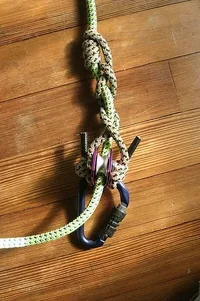
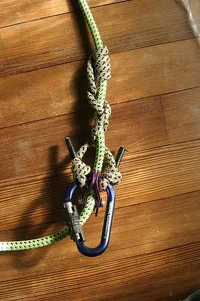
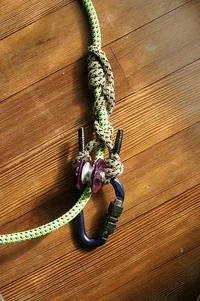
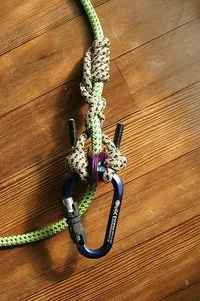
friction hitch woes

Not too long ago I stopped using the Blake's hitch in favor of french prusiks on a eye/eye split tail. While I've generally thought them too good to go back to the Blake's hitch, I've got one main concern. How do you keep the knots from loosening up during ascent?
Seems that every time(which honestly isn't very often)I'm body-thrusting any significant distance my knot opens enough to where it won't grab at all, unless I squeeze it while I ease my weight into the knot. A bit of a stretch to call that self-belay. While the constant friction of the Blake's hitch was a bit of a bummer while ascending, it was nice to know it was there if I slipped or let go. Can a little more security be built into these knots?

I've been monkeying with the V.T. and the Schwabisch, most recently favoring the latter. My side-work kit is a tenex split-tail and a Samson blue-streak line and also an older Wall pro-spec 16 strand line. At my regular job I climb on a New England HRC split tail with a 1/2" Yale XTC line as well as 1/2" Black Max from Bailey's.

If I was climbing daily I might have sorted this all out by now, but today was a more typical day for me, I planted two magnolias with a group of 200 7th and 8th graders.

I know a lot of this just gets into personal preferences, but I'd appreciate some thoughts on the matter.
Thanks.
 
This is a great question and I wish I had an answer for you because I'm having the same issues. I'm currently using the distal hitch after having used the blakes for years.

I would like to try the V.T. but have heard that you need constant tension on it to keep it from slipping.

I think I'm going to go back to my old blake's hitch till I get some hands on training on the V.T.

I'm sure some people here will have some good suggestions for us.
 
I had this same problem with the distel. I think it just didn't have enough wraps, but when I added a wrap, it became way to tight for me, so I switched to the V.T. and never looked back. A great knot.

When I body thrust up the trip, I usually keep going until I get to a branch to stand on, then take the slack out. I've never had slipping problems, and even after body thrusting, it still grabs.

I know this probaly dosen't have any real effect, but have you guys tried an 11mm or 11.5 or 11.7mm rope, like P.I., Fly, Velocity, Tachyon, etc. I use mine now with P.I. and its the smoothest rig

I've run so far. Hope this helps!
 
I'm no VT expert, but I think the length of the "legs" of your hitch (i.e. the amount of cordage between your hitch and your carabiner) affects how readily your VT grabs.

As you know there are a lot of factors to getting the more advanced hitches to work for you. Mark Adams articles on Friction Hitches in the Articles section is a great reference for different hitches.
 
It is virtually impossible to recommend a standard VT set up that will work for everyone since the climbers weight, the diameter of hitch cord, the diameter of climbing line, and the desired "feel" of the hitch will be different for everyone. If the hitch isn't holding for you as well as you would like you may want to add another wrap either up top or another braid down low to increase the resistance.

Many climbers are moving to "XT" variations as the extra twist seems to hold the knot together better and decrease the possibility of the hitch opening up on you.

For me the fact that the VT, XT, and other hitches occasionally will open up you is a feature that I actually like. This way I know for a fact that I need to pay attention to my hitch at all times and can never take it for granted. The way I look at it the more attention I pay to the hitch the safer I will climb.

I agree with Cory that Mark Adams article is a terrific reference for those working on climbing hitches.
 
I switched to the VT from the blakes a while back and did find I had to play with the combinations until I was happy with the number of wraps and braids for the specific cordage and line. I will continue to do that as my ropes change. I climbed 5 90' oaks yesterday and found the self-belay effect of the VT great. Like Rich H said it makes you check your hitch which is a great safety feature. Too many accidents occur when someone isn't paying attention to attachment points.
 
Nice points, Rich. However, when you say this...
[ QUOTE ]
For me the fact that the VT, XT, and other hitches occasionally will open up you is a feature that I actually like. This way I know for a fact that I need to pay attention to my hitch at all times and can never take it for granted. The way I look at it the more attention I pay to the hitch the safer I will climb.

[/ QUOTE ]
... it reminds me of the guys that say they're safer when they don't wear a helmet, because now they have to be extra careful not to hurt themselves!

I love sitting back into my Ocean Polyester and it grabs immediately. I most often visually check the hitch before I lean on it, but usually my hand is on it already. If you want to use a high performance hitch, you need to take the time to set it up right and then adjust it when necessary.
 
Like has been said with the vt it's all in the number of wraps, braids and tress cord length. It must be customized for every cord, rope and climber weight.
 
[ QUOTE ]
It is virtually impossible to recommend a standard VT set up that will work for everyone since the climbers weight, the diameter of hitch cord, the diameter of climbing line, and the desired "feel" of the hitch will be different for everyone. If the hitch isn't holding for you as well as you would like you may want to add another wrap either up top or another braid down low to increase the resistance.

Many climbers are moving to "XT" variations as the extra twist seems to hold the knot together better and decrease the possibility of the hitch opening up on you.

For me the fact that the VT, XT, and other hitches occasionally will open up you is a feature that I actually like. This way I know for a fact that I need to pay attention to my hitch at all times and can never take it for granted. The way I look at it the more attention I pay to the hitch the safer I will climb.

I agree with Cory that Mark Adams article is a terrific reference for those working on climbing hitches.

[/ QUOTE ]

Rich, I thought the whole first part of this post was right on the money, very well stated. Then in the 3rd paragraph you kind of went off the deep end. I know a lot of guys will agree with you but I think it is a wrong statement. The hitch not ony needs to work smoothly and efficiently, it needs to be trustworthy as well. There are moments when you need to respond to a given situation quickly. There may not be time to glance down or fiddle with your hitch. You should be secure in the fact it will do its job.

If that is not the way it is, my recommendation is to keep experimenting and adjusting until you find a satisfactory knot combination for your given situation.

D Mc
 
The VT is very customizable. For a VT that grabs consistently you need a cord with a soft hand (new england Sta-Set is a good choice) and to tie the knot with short legs.

As others have mentioned, everyone can find a setup that works for them with a VT, it just takes a little tinkering.
 
Funny you should mention Sta-set with short legs, Gord. I find OP(which has a firm hand) works best with longer legs! Goes to show how user-specific things need to be.
 
[ QUOTE ]
Nice points, Rich. However, when you say this...
[ QUOTE ]
For me the fact that the VT, XT, and other hitches occasionally will open up you is a feature that I actually like. This way I know for a fact that I need to pay attention to my hitch at all times and can never take it for granted. The way I look at it the more attention I pay to the hitch the safer I will climb.

[/ QUOTE ]
... it reminds me of the guys that say they're safer when they don't wear a helmet, because now they have to be extra careful not to hurt themselves!

I love sitting back into my Ocean Polyester and it grabs immediately. I most often visually check the hitch before I lean on it, but usually my hand is on it already. If you want to use a high performance hitch, you need to take the time to set it up right and then adjust it when necessary.

[/ QUOTE ]

I agree with this post.

Perhaps it would help if we referenced the hitches introduction as it appeared in Arborist News minus the illustrations. People put much thought into presenting this hitch to us for our benefit.

http://www.collegetermpapers.com/TermPapers/Science/The_Study_of_Cow_Shit.shtml

Joe
 
[ QUOTE ]
[ QUOTE ]
It is virtually impossible to recommend a standard VT set up that will work for everyone since the climbers weight, the diameter of hitch cord, the diameter of climbing line, and the desired "feel" of the hitch will be different for everyone. If the hitch isn't holding for you as well as you would like you may want to add another wrap either up top or another braid down low to increase the resistance.

Many climbers are moving to "XT" variations as the extra twist seems to hold the knot together better and decrease the possibility of the hitch opening up on you.

For me the fact that the VT, XT, and other hitches occasionally will open up you is a feature that I actually like. This way I know for a fact that I need to pay attention to my hitch at all times and can never take it for granted. The way I look at it the more attention I pay to the hitch the safer I will climb.

I agree with Cory that Mark Adams article is a terrific reference for those working on climbing hitches.

[/ QUOTE ]

Rich, I thought the whole first part of this post was right on the money, very well stated. Then in the 3rd paragraph you kind of went off the deep end. I know a lot of guys will agree with you but I think it is a wrong statement. The hitch not ony needs to work smoothly and efficiently, it needs to be trustworthy as well. There are moments when you need to respond to a given situation quickly. There may not be time to glance down or fiddle with your hitch. You should be secure in the fact it will do its job.

If that is not the way it is, my recommendation is to keep experimenting and adjusting until you find a satisfactory knot combination for your given situation.

D Mc

[/ QUOTE ]

I think you may have misunderstood me there. The hitch I tie is a 4/1 XT or if using a pulley (most of the time) a 5/1 XT. My hitch grabs about 99.9% of the time which is probably a little better than average for any hitch. Even with the Anchor Bridge I get a consistent grab virtually every time I sit back on the hitch. This hitch will even hold using a hitch climber pulley which is known to have more of a problem with the knot opening up. (due to the close proximity of the anchoring carabiner and splice or anchor knot) Because of the fact that there is still the 0.1% chance that the hitch will not hold I make sure that it is holding prior to climbing. In my mind this makes me safer because I check the hold every time instead of taking it for granted that it will hold. Your situation may be much different than mine, but that is the beauty of climbing, we are all different.

***For the record, I am not bashing the hitch climber pulley in any way, shape, or form. It is a beautiful tool that works perfectly for a lot of climbers and has a ton of applications other than tending your hitch. My comments regarding it are a result of working with and talking to a ton of climbers of every skill level and their experiences with its use.
 
[ QUOTE ]
I think you may have misunderstood me there.

[/ QUOTE ]

Rich, Yes, thanks for the clarification. 99.9% is as good as it gets. I just wanted to make sure that people that are experimenting with these knots continue to strive for the proper feel and not settle for a knot that doesn't grab consistently. Tending should be second nature to all climbers.

D Mc
 
and the last one, one is 4 coils up top and the other is 5 I got them from another thread when I had asked about it. The only noticeable difference is that it takes a turn around the leg from the top coil...if that made sense.
 

Attachments

  • 126778-xt4.webp
    126778-xt4.webp
    63.4 KB · Views: 209

New threads New posts

Back
Top Bottom