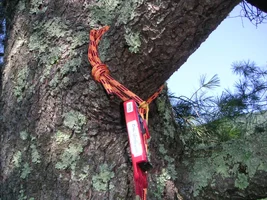
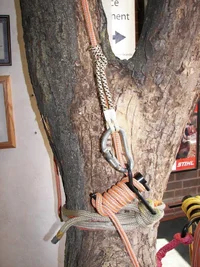
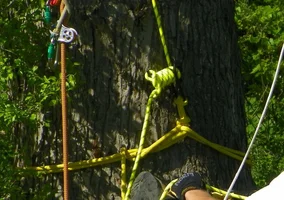
floating ancor points

I want to have a few different climbing techniques and options so that I can climb each tree efficiently and safely. I see pros and cons to all the systems, and if I had SRT and DRT, I could use each appropriately.

 
[ QUOTE ]
Thanks for the input. I prefer DRT, and wouldnt use a floating anchor every time I used SRT. But I see it having a time and place. I was thinking of using a french prusik above the top ascender, and have 2 of the steel cambium saver rings in the loop that comes down and having my DRT into that. If I had a marlin spike below it, is that legit assuming everything is rated?

[/ QUOTE ]

Sounds good to me.
 
i personally like the retrievability of of a Ddrt climbing system which you have none of with srt unless you work the ground man or tie a throw line to your running bowline
 
Using rings on the rope is a simple and non gear intensive method that I learned at the internationals. I will try to post some pics on how to set it up.
 
"i personally like the retrievability of of a Ddrt climbing system which you have none of with srt unless you work the ground man or tie a throw line to your running bowline"

I run my srt rope all the way back down to a ground anchor and have no problem retrieving the the system. Most the time it's easier than getting the Friction Saver down.
 
Just happen to have a nice pic of the throw line attached to the bowline. A floating anchor won't have worked here seeing with 150' of rope and a 70' tip didn't leave much rope for lowering. Does that mean that if you have a floating anchor your tie in point must be only at 1/3 the length of your climbing line? What's the way around that problem? Didn't read the article but will later.
 

Attachments

  • 240452-PICT0005.webp
    240452-PICT0005.webp
    434.7 KB · Views: 151
That setup looks very good.

In an emergency/rescue situation you could lower the climber from the ground.
 
Yep, I jumped the gun on that one. I read the first post and looked at the second attachment. Ha! Old and Blind is my excuse. ;-)
 
[ QUOTE ]
Does that mean that if you have a floating anchor your tie in point must be only at 1/3 the length of your climbing line? What's the way around that problem? Didn't read the article but will later.

[/ QUOTE ]

Yes, if you have a 70' TIP and you plan on lowering a climber back down safely, you need at least 210' of climbing line. Don't really know a safe way around that.

I personally setup my floating anchor with 200' of KMIII and keep my TIP at a reasonable height.
 
[ QUOTE ]


I personally setup my floating anchor with 200' of KMIII and keep my TIP at a reasonable height.

[/ QUOTE ]

the higher the better!
 
In most commonly used ground anchor SRT setups it would take three times the TIP--->ground length rope. There is a way to get around this long rope length.

If the ends of the rope are tied together into a loop a shorter rope can be used.

Of course the rope would have to have a direct path from the anchor side to the TIP. Or the intervening redirect branch unions have to be large enough to allow a large diameter knot to slip through.

Another option is to use a second rope tied to the climbers rope. When I've done this I tie the second rope on above the friction device when I was using one. Now, I use a trunk wrap with a friction hitch [Klemheist] loop for a brake.
 

New threads New posts

Back
Top Bottom