Flint locker retrieval

So what is the benefit over one ring/ biner girth- hitched on the eye of a butterfly?

Do you mean where the ring/biner/quickie is attached to the rope?

I like to plan routes where I can descend from my tie-in downwards. I find in some trees it's more efficient for me to redirect through branch unions and not plan to return from where I came from. By the time I'm on the ground I'll have taken multiple redirects. If my canopy anchor involves tying hardward to my line, as I pull it down the angle becomes tighter and tighter and can be impossible to pull my working end through.

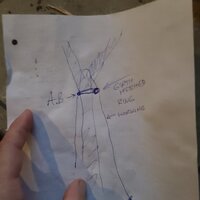
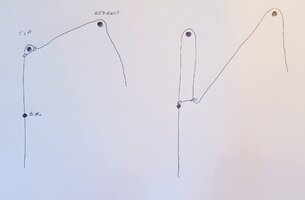
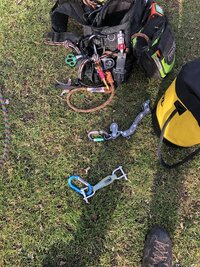
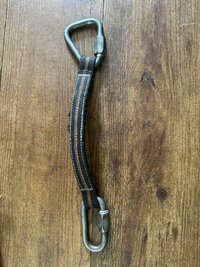
I have used a single ring, knot blocked. It works okay. I was hoping to come up with a mid-line attachable alternative. I made a flint locker type system with a quickie, sling and ring. I can take it apart and use the parts for other applications, so I feel like it's fairly cost effective.


I don't get it.

Why not girth hitch the ring onto an (adjustable size to the situation) alpine butterfly, then thread the end through the ring?
Do you think the FL helps significantly over this idea, using one ring/ screwlink/ connector?
 

Attachments

  • 17001472500931964467812041473967.jpg
    17001472500931964467812041473967.jpg
    419.3 KB · Views: 32
Do you think the FL helps significantly over this idea, using one ring/ screwlink/ connector?
With the Flint Locker, as you retrieve your line, the friction saver can float somewhere between the blocking knot and the TIP. I assume it would be wherever the resistance is least, depending on where the first redirect point is in relation to the TIP. With your method, or the one in the video, the friction saver is forced to come down with the knot, increasing the bend radius and friction on both the working end ring and on the redirect limb, until the working end is free from the first redirect (or any other limbs it might hang on during retrieval).
 
Yea, I use an ISC wizard with a rated gate, and clip an alpine butterfly. I agree that it seems to accomplish the same effect. I still don't see how any of these are beneficial for redirected retrieval. How is any of this better than the rope just hanging through branch unions at modest angles? The issue for me thus far is that the bend in the rope gets sharper as the ring/biner/FL gets pulled away from where it was anchored. So far, if I do re-anchor like that, I will be returning to undo that before descent. I have given up up redirected retrieval, as it seems to take more effort to pull the rope out of that mess than to climb back to the TIP and descend.
 
I already had one quickie and the dog bone from a rock climbing quick draw…

Which is what the guy in the video is using minus one quickie/ sub screw link.

Also works as a cinch anchor on a spar.
Don't get me wrong, it's got a lot going for it. I have rings and slings and no quickies, so I'll be trying to use what I have laying around.
 
Also, another difference between canopy anchors with a quickie on a butterfly or something is that you can simply pull your rope back through the whole soft 8, if you use a knot block unattached to the soft 8. So not only does the soft 8 float, but you can pull the rope back through the redirects and the soft 8. Can be stiff but does pull out even with some fairly sharp redirects close to the soft 8. But most of the time it pulls out with little friction.
 
Last edited:
While it might be frowned upon...
Anyone try a ring open or quickie connected to a pinto on the retrieval side?
Or shackle pulley? Isc quick link if they can fix that thing ....
 
Last edited:

New threads New posts

Kask Stihl NORTHEASTERN Arborists Wesspur TreeStuff.com Teufelberger Westminster X-Rigging Teufelberger
Back
Top Bottom