Tony
Carpal tunnel level member
- Location
- Lancaster, PA
Also, I would only use a rescue f8. The "ears" are essential in this application.
Tony
Tony
Follow along with the video below to see how to install our site as a web app on your home screen.
Note: This feature may not be available in some browsers.
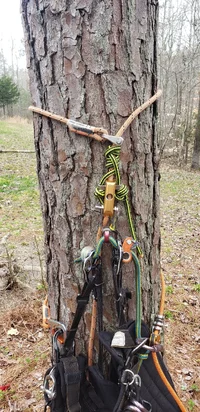
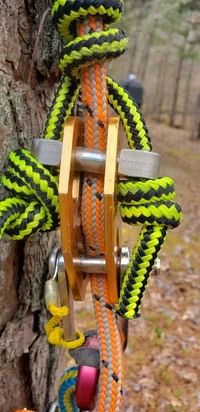
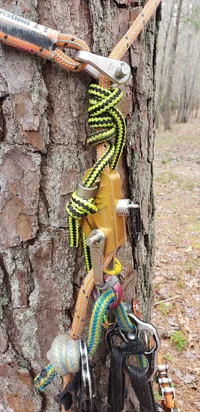
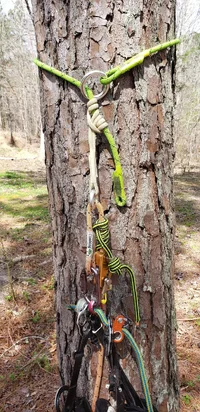
Probably how I would do it given the scenario with the gear that is normally in my bag. Photos below. In a single configuration I use the anchor cinch as my lanyard on the way up, or in conjunction with my lanyard. If I have to pass the victim's lanyard to attach above I can do that. Using my prototype added friction for The Hitchhiker X I can hard connect with the victim and bring us both down on that single line. If I want to do it in a double rope configuration, I use the ring to ring I have, using it as a lanyard, spiking up the tree and or in conjunction with my lanyard, once I reach the victim we can both come down on the doubles moving rope as it is the added friction on The Hitchhiker X. If mechanical advantage is needed two lists the victim I can do so with a 3:1 on the single rope or a 5:1 with the addition of a single prusik or rope grab.I believe it is by definition set from above the victim. This is a very specific scenario, pick off an injured/disabled climber off a spar with the rescuer using a DdRT system. The original post did not detail the overall scenario but from the looks of it the rescuer spikes up the spar (or swing/traverses) from a nearby tree if available and efficient) and installs the anchor above the victim. The F8 does the friction mediation job simply and with inexpensive gear that most climbers have at hand. I like it.
I imagine most trained arb rescuers would think in terms of installing an anchored/redirected lowering rope, belayed from the ground with any of the "whistle test" belay devices rated for the use. This approach allows a simple solo rescue for example in a two-person crew where a third person is not available on the ground to perform the belayed lowering and there are only two lines in play, the victim's and the rescuer's. Assumption is the victim's line is damaged or not trusted. Another tool in the mental kit.
-AJ




I believe it is by definition set from above the victim. This is a very specific scenario, pick off an injured/disabled climber off a spar with the rescuer using a DdRT system. The original post did not detail the overall scenario but from the looks of it the rescuer spikes up the spar (or swing/traverses) from a nearby tree if available and efficient) and installs the anchor above the victim. The F8 does the friction mediation job simply and with inexpensive gear that most climbers have at hand. I like it.
I imagine most trained arb rescuers would think in terms of installing an anchored/redirected lowering rope, belayed from the ground with any of the "whistle test" belay devices rated for the use. This approach allows a simple solo rescue for example in a two-person crew where a third person is not available on the ground to perform the belayed lowering and there are only two lines in play, the victim's and the rescuer's. Assumption is the victim's line is damaged or not trusted. Another tool in the mental kit.
-AJ
Also, I would only use a rescue f8. The "ears" are essential in this application.
Tony