Fat Boy Deodar Cedars

mdvaden

Participating member
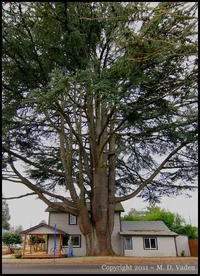
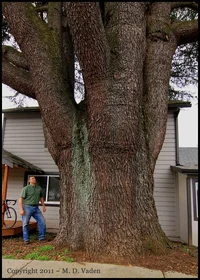
After a couple of years of putting off measuring a Deodar Cedar trunk, I took some time to swing by today. A man in Bend Oregon emailed and called twice the past month, asking about a huge evergreen he had seen near Sherwood, Oregon. He did not know what kind of tree he had in mind, but I knew he had to mean this one. I knew the trunk was huge, but it was the height that was a small surprise. I did not think it reached 100 feet. On a point system, it should be near 394 points. 113 feet tall. 256 inches circumference. Canopy 93' x 111'. The dbh is 6.8' - just under 7 feet.

If you have any fat boy Cedrus pics, add them in replies.

265686-deodar_cedar_600.jpg
 

Attachments

  • 265686-deodar_cedar_600.webp
    265686-deodar_cedar_600.webp
    176.8 KB · Views: 34
The house is about 1894. The new owner does not know the tree type, age, or anything other than it got some pruning. I think prior to it being listed. I noticed that the National Big Tree registry .pdf did not have any Cedrus at all on it's list.

265687-deodar_cedar_600B.jpg
 

Attachments

  • 265687-deodar_cedar_600B.webp
    265687-deodar_cedar_600B.webp
    169.9 KB · Views: 31
Massive and impressive cedrus, Mario!! I've worked on some great specimens of all three of the species, but none that large. The Wa record trees are:

Atlas- 310 pts, 107' tall, 16' girth, 99 width

Deodar 281, 84', 14'8",

Lebanon 281 101' 12' 2"

all were measured 1993-1995. So they'd be a fair bit larger today.
 
Got a note in reply from Robert Van Pelt, mentioning that he and someone else has measured this tree back around 1996. Said it is a champion at present. But also said he knows of some taller and wider ones. Bob said it's an Atlas Cedar, which makes sense in light of all the upright stems. He said the last measure for it was 100 feet tall and 16 feet and 8 inches circumference (with exclamation about the quality of soil). That's a big girth increase in a short span of time to reach 21 feet & 4 inches by 2011. And 7 feet height gain is decent for an old tree too. Anyhow, it seemed like someone had to have measured this tree before considering it is in plain view.
 
Cool photos Mario, I haven't seen any cedrus around here that nears that size. Some of the larger ones usually have a lot of broken limbs and stems, this one looks youthful relatively. Was it planted around 1894 or is it's age unknown?
 
[ QUOTE ]
Cool photos Mario, I haven't seen any cedrus around here that nears that size. Some of the larger ones usually have a lot of broken limbs and stems, this one looks youthful relatively. Was it planted around 1894 or is it's age unknown?

[/ QUOTE ]

Age unknown.

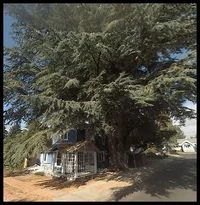
I was looking at the spot on Google Maps again today, and the street view thumbnail caught my eye. This "Atlas" Cedar is archived pre-pruning. Here's the screen shots. Sort of reinforces my thought that the pruning could have been a bit less, like 15% less.

266072-Cedar_GE_A.jpg
 

Attachments

  • 266072-Cedar_GE_A.webp
    266072-Cedar_GE_A.webp
    94.1 KB · Views: 31
Wow! What an amazing tree! I was thinking "Atlas" as well, just with the form of it. Top ten favorite tree. Awsome Pictures!
 
Thanks for the great post, Mario. That is a monster. I removed one about a year and a half ago in Portland that measured about 4.5 ft DBH and it had 8-10 stems (each stem about 2ft DBH) at around 40 ft and each stem was itself about 40 ft. It had been topped.

Was this tree topped, say 50 years ago?
 
[ QUOTE ]
Thanks for the great post, Mario. That is a monster. I removed one about a year and a half ago in Portland that measured about 4.5 ft DBH and it had 8-10 stems (each stem about 2ft DBH) at around 40 ft and each stem was itself about 40 ft. It had been topped.

Was this tree topped, say 50 years ago?

[/ QUOTE ]

50 years ago was 1961.

Keep in mind that the Columbus Day Storm hit the Portland area, Columbus Day, 1962.

Are you familiar with that storm. It's historic, and a lot is online about it. Bigger than the "perfect storm".

That storm may have done some damage.
 
I am aware of that storm and I have worked on many trees which I estimate were topped in the years immediately following the storm. The paranoia ran deep, it seems.

The stems on this cedar seem consistent with the branching of the species, although the fact that they all sprout out from a common height makes me wonder about whether it had been reduced, topped? Probably not because it is doubtful it would have been topped at that height. I can't for certain say. Do you have any pruning history for it? I agree that a tad less would have been just right, too.
 
We have a fair amount of deodar in central TX, but no Atlas. They are almost always single stem, but occasionally double stem a ways up, probably due to storms. Anyway, from my days back east I remember Atlas cedars looking more like this one, often multi-stem, and with more compact bundles of shorter needles. The deodar needles here are longer and thinner than Atlas needles I've seen in the east and NW. Has this one been positively ID'd? Either way, it is a beauty! Thanks for sharing the photos.
 
[ QUOTE ]
We have a fair amount of deodar in central TX, but no Atlas. They are almost always single stem, but occasionally double stem a ways up, probably due to storms. Anyway, from my days back east I remember Atlas cedars looking more like this one, often multi-stem, and with more compact bundles of shorter needles. The deodar needles here are longer and thinner than Atlas needles I've seen in the east and NW. Has this one been positively ID'd? Either way, it is a beauty! Thanks for sharing the photos.

[/ QUOTE ]

My further reply above, mentioned Robert Van Pelt identifying it as Atlas Cedar.

Pretty sure that's right for several reasons. One, the branching or upward stems. Two, the color. But third, the twig tips are more straigh: not so much droopy. Around here, Deodar twigs tend to be droopy, almost the way western hemlock twig ends are. Graceful. But the Atlas Cedar twig ends seem more straight.
 
It may put on another inch circumference before summer is over.

At that rate, maybe 40 more inches circumference in 10 years. Bet you would have seen 21' & 8" had it been pruned a little less vigorously.

That tree is a beast.

bigeyes.gif
 
It was mentioned that Van Pelt thought it a Cedrus atlantica. My own impression was that of a Cedrus libani. The recent subsumption of atlantica back into the libani epithet (Kew) is helpful here. There was only faintest blue over the leaves, which were mostly darker green. I guess the form decided it didn't need the suntan lotion.
 

New threads New posts

Back
Top Bottom