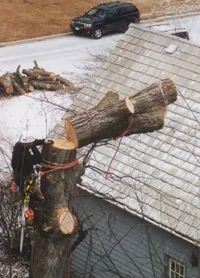
"Extreme Rigging"

Re: \"Extreme Rigging\"

I don't know... it seems slower to me. Pull up drill and lags. Install lags. Lower drill and lags. Pull up chainsaw. Lower chunk. Remove lag. Chip/load chunk.

Where is the time savings?
 
Re: \"Extreme Rigging\"

damnmate.gif


att.gif


I'm not being personal or patronising Contract - just a general observation. Instructor risk I suppose (coming across that way). No hard feelings at all - this is hardly the best classroom to discuss this without visual aid.

We could discuss this until the cows come home - in fact they've been milked several times I'd say.

Thanks for your thoughts and actually trying the technique on big stuff (safely) jonseredbred. 3 times and the lags didn't pull or snap. Thats good news! Never had a go with a tub grinder - I expect the novelty soon wears off, but at least such jobs give us time to think (as long as you don't pick up a nosey horse and drop it in by mistake cause you're thinking lags!).

The ropes in the article I broke were fuse failures. Remember the euc log in the hobbs v grcs vid?

Anyway, for those that don't want to do the math, run it through 'Rigging 1.0' programme. Time issues are secondary to the math and safety. If it takes me a half day longer doesn't matter, as I am employed not to take unnecessary risks, which the lag technique could be until I run the tests.

Mahk - 'chogging', a great Brit term! This technique could be considered controlled chogging of cookie cuts.

The article and this discussion has served its purpose of opening our minds.
cool.gif


Time to go to work!
 
Re: \"Extreme Rigging\"

[ QUOTE ]
Care to tell us your alternative Norm?

[/ QUOTE ]

I use a double braid eye sling for the block and a double braid lowering line to lower the wood.
From what I understand, the lag catches the wood. If a lag is catching the wood there is no shock absorbtion. If a synthetic sling is catching the wood, there is minimal shock absorbtion. Right??
 
Re: \"Extreme Rigging\"

I sense you all are growing weary of this thread, but I wanted to post the results of a little research I did from an engineering perspective.

I located an online copy of:

Forest Products Laboratory. 1999. Wood handbook--Wood as an engineering material. Gen. Tech. Rep. FPL-GTR-113. Madison, WI: U.S. Department of Agriculture, Forest Service, Forest Products Laboratory. 463 p.
Wood Handbook -- Wood as an engineering material

From Chapters 4 & 7, I threw together a "quick and dirty" spreadsheet which calculates the "max withdrawal load" for a lag screw in different species of wood. You can play with it yourselves if you like, but by way of example, for a lag w/ 3/4" diam x 10" length, the max load is around 31,000 lbs.


There are other things to consider, but I wanted to at least give an idea of the potential holding capabilities of a threaded fastener like a lag screw.
 
Re: \"Extreme Rigging\"

You're a rational guy TomNJ - like your style; dig deep enough and you get to the bottom of something.

Thats great info - 31,000lbs - Phew! Nothing to worry about there then. Which is what I hoped, so its still lags snapping then that is an issue (if indeed it is an issue with steel lags and minimal fall force/shock).

Thanks for your method norm. But what materials and diameter? What size sections? I prefer to run a 7:1 safety factor on my slings and 10:1 on the rope. Which is why I decided to cut cookies of 4' wide by 1' long and clip to lags. The sling would absorb some energy, especially with streeeeeeetch from a lump like that. I feel its better to forget the sling, lower the fall energy with cookies and use a nylon rope for energy absorption. Setting lags is easy. Clipping to lags is even easier.

Anyway - starting to repeat myself!
goodnight.gif
 
Re: \"Extreme Rigging\"

At this point I suggest the way forward is to look for opportunities to aquire footage of our various techniques in relation to this task. I'm happy to make the effort and come back and hopefully gain further ground on the topic. It takes a little more than that to offend me laz, no worries mate, but sort out your footage.
 
Re: \"Extreme Rigging\"

To promote proper interface with hardware and software it would be paramount to use a rigging line with a spliced eye and a thimble large enough to provide the proper bend ratio for the rope. Tying directly to the biner or the lag will stray from the principle of proper interface of software to hardware.

Still not completely sold on the idea, TomNJ's data could/should be cross referenced with a spreadsheet of pullout forces that has been posted here before, I belive by Norm Hall. I saved it somewhere but I have yet to be able to dig it up.
 
Re: \"Extreme Rigging\"

I can not see how this technique is safe or effcient. I have not tried it so I can not say if it works or not. I've been doing this for years with no problems. If you have a strong understanding of risk assesment and your equipment and the forces applied I feel this is safe and practical.
 

Attachments

  • 58518-log3a.webp
    58518-log3a.webp
    60.2 KB · Views: 226
Re: \"Extreme Rigging\"

[ QUOTE ]

Still not completely sold on the idea, TomNJ's data could/should be cross referenced with a spreadsheet of pullout forces that has been posted here before, I belive by Norm Hall. I saved it somewhere but I have yet to be able to dig it up.

[/ QUOTE ]

I certainly hope someone will check my calcs!! Like I said, "quick and dirty."
 
Re: \"Extreme Rigging\"

Nice pic Tod.

Thats what I do on stuff that diameter. Only I choke my lifeline under the block sling but above the block. Being choked it doesn't slip into the danger zone of block chop or rope burn, and if the sling shifts down on it it still doesn't budge. It gives a nice distance between both life-line and lanyard so not both get cut should the spurs slip on a back cut (A particular worry for me when training novices).

The sections I'm talking about are at least twice that diameter.

Last two posts on Arborist site on this topic got some positive feedback. I know there are some rigging gods out there that use this technique. They're not the computer types though (unsurprisingly), but it'd be nice if they chimed in.
cool.gif
 
Re: \"Extreme Rigging\"

Laz, have you actually used this technique on sections of the size you describe. If so as you say, the initial article was written years ago, I would have expected you to have had ample opportunity to apply the technique and at the very least take a photo or two in the process.

May be Ive misunderstood here, I tried to explain and document a technique that Ive actually used successfully, and not one that I thought might work in theory. Please tell me you've actually used the technique you've defended so passionately. Really hope I'm mis-reading between the lines on this occasion.

Also, the riggers you say used to use the technique, why did they stop? why has the technique not stood the test of time as others have?

Maybe the riggers realised it wasn't the best idea they'd ever had and buried it. Need some clarity here laz. what do you say mate
 
Re: \"Extreme Rigging\"

Interesting article. Getting outside the box. There have been times where I've found myself thinking - "if only there was a way to put a hole through that piece of wood and tie-off to that. It would have been so much easier than notching and using a marline hitch or or half hitch". After many eucalyptus (smooth smooth bark) over many nice houses in California - this idea would have been worth trying a few times. I just never had the gear or thought to give it a shot. Like anything, it wouldn't always be the "best" way to go - but in the line of thought where safety is a priority, I can see this as a very reasonable possibility. Knowing the right balance between minimalism and over-gearing is an art as well as science... :)

peace,

matthew

this is so cool!

|
|
V


"Ken explained he used to use a chest pocket full of straws filled with ball bearings and their tops folded over. He'd blow the ball bearings into the kerf, then the cookies could be rotated wherever with ease."
smile.gif
 
Re: \"Extreme Rigging\"

The "blow the ball bearings into the kerf" thing...

SAY WHAT???
 
Re: \"Extreme Rigging\"

I think this "extreme rigging" idea is a waste of time.

However, let's pretend that someone had the time and money to set up a relatively controled experiment/competition. Set up two seporate 50" posts (like they do for timber sport comps). Post #1 will be the conventional/proven way of taking down wood. Post #2 will be the "extreme rigging" way.

So, Butch gets to climb post #1. I've seen him spike up stuff, he's fast! He cuts a notch, places his block, and makes his back cut. The groundie does a great job with letting the wood "run" and Butch is "kissing the sky."
applaudit.gif
Butch is crusing! He does about 6 or 7 of these until he is has a safe length of tree to fell. Done!

So, the mystery climber gets into post #2. He/she (politically correct by the way) organizes the lag bolts, makes sure the battery is charged on the 24 volt cordless drill, and starts up the post. (Imagine a cheesey sports announcer voice on this one)Great! 1 hour later (and 3 exchanges of batteries) the lag bolts are in place! Then the climber procedes to lower large sections of wood. Everything goes smoothly. However, little did the mystery climber know, Butch went home with the prize money (and the Stihl model)
applaudit.gif
during his "extreme rigging" efforts.

Bottom line:

This "extreme rigging" will never be faster, safer or cheaper for the customer.

Can I get a cheers to that?

beerchug.gif
 
Re: \"Extreme Rigging\"

A funny thing happened yesterday. I explaining this technique to a colleague, he predictably ridiculed and dismissed it as nonesense,. Couldn't believe I actually found myself defending it, but here's why. Although I have total confidence in my own prefererd solution to the problem as I'm sure the other participants in this debate have in their's, if I'm honest, I would have to advise a 'novice' climber to favour the lag technique over my own. Purely from a safety standpoint the lag technique, with limmited caluclated forces involved and the correct task specific equipment issued (although this still needs to be clarified), would be more predictable and require fewer 'judgement calls' for the 'novice' climber, making it the safest method when their is a need to safely lower standing timber of this profile, at this level of expertise.

Slower, labour intensive, repetative, yes but easily explained and implemented, requiring only a basic level of skill and experience. Perhaps it does have it's place but obviously require's further research and experimentation in order to establish safe working guidelines.

I personally find it quite stressfull watching and worrying about the safety of groundsmen working below, If I was teaching and responsible for the safety for learner climber's, all risks taken into account, it would have to be a case of slowly, carefully, surely. All depends on whose risks your weighing up I suppose. Make any sense ?
 

New threads New posts

Back
Top Bottom