Experimental Pruning

Is this kind of tree management too extreme?

  • Yes

    Votes: 9 52.9%
  • No

    Votes: 3 17.6%
  • It's worth a try to save an old tree for a few more years

    Votes: 5 29.4%

  • Total voters
    17
One theory is; active buds send stimulation, in the form of hormones like cytokinin, to the roots. Less active buds = less root growth.
Another more visible, palpable theory; Long limbs wave in the wind, which stimulates the flare and buttress roots to expand. Shorter limbs > less waving > less buttressing > less impact on wall.

There are others, but the bottom line imo is: First do no harm. If the wounds close, no harm is done. That tree's gonna make enough starch next year to restore health. What else matters?
JK's got the best idea: prune the wall!

This kind of pruning is done all the time, all over the world (and in my avatar!). It's good to consider it an experiment in terms of monitoring and recording, but there's really nothing experimental about it.
Nothing experimental or bad about Paclobutrazol either. ;) O and improving soil on the other side of the flare might also lessen root growth on the wall side.
 
Last edited:
If you are going to pollard a willow, those stems have got to be taken down a lot lower I think. At present it does look a little like topping and it probably will have negligible impact on the wall issue--it'll sucker up fiercely next spring and keep putting down fat growth rings.

This is all being done for a beautiful willow tree? Makes me think of what Jomoco used to call a rent-making scheme.

Maybe basal pruning would do the trick?
 
Root prune, stem trace and naturalize pruning. Think over sized bonsai. It's going to be tough to renovate the ol girl. Seem to have to do crabs quite often. Last one we used the pwr shears. But a tree that size is going to take a pretty penny or two.
 
ward, the tree in the avatar was pruned with 'heading cuts' after an ice storm in 2002. I reclimbed it in September to take pictures, and suggested a light restoration prune next January--nothing urgent.

The OP's willow will need more frequent attention than a 13-year cycle, but nothing onerous. The theory that a reduced tree requires frequent and excessive maintenance is an A300/ISA myth, an unproven assumption conjured to support basal pruning as the default service that tree guys offer. iow, bs.

Rope, what part of the stem would you trace?
 
Last edited:
Wait Guy, are you saying pollarding isn't onerous?

I have never pruned a tree using heading cuts unless there is storm damage involved and I am forced into something less than ideal. In my experience, heading cuts resets the limb at that diameter and starts the new growth from the outer layers of the branch... rather than having the history of the woven more secure attachment from when the parent stem was a similar diameter. I know this is basic tree anatomy and is not news to you, but this is how I view heading cuts.
upload_2014-11-1_10-53-26.webp
If you could help me out and guide my understanding of this I would be much obliged. I respect your authority in this matter with your history of experience and study. I can see how heading cuts make for a more stable branch for the following few winters and the like, but how can it be as healthy or long term as reduction cuts back to a lateral. Leaving some extension for the tree to develop rather than reseting it to pure stress growth. I don't think heading cuts look good initially and I not a big fan of the growth that it produces.

With this willow, the pollarding is costly and even with the frequent care the stem is still going to grow and push on the wall. I say if you want to keep the wall the tree has to go and if you want to keep the tree the wall has to go. Meanwhile, the heading cuts are making for a less healthy crown. But all this is me saying so, again I bow to the all mighty Guy for true enlightenment on this matter. Thanks Guy in advance for understanding that I am not disagreeing with you but rather asking for further explanation so I can agree with you.
 
TC--I might recommend going another 2 feet in or so to establish the pollard heads. Yours are too diffuse and many to establish them. True pollarding (and I don't often do this "but when I do...") requires pulling back to far fewer clubs.
 
the wounds close, no harm is done. That tree's gonna make enough starch next year to restore health. What else matters?
At present it does look a little like topping and it probably will have negligible impact on the wall issue--it'll sucker up fiercely next spring and keep putting down fat growth rings.

This is all being done for a beautiful willow tree? Makes me think of what Jomoco used to call a rent-making scheme.
These statements make me wonder if the initial goal of this "experiment" were even on target or was it just b.s. to make the rent . I'm confused about this whole thing now. If its not going to stop the stem/roots from breaking up the wall ..which in my opinion is not a good reason to remove the tree by the way . What is the answer to what has been performed .....
 
Pollarded trees last centuries; can't be that onerous. But did we hear the OP say that 'true' pollarding was his program?

"heading cuts resets the limb at that diameter and starts the new growth from the outer layers of the branch..."

I don't understand this concept. Isn't new growth always in the outer layers?
Gilman-Grabosky: "Reduction pruning released the smaller remaining lateral branches as the new primary growth axis on the shoot more than larger lateral branches."
This follows the loss of apical dominance after the terminal is removed.
Most of the new growth is gradual, in smaller interior laterals.
Only when the reduction is too brutal does the tree 'panic', sprouting from adventitious buds hastily made at the cut surface. On the willow oaks at the car dealer, ~99% of the sprouts were from dormant buds at nodes.
But I'm no expert with S. caprea so I'll make no predictions on it!
 

Attachments

Guy is that the tree from your avatar, the canopy over the cars?

Firstly, TC the OP said:
... but I said we can retain the tree for a few years yet by carrying out a very heavy reduction and then follow a cycle of pollarding every couple of years or so.

And yes all new growth is from the outer layers, but my comment had more to do with the ratio. If the new growth is stemming from a 1" branch the attachment point will have a much stronger relation to its parent than if new growth stems from a 4" or 7" or 10". The new growth you see on a topped tree is as you said in the article,
"Many sprouts will arise from the pruning wounds. They will
grow vigorously to replace the branches that were removed.
Because they are so crowded, these sprouts will tend to form
narrow angles of attachment with included bark, making them
prone to splitting apart later on. They will cast dense shade on
the interior of the plant, causing inner branches to die. They
will reduce the flow of air and light, which creates a better
habitat for decay and pests."

This is exactly the fast, weakly attached growth I see on a daily basis dealing with topped/butchered trees in my area. This new growth from arbitrary internodal cuts is absolutely this way, but I would go further to say that even cuts at a node are not much better. Better, but not much better. The 1/3 rule is used as a guideline and can be flexible this way or that, but it serves as a reason not to cut back to leave 0/3... At a node you are likely to get more growth from that origin and not sporadic growth at odd locations, but this will still be more eager in its growth, and more weakly attached, and more likely to have introduced sun scald, decay and, pests etc ... than if you were to prune to an appropriate lateral. You did make me more of a believer in the power of the nodes, but I still will not be cutting back to Zero unless a storm or another outside force dictates it... Guy you still might have a chance of being one of those outside forces. Your article was great and I appreciate you schooling me.
:hueco:
 
Last edited:
When I said a 'cycle of pollarding' I mean treating the tree as a true pollard in management terms. I'm aware that true pollarding is carried out on young trees and is generally viewed as something very specific in terms of tree management. I used the term pollarding as a way of explaining my intention to manage the tree like a true pollard.

As far as a rent making scheme goes - no, the heavy reduction was done in an attempt to minimise annual stem thickening at the base of the tree thereby prolonging the life of the tree by abating or slowing down the stone wall being pushed out into the car parking area.

On the issue of large height/crown reductions on mature trees to prolong the life of a tree, Shigo was never against this kind of 'topping' (crude wording), he just never said it publicly because he knew it would give a green light to hackers everywhere who either didn't care or didn't understand the physiology of certain tree species that would allow for this kind of work that would prolong the life of a mature tree (making the tree more stable in high winds, reducing the sail effect etc)

For those who didn't realise. Arbitrary random cuts were not made on this tree. This was not a hackjob 'rounding over' special as used by tree hackers worldwide with their tragic attempts to look professional by maintaining a natural looking shape to the detriment of tree health ie random cutting at any point along the branch disregarding CODIT.

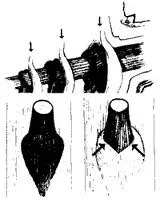
I said in the original post that I reduced the branches back to natural target pruning points (see pic below) as you would during a crown reduction or thin, only difference being I also removed any laterals as well, this is where the crossover into pollarding arises from. I pruned to Shigo's model of CODIT which naturally encourages WALL 4's reaction wood to eventually seal over the wounds. I also left on occasional small sprouts as there was no point in removing them I wasn't looking for a sterile and complete clean out of the tree.

I suspected some people would wonder why I didn't reduce back to the previous cuts (the tree was obviously heavily cut back at some earlier stage in it's life) instead of leaving the 3ft long stems. But the idea behind leaving the 3ft stems is that they are storing starches and photosynthates which will help the tree replace the lost leaf - like batteries ready to initiate and power up the new adventitious bud break next spring, the 3ft stems are also younger more active wood rather than the timber lower down the tree where the previous cuts were made years ago.

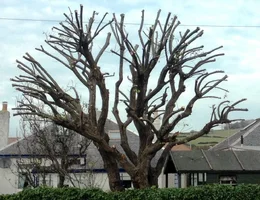
I know the tree looks hellish, but it is still there in a form which is prolonging it's life. Maybe a cycle of pollarding every couple of years wont work in minimising annual stem thickening. Depending on the growth next year I may decide to restore the crown leaving some sprouts to develop into branches and work from that point.willow 5.webp
 
Last edited:
TC,

Just to reassure you.... I am quite appreciative of your job above. The science behind your cut is as clear as day (because there aren't any branches to get in the way ;)) you are obviously a trained and experienced professional. Considering its maturity, I agree with the cuts out at smaller diameters rather than taking it back in closer to the expected location of pollard heads. The cuts at nodes were 'node'ceable to me as it is a clear demonstration that you know what you are doing. My hangups with this is that I prefer not to remove all the 'light and fluffys' from a tree. That is, I don't like the look of it for one - secondly I don't think this is as healthy as leaving laterals - and thirdly, I don't know if it will solve the problem at hand.

I would be concerned with the canopy presenting issues in the future if it weren't for your client's willingness to have you manage the tree from this point on. Often we don't get a chance to do the follow ups on a tree and are left with decisions that day as to what is best for the tree.

Great work TC. Thanks for trying where others would not, thanks for allowing us this puzzle to ponder. There are many opinions as to what is best, but you are the arborist tasked with this particular tree. This particular tree has presented you with unfavorable circumstances and you dealt with the situation with experience and skill, science and art...not so much art - the thing looks "hellish". But, I can't say what I would have done in your place. I appreciate this attempt and I look forward to seeing photos as this thing develops. Lets hope things don't develop down at the wall!
 
For those who didn't realise. Arbitrary random cuts were not made on this tree. This was not a hackjob 'rounding over' special as used by tree hackers worldwide with their tragic attempts to look professional by maintaining a natural looking shape to the detriment of tree health ie random cutting at any point along the branch disregarding CODIT. "
When I look at the photo, I think it is unfortunate that that unfortunate tree's stature and place in the world doomed it to being professionally pruned to resemble a hackjob rounding over special.
 
My bad--I missed the scheme to make this a 'true' (annually maintained) pollard. In any case i do not understand the reasoning for taking off every bit of growth. Those little laterals could have sped closure. I did this to one of my sweetgums and the cambial dieback was ugly. On another gum I left little laterals, and the closure was rapid.

TC you may not want to talk about digging to see roots, or pruning walls, but re chemicals, a growth regulator might have been cheaper and easier on the tree. You might want to consider it next time you want to regulate growth. Leaving the 3' sections avoided heartrot, and following the tree's lead by leaving vigorous sprouts makes sense to me.
Have fun with the sprouts; I hope you get paid for all the time it will take to sort them out!

JK, I was pretty much spouting dogma, repeating what was hammered into me when I supposed "Many sprouts will arise from the pruning wounds." The pics show that was NOT the case; and seldom is ime, when cuts are not large. I hate it when I lie like that; duped again. btw I'll be visiting that car lot again soon, and may remove some limbs for dissection.

Outside force? Well I only know that the 'inside' is reserved for dominant corporate interests, in the US anyway. What effects that people's efforts to bring some better-informed European experience into the A300 mix and later the BMP will have remains to be seen, but resistance, fueled by entrenched 'worst-case' suppositions like mine 7 years ago, to change is fierce.

Avatar pic is from another ice-damaged willow oak. The pic here http://www.historictreecare.com/wp-content/uploads/2012/05/restore_2010_06.pdf shows a 6" wound closed in 6 years after reduction of the damaged central leader (the definition of 'topping' in the UK).
I agree, cutting back to zer0 laterals is usually not the first choice, but it can have good results. https://www.dropbox.com/l/pRiZdR4JgJrXP7xPXmDKqu is the retrenching ppt. It's the short version. ;)
 
ward, the tree in the avatar was pruned with 'heading cuts' after an ice storm in 2002. I reclimbed it in September to take pictures, and suggested a light restoration prune next January--nothing urgent.

The OP's willow will need more frequent attention than a 13-year cycle, but nothing onerous. The theory that a reduced tree requires frequent and excessive maintenance is an A300/ISA myth, an unproven assumption conjured to support basal pruning as the default service that tree guys offer. iow, bs.

Rope, what part of the stem would you trace?
I wouldn't trace the main stem/bole for reason of inconspicuousness.
Mb 6 or more per stem/branch and only on the more vigorous parts.
Starting away from the point of attachment and spiralling up the stems spaced approximately 6 to 10" apart. The trace would be approx 2-3mm wide and 30% of stem circumference. Most times it is done with a light score with the hand saw and sometimes done with secateurs with two slicing cuts and then lifting out the tissue with the anvil of clippers.
Great technique to stimulate growth on bare limbs and leads with crown restoration after yrs of lions tailed trees or in young tree training to stimulate new permanent scaffold. Also works well with to control aggressive vines and/or to stimulate fruiting and flowering.
I do this also below ground to graft girdling roots to stem and to stimulate rooting where a roots do not exist such as in a kinked/j-root etc.

Anyone else trying this sort of thing?
 
When I said a 'cycle of pollarding' I mean treating the tree as a true pollard in management terms. I'm aware that true pollarding is carried out on young trees and is generally viewed as something very specific in terms of tree management. I used the term pollarding as a way of explaining my intention to manage the tree like a true pollard.

As far as a rent making scheme goes - no, the heavy reduction was done in an attempt to minimise annual stem thickening at the base of the tree thereby prolonging the life of the tree by abating or slowing down the stone wall being pushed out into the car parking area.

On the issue of large height/crown reductions on mature trees to prolong the life of a tree, Shigo was never against this kind of 'topping' (crude wording), he just never said it publicly because he knew it would give a green light to hackers everywhere who either didn't care or didn't understand the physiology of certain tree species that would allow for this kind of work that would prolong the life of a mature tree (making the tree more stable in high winds, reducing the sail effect etc)

For those who didn't realise. Arbitrary random cuts were not made on this tree. This was not a hackjob 'rounding over' special as used by tree hackers worldwide with their tragic attempts to look professional by maintaining a natural looking shape to the detriment of tree health ie random cutting at any point along the branch disregarding CODIT.

I said in the original post that I reduced the branches back to natural target pruning points (see pic below) as you would during a crown reduction or thin, only difference being I also removed any laterals as well, this is where the crossover into pollarding arises from. I pruned to Shigo's model of CODIT which naturally encourages WALL 4's reaction wood to eventually seal over the wounds. I also left on occasional small sprouts as there was no point in removing them I wasn't looking for a sterile and complete clean out of the tree.

I suspected some people would wonder why I didn't reduce back to the previous cuts (the tree was obviously heavily cut back at some earlier stage in it's life) instead of leaving the 3ft long stems. But the idea behind leaving the 3ft stems is that they are storing starches and photosynthates which will help the tree replace the lost leaf - like batteries ready to initiate and power up the new adventitious bud break next spring, the 3ft stems are also younger more active wood rather than the timber lower down the tree where the previous cuts were made years ago.

I know the tree looks hellish, but it is still there in a form which is prolonging it's life. Maybe a cycle of pollarding every couple of years wont work in minimising annual stem thickening. Depending on the growth next year I may decide to restore the crown leaving some sprouts to develop into branches and work from that point.View attachment 28624
I'm not critical of your pruning work ..I just don't believe that the work you performed is going to be as helpful to the goal of retaining the tree and the without combining it with some other ideas and treatments ..all of which are probable to reduce the vitality of tree , that said I hope the thing out lives us all hahahahaaa! Good luck , wiegh energy in vs.energy release and don't lose sight of what the true goal to be achieved ..if its just to retain for a few more years then slay it once it busts up the wall some more you may be on the right track.
 
"Historically, the bowl haircut was popular among common people of various nationalities as an easy and relatively neat cut by a non-professional.[1] Indeed, it was done by putting acooking pot of a fit size to the level of ears, and all hair below the rim was cut or shaved off."

Indeed it doesn't matter if a $$$ BCMA barber or a novice does that hairstyling. In the fullness of time, the hair, er limbs will grow back requiring another round with the scissors / Stihl.
 

New threads New posts

Back
Top Bottom