Quote:
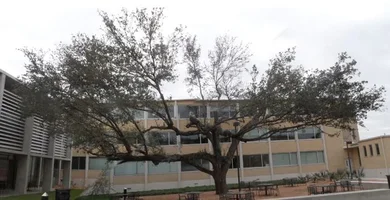
An overextended tree growing into a clearing and likely to fall doesn't have a problem; we have a problem.
In one of the few black-and-white explanations for things, trees are either volunteers or purposely put in place by us. How the tree got there isn't really an issue as much as whether or not we're going to let it stay. It's our problem, and not any fault of the tree, or in the tree.
If I'm understanding you correctly, you're saying that it is EITHER the tree growing in the clearing has a problem OR we have a problem with the tree growing in the clearing.
I didn’t say that at all. I said, trees at locations that were determined by the general processes of seed dispersal, and in that sense carried to their place by fate, are what we call volunteers. This is not a label I invented, it seems to have been used back into the 19th century. Creating a true dichotomy would be to distinguish these volunteers from the trees that are planted in a location by us, by our conscious decisions and interventions. In a way I guess we could call them conscripts, but I won’t do that and will simply call them non-volunteers.
Looking at non-volunteers, there are issues of responsibility created when we plant trees; these are well-founded in practical issues and laws involving ownership and liabilities. I can harvest the apples from a tree on my property, and I’m responsible when that tree falls on the car. If we shift the locations to public property, we also shift the ownership and the liabilities to the public owner.
Volunteer trees, almost by definition, sprout up on both public and private property and their future is tied to being left alone to grow to a significant size. Municipal arborists don’t generally care for them, and they are often times left relatively unprotected by the public because the trees are not considered part of a conscious design.
Guy’s hypothetical doesn’t state if his tree is a volunteer or a non-volunteer; I think he’s saying it is a probable hazardous tree determined by its targets, angle of lean, and other variables. I don’t think he was talking about providing tree care for that tree. (He can correct me if I’m wrong.)
And you're inclined to say that it is not the tree's problem at the end of the day - it's our problem, depending on how much or how little we care about that particular tree in that particular clearing.
I respectfully accuse you, sir, of a false dichotomy. We share this earth with trees. The trees share this earth with us. A tree's problem is our problem. Our problems are the trees' problems. We have the sentience to reason/rationalize/care and trees do not, but our coexistence on this planet necessitates a proper relationship between us, which in my opinion is shared problems.
If I am right about Guy’s context, you are creating a flawed relevance. Guy is responding to a previous post saying, “trees seem to have no problem coexisting with us, it's the people who have a problem coexisting with the trees.” Guy is not talking about shared-problems with a tree; he is only talking about that tree as a threat. It may be extraordinarily healthy, it may be exceptionally well-anchored, and it may have no included bark at all.
A position at the edge of a clearing, its angle and height are not problems
in the tree. They are our problems. That tree’s future will likely be not be determined by its health, but by the most shrill complaint that the tree will fall on some innocent’s head.
To the topic at hand, epicormic growth may be in the best interest of a particular tree (starch production, etc. mentioned above), but may not be in the best interest of the people who live locally around that tree (aesthetics, potential future failure of a poorly attached epicormic branch).
Our discussions on epicormic growth are different orders of magnitude from the tree that Guy introduced. It will be a big beast falling unexpectedly to the ground. Our epicormics are localized reactions and local people may have cosmetic opinions. They have little significance placed alongside Guy’s threat.
Some sort of compromise is necessary. Shared problem. Arborists should be there not to correctly apply the dogma of the day, but to mitigate the problem and work out the compromise.
Compromise is often artificial. Dogma becomes hollow as we learn more. Neither are necessarily useful if you want an appropriate correction. Arborists shouldn’t be lemmings. Then again, they shouldn’t be badgers either.
(Just taking someone's advice not to keep my mouth shut.)
--------------------
Robert Heiskell
You’re doin fine…
Bob Wulkowicz