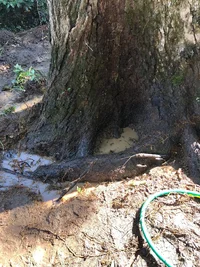
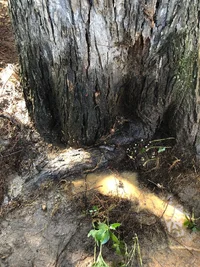
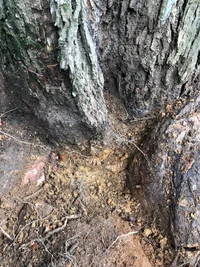
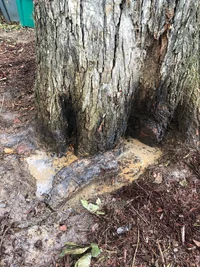
Elm Prognosis?

Think RCA over RCX
Root Collar Archeologist over Root Crown Excavator

A huge air compressor helps, short of that a small one is better than nothing.
A whisk broom.
A garden hose and nozzle...you're in luck, you have a downhill slope, washing stuff away will be easy!
A small garden trowel.
Patience.

Anything your uncover that is an important root is going to be woody and covered in bark (if you don't damage it), and not dry out, so don't worry. Anything that is a fine root can come out.

You will need some expendable chisels, small, sharp handsaw, possibly a chainsaw, but a sawzsall is way better.


What did the BCMA offer for info and treatment?

Have you watered it?
 
Think RCA over RCX
Root Collar Archeologist over Root Crown Excavator
I'm embarrassed that a BCMA would not look at the flare.
I was unsuccessful in getting RCX defined as Examination instead of Excavation. Which is grammatically incoherent, but it helps sell an established profit center. The corporate boys won that one, too. Lack of coherence helps smoke-and-mirrors marketing
Tree Inspection Procedures, from ANSI A300 Part 8
Arborists consider potential tree benefits, applicable tree care techniques, and the owner’s intended use of the site.

Arborists establish the objective (the expected outcome) based on our experience in the field and understanding of the plants. After clarifying the owner’s goals, we can study aerial maps, the ecosystem, the microclimates, the past, current and potential management of the site, soil volume, fill, air and water movement, and the plants.

Arborists write specifications (detailed, measurable plan or proposal for meeting the objective). Specify tools and practices that avoid damage to living tissue, bark or soil. Keep tools sharp and clean. Specify the method, area, and depth of inspection.

“83.3.4 Inspection should include…:

Conditions in the crown that may reflect root conditions;

Stem tissue connecting the crown and the roots;

Girdling of buttress roots or stems by roots or foreign objects, and the tree’s response;

Tree association with beneficial and harmful insects;

Tree association with pathogenic and beneficial microorganisms (e.g. mycorrhizae);

Wounds, and the tree’s response to wounds;

Mechanical damage to detectable roots, and response;

Indications of root disease and response, and

Graft unions in grafted trees;”

Mulch, soil and foreign material should be removed to allow inspection.

Bark tracing of wounds shall remove only dead, loose, foreign and damaged tissue. Evaluate decay, callus and woundwood growth, and response growth in trunk and crown.”

“83.4.1 Root collar examination objectives shall be established.

83.4.2 The method, area, and depth of excavation shall be specified. 83.4.3 Tools and equipment used in excavation shall be specified.”

Prune adventitious roots if they interfere with excavation or examination.

Protect root and stem tissue newly exposed to sunlight where needed.

Diagnose any detectable flare and root diseases and disorders.

83.4.8 The flare shall remain visible after excavation.”

“84.2.7 Specifications for monitoring and maintaining tree health and stability should be established.”

84.2.5 When root loss is unavoidable, selective pruning shall be the preferred method.”

84.4.6 If more than one large girdling root is present, root pruning over time should be considered.”

Sample specifications for RCX (root collar examinations) with hand tools

Scope: Trees with fill contacting the trunk.

Objective: Avoid damage to the tree from the effects of fill on the trunk. Lessen risk and maintenance needs, improve health.

Specifications:

Rake any coarse woody debris or fresh mulch away from the root collar area.

Press the blade of a shovel or a trowel against the trunk. Slide it carefully downward until resistance is met.

Push the handle toward the trunk, moving the blade away from the trunk.

Remove individual adventitious roots <1 cm and stem-girdling roots <1/10 trunk diameter. Manage larger roots per A300 (Part 8), 83.4 and 84.4. Avoid contact between the trunk and any remaining adventitious, girdling, and circling roots.

Lift the material away from the trunk and place it in a temporary staging area.

Separate and dispose of any infertile soil and debris. Retain the fertile soil, fine roots, mycorrhizae, and decomposed mulch.

Repeat until trunk and flare are clear, out to the root collar, where buttress roots divide. Use smaller hand tools, or compressed water or air, to complete the excavation. Commence the RCX (root collar examination).

Consider replanting the tree, if the flare is over 2” below grade and the tree has been in the ground for less than 5 years.

Remove soil and fine roots outside of the root collar to make a gradual slope.

Consider installing a device to control erosion.

Apply 2-4” of mulch over the root collar. Avoid mulch contact with the flare.

Remove the fine roots, fertile soil, mycorrhizae and decomposed mulch from the staging area. Incorporate the material into the outer rootzone.

Specify that future management will keep the flare visible.

84.4 Selective root pruning – girdling roots

Roots that encircle or contact (girdle) the trunk or a buttress root should be considered for redirecting or pruning.

Girdling roots should be exposed before pruning cuts are planned or made.

(Girdling roots that provide more benefit than damage should be retained.)

Roots that cross other roots outside the root crown should be retained.

(Avoid damage to the trunk and buttress roots beyond the scope of the work).

If more than one large girdling root is present, root pruning over time should be considered.

Moving and redirecting root growth should be considered before pruning.

 
That has been extremely helpful. The BCMA that came felt that the drought caused the effects we were seeing and didn't ever mention a root excavation so I was a little disappointed too. Very well could have a lot to do with the drought but probably not the only issue.

Wow, I thought I could get this done but I didn't get as far as I'd hoped. I was so dirty I actually took a shower before going to home depot to get mulch ha ha. I started around 12 today and had to bail. I need an air compressor, the hose and blower took forever. I didn't realize the mass of vine (smilax I think?" roots around the root collar. I pulled so many roots out of the collar area it took me a few hours to just do that, and I was careful to trace them to the vine stump before yanking them out of there. There was a vine stump in almost every notch of the collar, some of them 2" in diameter. The roots were totally encircling the collar area and I probably pulled 100lbs of roots away, I should have taken a picture of the root mass I removed, maybe this will help the tree. I hated to find a 1" deep gash about 3" long in the tree where the first guy cut one of the vines.

Here are a few shots of what I exposed. Do these roots fall in the category of "girdling?" I bailed and mulched around the area just because it was getting late and I needed to get to a stopping point.
 

Attachments

  • IMG_1094.webp
    IMG_1094.webp
    1.1 MB · Views: 31
  • IMG_1095.webp
    IMG_1095.webp
    1.1 MB · Views: 31
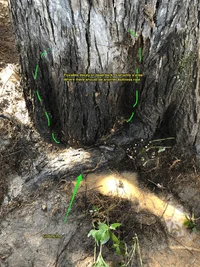
Great job! and yes Sir, it certainly is girdling roots. That sunken area in the second photo looks like it could be dead tissue. I'd tap on it with a mallet (gently) and see if the bark is loose. This with out a doubt is drought stress, not caused by drought but by the girdling roots. Also this issue has been going on for much longer than a typical drought cycle, you said 20 years? How much did that BMCA charge you? What is your email addy and I will invoice for 3/4 the amount.

This is where I'd call in a good Arborist for an assessment and root pruning (if salvageable), It isn't out of the realm that this could go either way of preservation or removal.

I'd give that BMCA a call, and let them know they really dropped the ball. They should know better as a bunch of lowly Cert Arbs on the internet were able to diagnose the tree based on a few snapshots. (any Guy but we wont hold it against him or his BMCA cert)

1535931116875.webp1535931116875.webp
 
Last edited:
I'm scared to call anyone else! He billed $200 for the consultation, hell maybe I should have kept on my horticulture track years ago if ya'll can bill that per hour ha ha. Between the two of them I've spent $400 and I can't spend anymore. My neighbor was laughing at me for it. I've been jerked around twice now and you guys are the only ones shooting me straight ha ha. I'm not man enough to try to prune those, the poor tree would be doomed if I tried, that would be a sure way for me to kill it. I'll call the horticulture teacher and see if he has enough sympathy for me to come look at them.
 
Great job! and yes Sir, it certainly is girdling roots. That sunken area in the second photo looks like it could be dead tissue. I'd tap on it with a mallet (gently) and see if the bark is loose. This with out a doubt is drought stress, not caused by drought but by the girdling roots. Also this issue has been going on for much longer than a typical drought cycle, you said 20 years? How much did that BMCA charge you? What is your email addy and I will invoice for 3/4 the amount.

This is where I'd call in a good Arborist for an assessment and root pruning (if salvageable), It isn't out of the realm that this could go either way of preservation or removal.

I'd give that BMCA a call, and let them know they really dropped the ball. They should know better as a bunch of lowly Cert Arbs on the internet were able to diagnose the tree based on a few snapshots. (any Guy but we wont hold it against him or his BMCA cert)

View attachment 53807View attachment 53807
Hey I voiced up too. Another dumbass bcma...
 
  • Like
Reactions: evo
@JD3000 Ooooohhh . whoop.. Sorry princess, I rather pick on Guy, I like you too much, you give beer, beer good, JD good, BMCA bad.. Now give cookie
 
@arthurj Well Sorry about being out $400 bucks, but you can cut on the top of this tree and until you correct the root issue it will be a stump. It might be a stump anyway, but you don't want it on your house or neighbors. It really sucks you blew $400, but now you know so what are you going to do about it?
 
The photo you edited, I had actually just sprayed that rinsing the dirt off so hopefully its not decay. But those girdling roots put pressure on the buttressing roots is that what's going on? What is someone going to charge me to prune those? If its dead in a year I might have rather paid someone I can blame instead of thinking I screwed it up. Or I could have a few more coldies and watch some videos and get the courage to try it.
 
Before I try to figure out how to do this...When I think about resecting that piece of root I just think about how many tiny tendrils it leads to that will die...but you are telling me that the pressure it puts on the collar, or other roots causes more problems is that idea correct?
 
Mmmm someone say dirty martini?
Cant really help ya there. I'd go deeper, poke tap around the area I circled. Prune a root, maybe both, but maybe not.
You could always fly JD and I there to tell you what to do and how to do it while we drink beer!
 
Before I try to figure out how to do this...When I think about resecting that piece of root I just think about how many tiny tendrils it leads to that will die...but you are telling me that the pressure it puts on the collar, or other roots causes more problems is that idea correct?
This is where it gets tricky online. But in short, yes. This is where experience comes in and your BMCA, Arborist, should have done better jobs. I charge by the quarter day with root / dirt work, you never know what your going to get till your in it. Much like what happened to JD, but we won't go there.... But I charge just over $200 an hour for the work, helper grunt, airspade, and the tools to do the job, in and out, quick and dirty.
 
This is where it gets tricky online. But in short, yes. This is where experience comes in and your BMCA, Arborist, should have done better jobs. I charge by the quarter day with root / dirt work, you never know what your going to get till your in it. Much like what happened to JD, but we won't go there.... But I charge just over $200 an hour for the work, helper grunt, airspade, and the tools to do the job, in and out, quick and dirty.

I do t think I can stomach the thought of spending another 400 bucks. I'm going to man up and do it tomorrow!
 
Excavate deeper before considering cutting.

The important roots don't dry out without mulch. You have time with them uncovered.


A plastic faceshield ($3 at harbor freight) is your friend when using the garden hose.


I went to my old vet's house today, while in the neighborhood. He had a mimosa limb fail, independent of the girdling root I spotted from across the yard. The more you dig root-collars, the easier it gets.


Call the BCMA and ask for your money back. That's raised bed around the nearly parellel-sided-at-trunk is Arboriculture 201, not Graduate School. True Story. What are they going to say at worst? no.
 
Wow, what a butt kicker. Did I kill it?

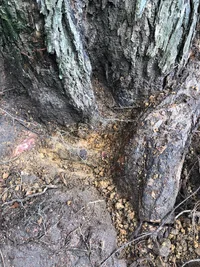
I decided to tackle that side that looked more deformed from the root. As I excavated more I found that the root continued around farther than I thought. First pic: I removed the left section and found another smaller one under it that I removed(second pic after I removed it). Then I went back to the larger section and it was tough. I couldn't get the middle section out, but third pic is the final. I was so beat I gave up but I think there are some roots on the left side of that section. It is sectioned at its origin, left side, and third main arm should that still relieve the tree?
 

Attachments

  • IMG_1097.webp
    IMG_1097.webp
    1.4 MB · Views: 30
  • IMG_1098.webp
    IMG_1098.webp
    1.3 MB · Views: 31
  • IMG_1099.webp
    IMG_1099.webp
    1.3 MB · Views: 32
Last edited:
You should have listened to Sean, or believed the standard I posted about exposing before cutting. That last pic show a LOT of support gone, and nothing gained in terms of relief from compression.
You should have listened to your own better angels!

DIY is fine but not in a panic! And yes I would seek a refund from the $200 drought diagnosis from the guy who would not get his hands dirty. That or use yelp etc. to share your experience in your region. Assessment without inspection is potentially fraud imo.

evo maybe if you passed the BCMA, you would get some perspective instead of guiding tree owners to damage their tree like that. Try reading the Root standard for starters; I hate to say it but many parts of the BMP are not accurate, or responsible guidance.
 
Last edited:

New threads New posts

Kask Stihl NORTHEASTERN Arborists Wesspur TreeStuff.com Teufelberger Westminster X-Rigging Teufelberger
Back
Top Bottom