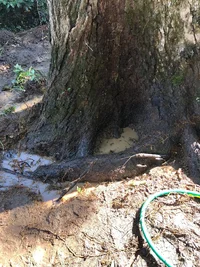
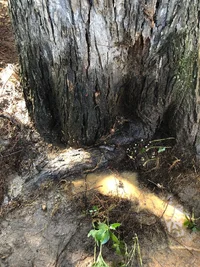
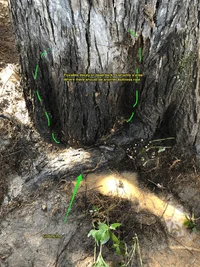
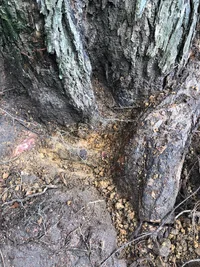
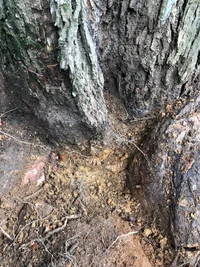
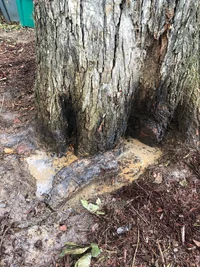
Think RCA over RCX
Root Collar Archeologist over Root Crown Excavator
I'm embarrassed that a BCMA would not look at the flare.
I was unsuccessful in getting RCX defined as Examination instead of Excavation. Which is grammatically incoherent, but it helps sell an established profit center. The corporate boys won that one, too. Lack of coherence helps smoke-and-mirrors marketing
Tree Inspection Procedures, from ANSI A300 Part 8
Arborists consider potential tree benefits, applicable tree care techniques, and the owner’s intended use of the site.
Arborists establish the objective (the expected outcome) based on our experience in the field and understanding of the plants. After clarifying the owner’s goals, we can study aerial maps, the ecosystem, the microclimates, the past, current and potential management of the site, soil volume, fill, air and water movement, and the plants.
Arborists write specifications (detailed, measurable plan or proposal for meeting the objective). Specify tools and practices that avoid damage to living tissue, bark or soil. Keep tools sharp and clean. Specify the method, area, and depth of inspection.
“83.3.4 Inspection should include…:
Conditions in the crown that may reflect root conditions;
Stem tissue connecting the crown and the roots;
Girdling of buttress roots or stems by roots or foreign objects, and the tree’s response;
Tree association with beneficial and harmful insects;
Tree association with pathogenic and beneficial microorganisms (e.g. mycorrhizae);
Wounds, and the tree’s response to wounds;
Mechanical damage to detectable roots, and response;
Indications of root disease and response, and
Graft unions in grafted trees;”
Mulch, soil and foreign material should be removed to allow inspection.
Bark tracing of wounds shall remove only dead, loose, foreign and damaged tissue. Evaluate decay, callus and woundwood growth, and response growth in trunk and crown.”
“83.4.1 Root collar examination objectives shall be established.
83.4.2 The method, area, and depth of excavation shall be specified.
83.4.3 Tools and equipment used in excavation shall be specified.”
Prune adventitious roots if they interfere with excavation or examination.
Protect root and stem tissue newly exposed to sunlight where needed.
Diagnose any detectable flare and root diseases and disorders.
“
83.4.8 The flare shall remain visible after excavation.”
“84.2.7 Specifications for monitoring and maintaining tree health and stability should be established.”
“
84.2.5 When root loss is unavoidable
, selective pruning shall be the preferred method.”
“
84.4.6 If more than one large girdling root is present, root pruning over time should be considered.”
Sample specifications for RCX (root collar examinations) with hand tools
Scope: Trees with fill contacting the trunk.
Objective: Avoid damage to the tree from the effects of fill on the trunk. Lessen risk and maintenance needs, improve health.
Specifications:
Rake any coarse woody debris or fresh mulch away from the root collar area.
Press the blade of a shovel or a trowel against the trunk. Slide it carefully downward until resistance is met.
Push the handle toward the trunk, moving the blade away from the trunk.
Remove individual adventitious roots <1 cm and stem-girdling roots <1/10 trunk diameter. Manage larger roots per A300 (Part 8), 83.4 and 84.4. Avoid contact between the trunk and any remaining adventitious, girdling, and circling roots.
Lift the material away from the trunk and place it in a temporary staging area.
Separate and dispose of any infertile soil and debris. Retain the fertile soil, fine roots, mycorrhizae, and decomposed mulch.
Repeat until trunk and flare are clear, out to the root collar, where buttress roots divide. Use smaller hand tools, or compressed water or air, to complete the excavation. Commence the RCX (root collar examination).
Consider replanting the tree, if the flare is over 2” below grade and the tree has been in the ground for less than 5 years.
Remove soil and fine roots outside of the root collar to make a gradual slope.
Consider installing a device to control erosion.
Apply 2-4” of mulch over the root collar. Avoid mulch contact with the flare.
Remove the fine roots, fertile soil, mycorrhizae and decomposed mulch from the staging area. Incorporate the material into the outer rootzone.
Specify that future management will keep the flare visible.
84.4 Selective root pruning – girdling roots
Roots that encircle or contact (girdle) the trunk or a buttress root should be considered for redirecting or pruning.
Girdling roots should be exposed before pruning cuts are planned or made.
(Girdling roots that provide more benefit than damage should be retained.)
Roots that cross other roots outside the root crown should be retained.
(Avoid damage to the trunk and buttress roots beyond the scope of the work).
If more than one large girdling root is present, root pruning over time should be considered.
Moving and redirecting root growth should be considered before pruning.