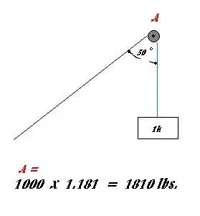
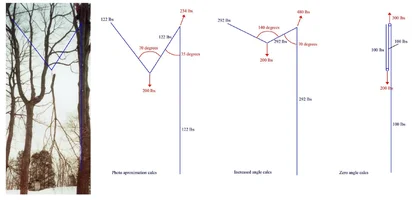
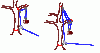
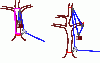
If i understand the question correctly; i think that the loads on the spread apart anchors that support the 2/1

WT will be determined by the angle created, in the line, in the same numbers/math as speedline support loading. Also, maximum power of 2/1 will be in parallell lines, so the wider/unparallel lines have less MA?
i think both would be calculated like sling angles , only the load pulls down, rather than crane pulling up, but same loaded angle of pull function. Like in Blair's "Arborist Equipment" pp175,176. And Clicking "Slings 6.7" in
OSHA Crane Rigging Manual and
AirForce Crane Certification Manual on page 55. (Great Links on certification training for hadling load forces).
Therefore as the load lowers the angle that determines the load on support anchors will change, as the angle in the line gets less obtuse (angle going from support-load-support), the load angles on the lines/anchors change and load on anchors is reduced. So, as the line is first taking the load impact, it is also most leveraged; whereby these higher loading factors at the same time compound each other; making tearoff about the most hazardous time?
The power of the DWT can give more support, as well as pretightening, helping 2 ways. Also, offer different steering properties (to center of anchor's support,still) be tag lined easier between the 2 points of support. If the control leg, deflects to the ground, that anchor will be more loaded, and the legs of lines angles of pull would matter on that support too. i like a 3/1; as 'odd legged' systems are retreivable and pull to a favored side. With no pulleys on supports, sweat lines in well, giving super pretightening before loading, and more available support x friction for control, can take 4 legs of line though!
Or at least that is how i always looked at it!