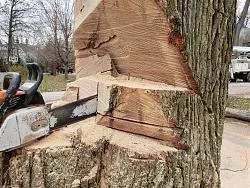
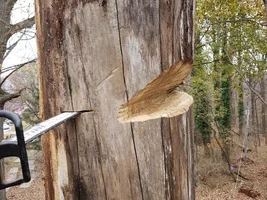
Dutchmans

Dutchman Usage

  • When needed

    Votes: 2 16.7%
  • Not in felling

    Votes: 4 33.3%
  • Never/Never

    Votes: 4 33.3%
  • Huh?

    Votes: 2 16.7%

  • Total voters
    12
  • Poll closed .
He just told you... It makes sense that the dutch might work with that much lean, even though it seems a bit counter intuitive.. it was actually the weight of all that front lean was able to trip the hinge while it had enough meat to give the dutchman enough hold to turn the tree...

stranger things have happened!!!
Geez Danny, but if this tree had a front lean as you just described, there would have been zero need to use a Dutchman. Please tell me you know the difference between a side lean, a back lean, and a front/head lean?

These trees were first described as “wider than 36 inches”, “leaning past 45 Degrees”, and apparently over a structure. As someone who has used Dutchman’s hundreds of times I know that even a species with the best hinge in the world ain’t gonna swing very far in this scenario. As such I have to question how far he actually got these trees to swing. Was it 10 ft, 15 degrees, or 8 inches? Truth and accuracy in our words are very important when discussing the use of a Swinging Dutchman near valuables.

Please do yourself a favor and go learn to sharpen a fucking saw, and let the man answer my question. Pretty Please with bar oil on top !
 
Last edited:
i'm going to say was like ~30 degrees float to side, put in driveway, didn't crash down hard, had it the whole way but kept it moving as a flow. Minimized hinge support so minimal cutting once started movement.
Wasn't deep over house. Actually sat on top one to cut it after bottom, that was stupid, it did shift some.

Both were pitched over in hurricane top 1 laying over other one at bases but still anchored.
Both over house corner. Lower one almost out of ground, upper pinching it down.
The whole street looked like a war zone. Power lines down , houses cars crushed here and there The din of media hustle, and what seemed like crane bidding could be heard down the road along with matching animations. I was alone in head on lonely end of road tide of people seemed were rolling towards. All quite a scene!
Ushered them to slam close down and fade sideways rather than hit house with the continuing motion.
Approximately 45 degrees lean, but in any case not light, not soft lean.
066 w36" bar buried, was along time ago tho, had many saws, but this is as fair as I can remember. Partially luck part instinct, but honestly have lost that edge!
Especially remember walking out into street, wishing tv cameras where there instead, but knew would have hit house then on camera.
.
I've never written here to impress, only examine what tried to focus on as best leverage points in this fascinating world that is just really just better viewable workings for all things. The things I write are imagery views of what I imagined was facing and invoking, while constantly looking to prove self wrong, collecting all polishing each time better. What remains are best working theories of force and handling could muster and stood test of time of not being able to prove wrong. It is OK not to believe, some probably don't see 2:1 in climber self lift, many have balked at Tapered Hinge, swigging, getting 8x from 5:1 pulley jig, cosine as rope efficiency etc. I try to be open minded, don't think my presentations have changed, honestly remember very distinctly and thankfully few times changed model to encompass other view on forums. Just as remember reading Dent's diagrams over and over before really getting them.
 
Thanks for the in-depth answer useless info. I appreciate it. 30 degrees is a big swing on a tree leaning that hard. I imagine it was both fun and a little scary to watch.
 
Last edited:
If someone could put all these special dutchman cuts into a cheezy Nintendo 64 diagram or sumthin maybe some of us millenial types could follow along. Truth and accuracy in words is nice, but words is still jus words and making whole bunches of em strung together doesnt do the know-know!
I get what they are in general, but in formal basic training they were classified as a mistake...both cuts should meet evenly all the way across the hinge...
 
Geez Danny, but if this tree had a front lean as you just described, there would have been zero need to use a Dutchman. Please tell me you know the difference between a side lean, a back lean, and a front/head lean?

If he used a dutchman to turn the tree, it was the "front" lean of the tree that got it started moving FORWARD before the dutchman turned it to the side.... do you have to act like such an asshle all the time?
 
If someone could put all these special dutchman cuts into a cheezy Nintendo 64 diagram or sumthin maybe some of us millennial types could follow along. Truth and accuracy in words is nice, but words is still just words and making whole bunches of em strung together doesn't do the know-know!
I get what they are in general, but in formal basic training they were classified as a mistake...both cuts should meet evenly all the way across the hinge...
.
i'd think anyone speaking on this here would concur this is already done (except cheezy nintendo part) in this 70's guide to using the 1 man chainsaw marketed starting in 50's.
Dent (and Beranek) were luckily first on scene, writing guides that no one has topped!:
51hMV2mIQcL.jpg

.
Pencil drawing types in msPaint are my earliest scribbles, probably more to requested cheezy side!:
Add%20Kerf%20Dutchy%20to%20make%20Swing%20Dutch%20multi%20use.jpg

.
Once again talk and visualize at full steam felling,but more usable in tree. Just as a long horizontal(or hard lean ) can grow more of an oval than round response to severe loading on given axis to maximize support to that specialized direction, Tapered and Dutchman likewise appear not on path of least resistance across thinnest part of hinge to target, but rather on the loaded axis line from CoG to pivot(compressed part of hinge) and beyond. Just as Tapered is on this line behind said pivot, Dutch region is in front of pivot. BOTH are on this most loaded force line
.
This shows more color of definitively after 2000 in my drawings.
It shows also a Swing-Dutchman that uses again Tapered and Dutch,but also cuts thru hinge on lean side. Allowing swing to offside in right conditions to show pure power of strategy. It can go wrong, real wrong, have used saw to chase tree off stump not to swing to far. Was playing shouldn't do that.. Biggest lesson:always preserve leveraged distance extremes of at least tuft of fibers at each end of hinge/face to prevent swings, even in daily hinging! Tho, same setup in horizontal limb swing can be okay, as can't swing up to opposite side of gravity pull down,just getting across action. To get the most out of Dutchman, have to slap faces hardest, to get hardest response back. Can't use as resting shelf to slightly roll off of, need to use as a striking pad to rebound across face in side lean scenario.
.
dutchman-step-kerf-swing.png

.
Once again this is a study in forces, not a recommendation.
Large scale felling is how usually pictured, and easier to imagine forces for study.
Actual usage in tree and bucking preferred.
Bucking (and most climbing) cuts reduce speed input some.
Climber's cuts usually will generally have less leveraged distance across hinge for Tapered pull, so might need to exaggerate Tapered, Dutchman to compensate.
Neither would expect to have as much weight force input into face slap as full scale felling..
Climbing kerf face to vertical top for hop to me is a type of Dutchman, would never do in felling.
As like kerf undercut in horizontal is likewise a Dutchman study to me. Inner part of kerf is hinge pivot, outer is Dutchman early close in face. Distance between is leveraged push from Dutchman against CoG pivoting on hinge.
.
Dutchman is more like crack in tree jamming against self rather than manageable monolith, only not looking to stall, but rather bounce out. But still is obstruction inpath could bind/sieze against.
.
.
step-dutchman%20(Custom).png

.
This shows Step-Dutchman. Today, would say to use to guide one tree off of another, not off house if ever use this. Note how if going to brush tree in foreground to house side, the open face on other side of step would not resist this push to side by other tree until much later/at tearoff.
.
The high step this side would also push to same side in concert with /as other tree pushing to same direction, as Tapered Hinge pulls across to same. The high part of step helps enforce to target, the lower face just doesn't fight this action.
.
If sidelean towards reader, that side will hit step side harder, even w/o step.
But if step full face for just early close ,would stop hinging.
ALSO, offside/away from lean side face would be resisting movement towards it tho not hit as hard, is still 'genericizing' the face to more 'mute' the harder push from the lean side.
.
Cutting thru hinge on this side could incite wild swing to offside.
Hope this helps, once again more of a study in what to not accidentally invoke in felling and why is powerful enough to mis-lead to disaster; which could of curse be barberchair etc. where in my imagery trees own forces are rallied to compound against it's own self and break the tree container of said forces.

 
If he used a dutchman to turn the tree, it was the "front" lean of the tree that got it started moving FORWARD before the dutchman turned it to the side.... do you have to act like such an asshle all the time?

Go read my first post on this thread, then go read the very first sentence of your first post here. Your words were an outright insult to all the highly skilled pro fallers out there that have concluded that the dutchman is unreliable. Please correct me if I'm wrong, but I don't believe you have spent a day in your life as a contract timber faller Daniel? Now you're once again whining because some asshole is calling you on your fucking nonsense?

Tell ya' what Daniel. I will start playing nice when you stop posting pics of all your hackery, then follow it with your never ending self-bloviating sales pitch about how fucking awesome you are. Unfortunately for you we have mucho evidence that supports the hypothesis that you are in fact a fucking hack, and not the 1%er you claim to be.
short bar bisect.webpdry tulip top plunge.webp
 
Last edited:
If someone could put all these special dutchman cuts into a cheezy Nintendo 64 diagram or sumthin maybe some of us millenial types could follow along. Truth and accuracy in words is nice, but words is still jus words and making whole bunches of em strung together doesnt do the know-know!
I get what they are in general, but in formal basic training they were classified as a mistake...both cuts should meet evenly all the way across the hinge...

Go to amazon and get Doug Dents book if you are truly interested in the dutchman. You seem like a properly trained modern climber with all the skills, techniques, and methods necessary to perform the same task in a much safer, more reliable fashion. My recommendation would be to leave the dutchman to those who are professionally falling timber for a living, as it is not really the proper tool for those doing tree work around valuables.
 
Mr. Dent's diagrams can work very well in tree, even turned sideways to more horizontal path with downwards as the sidelean calling away from target, but powering works. Have often thought the sawyer and tall rooster tail of tension fibers were like 2 soldiers saluting each other over large job well done. There had to be a lot of force to front/side towards reader to stretch that fiber so tall and proud (Tapered Hinge concept on front cover i believe).
.
He doesn't really guide into climbing usage in book,but does apply some to bucking. Drawings are consistent principles as comparatives, that then can extend same strategies to same force and materials in tree.
.
Climbers daily give full face kerf Dutchman to small horizontals for clean cuts etc. also hop small tops with just kerf face. And in that load range etc. successes greatly outnumber fails
.
Hopefully no one just makes kerf face for felling; but may accidentally invoke about same by simply crossing/bypassing horizontal cut past slanted across full face.
This is a face within a face, and the inner kerf face rules!
>>This gives full face blockage of no where to go if can't snap off
>>just a bit later close on a small amount of rotation
This can be a calamity, accidentally invoked in felling that could work in climbing ranges if enough inertia and column angle to throw thru the face obstruction cleanly.
 
Not even close.
The others I wrote about were Live Oak type, this is near Water Oak end of scale.
I don't think this would take same stresses at that load range, but got fair action like this
Also this was more to 16" type scale best I can remember.
.
This does show instead of trying to pull around on tension only by pulling sideways,
allowing to accelerate forward and then using that acceleration and bounce to assist tensions.
Others were leaned over corner of house at hard angle, allowed to similarly gain speed to throw sideways. Always picturing feeding into lean as fastest most severe, works here and reverse to use tapers when not needed for not as severe ground concussion and constant practice.
Similarly in tree might press down with long limb to slap face harder or pretighten rope last bit before serving across.
Tighter rope to side of course helping fold sideways on vertical force load.
.
This has thinner bark, faster grower making 'cheap' wood.
Live Oak thick double cambium type bark can even climb some by gripping thick bark. >>stuff grows slower, more tenacious wavy almost twist cable type grain hard to split.
About 2x as heavy per cu inch as our yellowish pine.
Much more trustworthy in tension and compression. Longer lived etc. Thicker bark more resistant to mistletoe.
.
For me Live Oak is high performance tree benchmark as a potential to (de)grade other trees by. Showing best architecture, strength, calloused wounds show highest order of best potential for other trees to mimic etc.
.
Old Live Oaks also most teaming with rich fauna of symbiotic live's in tree and on ground.
Locally, I'd think Live Oaks would be a tree man's tree.
 
Last edited:
Not even close.
The others I wrote about were Live Oak type, this is near Water Oak end of scale.
I don't think this would take same stresses at that load range, but got fair action like this
Also this was more to 16" type scale best I can remember.
.
This does show instead of trying to pull around on tension only by pulling sideways,
allowing to accelerate forward and then using that acceleration and bounce to assist tensions.
Others were leaned over corner of house at hard angle, allowed to similarly gain speed to throw sideways. Always picturing feeding into lean as fastest most severe, works here and reverse to use tapers when not needed for not as severe ground concussion and constant practice.
Similarly in tree might press down with long limb to slap face harder or pretighten rope last bit before serving across.
Tighter rope to side of course helping fold sideways on vertical force load.
.
This has thinner bark, faster grower making 'cheap' wood.
Live Oak thick double cambium type bark can even climb some by gripping thick bark. >>stuff grows slower, more tenacious wavy almost twist cable type grain hard to split.
About 2x as heavy per cu inch as our yellowish pine.
Much more trustworthy in tension and compression. Longer lived etc. Thicker bark more resistant to mistletoe.
.
For me Live Oak is high performance tree benchmark as a potential to (de)grade other trees by. Showing best architecture, strength, calloused wounds show highest order of best potential for other trees to mimic etc.
.
Old Live Oaks also most teaming with rich fauna of symbiotic live's in tree and on ground.
Locally, I'd think Live Oaks would be a tree man's tree.

Pretty obvious that the Dutchman picture you posted was not the 3 ft DBH tree in question, but a fairly clean interpretation nonetheless. I really appreciate that fact that you chose not to completely destroy the downside hinge like many do. I was taught that leaving the downside hinge relatively intact allows the dutchman portion to really pop, and the uphill hinge to hold better, thus creating a much better swinging dutchman.

I share your love for the Live Oak. When you leave the deep Redwood holler I live in, you enter Live Oak terrain. We have the Quercus agrifolia (coastal live oak) type here, and they are truly stunning trees. Wonderful to climb and work with, heavy as hell, hinge like a mofo, and are one of my all time favorite hardwoods. Stuff is keeping me warm as we speak.
 
Last edited:
I still think a ban on techniques is like a red rag to a bull in finding people wanting to experiment with it. Sometimes I think it would be better to just teach the method properly with practical analysis of why it is so bad and then ban it. I have seen this approach work on firearms courses to great effect.

But as had been mentioned the technique may have a place in areas without targets, but in the urban environment we have access to ropes and throwlines that can make the technique largely unnecessary.

Having said that it would be nice to see an experimental thread open up with success and failure stories with up close pictures and analysis to actually visualise the positive and negative aspects of the techniques involved in the dutchman.

Issue is society often wants to blame someone so that the page might be blamed for a foolhardy experimenter reading the page and trying it out to effect an entry in the Darwin Awards...
 
In tree can use this in lower force ranges that don't conjure enough force to break wood apart.
.
Couple of feet of 6" horizontal undercut, then cut down from top is to me mechanically a Dutchman, full face kerf even, would consider deadly in felling, but daily essential in trimming.
.
Have done a lot of in tree cuts of 3"+ verticals that could man handle. Sometimes push small sling high as could. Could make small faces, some with handsaw in face or back cut. Could leverage bodyweight against to incite fall. Experiment with Dutchman effect, get feel, even reset and try different face effect, backcut tapers etc. in same exact model unit to really sift differences. Different angles of pull/push to assimilate different sideleans etc. Especially Step Dutchman type.
.
In felling think of step form like letting tree run to where it wants to go and trick it to chosen path. Like dog running full blast and hits stop at end of leash and throws dog to side with own force.
 

New threads New posts

Back
Top Bottom