Double whip vs "single whip"?

dmonn

Branched out member
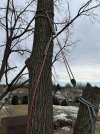
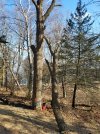
I don't often need to deal with lowering "heavy" pieces, especially near a sensitive target (like my stepson's house). I did my first "whip" rigging a few days ago and it went very well. It was in a very dead ash tree so climbing high was not going to happen. Doing a double whip just seemed like more trouble than it was worth. I decided to set a block up higher than the tip of the branch remotely (from the ground), tie it (from the ground) near the tip of the branch, run the line through the block (done ahead of time), then to a rope puller. I backed up the rigging on a porty. I did a face cut on the trunk side of the limb, tensioned the limb with the rope puller, did a back on the limb away from the trunk until I had a reasonable hinge (1.5 inches or so on a 14 inch limb), then cranked on the rope puller. The hinge broke just before the limb made contact with the trunk. I had enough MA to raised the limb up off the stump, then lowered it using the porty. (photo)

1. Was that a reasonable way to remove this limb?

2. If you have plenty of MA, is there any reason to complicate the rigging to do a double whip?

3. Would you call this a "single whip" or something else?

I also work solo and slow, since I'm retired and do this for fun.
 

Attachments

  • Big limb at Masons.jpg
    Big limb at Masons.jpg
    1.3 MB · Views: 85
Be real careful with ash and heavy rigging. Guy lines on your spar/lift tree will help stabilize it. That looks like single whip to me but my view may be skewed from my recliner and cell phone. If it makes the job go easier/more controlled then why not use double whip. I’ll often use double whip when I want to rig heavier with smaller lines.
 
Be real careful with ash and heavy rigging. Guy lines on your spar/lift tree will help stabilize it. That looks like single whip to me but my view may be skewed from my recliner and cell phone. If it makes the job go easier/more controlled then why not use double whip. I’ll often use double whip when I want to rig heavier with smaller lines.
I hadn't thought about guying the spar at the block. Great thought I'll have to remember. Double whip would give you less "weight" at the porty, which would be nice. On reflection, it wouldn't have been that difficult to set a retrievable anchor point on the rigging spar from the ground to create a double whip. Next time!
 
One other thing to remember is when you hang a block on a tag line is you are now pulling on it with a 2:1 . Stay Safe!
 
It looks like you climbed to set that up. I'm super cautious about climbing the dead ash I'm working on. Setting that up from the ground on the trees I'm working on wouldn't be that tough, but wouldn't be as easy to do as setting up while up in the tree. Nice setup, and gives me some more ideas. Thanks.
 
I don't often need to deal with lowering "heavy" pieces, especially near a sensitive target (like my stepson's house). I did my first "whip" rigging a few days ago and it went very well. It was in a very dead ash tree so climbing high was not going to happen. Doing a double whip just seemed like more trouble than it was worth. I decided to set a block up higher than the tip of the branch remotely (from the ground), tie it (from the ground) near the tip of the branch, run the line through the block (done ahead of time), then to a rope puller. I backed up the rigging on a porty. I did a face cut on the trunk side of the limb, tensioned the limb with the rope puller, did a back on the limb away from the trunk until I had a reasonable hinge (1.5 inches or so on a 14 inch limb), then cranked on the rope puller. The hinge broke just before the limb made contact with the trunk. I had enough MA to raised the limb up off the stump, then lowered it using the porty. (photo)

1. Was that a reasonable way to remove this limb?

2. If you have plenty of MA, is there any reason to complicate the rigging to do a double whip?

3. Would you call this a "single whip" or something else?

I also work solo and slow, since I'm retired and do this for fun.
I had never heard of a ‘single whip’ but as I understand it, that describes a basic rigging setup with one rigging TIP. But I’ve never heard someone describe a rig as a single whip. As far as describing this to another arborist, I would say this is a ‘tip tie with pretension,’ nothing to do with double whip.

It looks like there’s room to bomb large sections- I see an empty field through the trees- I would give the client the expectation that some understory trees may get damaged. I’ve seen some really scary ash breakouts in large diameter parts of the tree and personally I’m interested in getting home safe at the end of the day. If a few shrubs or trees get damaged, my conscience can accept that. I would not choose to rig this ash in any way at all. If it couldnt be bombed, I would bring in a crane, and if that wasn’t an option, pass it to someone in the area with a large spider lift.
 
After messing around with different rigging the past week, I think I get why a double whip is better than a single whip using twice the force from the ground. With a double whip setup your rigging rope sees only half the force it would from a single whip system. That's a lot of rope with half the force on it, which is a pretty good reason to spend a little more time and effort setting it up. The only spot that sees the full force in a double whip is the rigging at the limb you're cutting--the rigging block and the rigging sling. Is that right?
 
I had never heard of a ‘single whip’ but as I understand it, that describes a basic rigging setup with one rigging TIP. But I’ve never heard someone describe a rig as a single whip. As far as describing this to another arborist, I would say this is a ‘tip tie with pretension,’ nothing to do with double whip.

It looks like there’s room to bomb large sections- I see an empty field through the trees- I would give the client the expectation that some understory trees may get damaged. I’ve seen some really scary ash breakouts in large diameter parts of the tree and personally I’m interested in getting home safe at the end of the day. If a few shrubs or trees get damaged, my conscience can accept that. I would not choose to rig this ash in any way at all. If it couldn't be bombed, I would bring in a crane, and if that wasn’t an option, pass it to someone in the area with a large spider lift.
Thanks for the advice. I'll definitely bomb the rest of the limbs on that tree. What you couldn't see from the photo was the house. To bomb that limb would have put the house at risk. You're right about the rest of the tree, and all the other dead ash trees in that yard. The rest of the dead ash trees in that yard (10 of them) will be simple drop them from the ground and then cut 'em up.

I used the term single whip instead of tip tie because of the different cutting and handling technique. To me a tip tie with pretension means your notch is to the outside of the tree and back cut is toward the trunk side. Once you're made both cuts, you then lower the limb away from the tree until the hinge breaks. This may have put the house at risk.

What I did was cut the notch on the trunk side and make the back cut on the "outside" of the limb. I then pulled the limb toward the trunk to break the hinge when the limb was vertical. I then lowered the limb to the ground while guiding it with a tag line. I think that makes it different. I'm no expert by any means, but that was my understanding of the difference between a tip tie and a whip. Is that not true?
 
I used the term single whip instead of tip tie because of the different cutting and handling technique. To me a tip tie with pretension means your notch is to the outside of the tree and back cut is toward the trunk side. Once you're made both cuts, you then lower the limb away from the tree until the hinge breaks. This may have put the house at risk.

What I did was cut the notch on the trunk side and make the back cut on the "outside" of the limb. I then pulled the limb toward the trunk to break the hinge when the limb was vertical. I then lowered the limb to the ground while guiding it with a tag line. I think that makes it different. I'm no expert by any means, but that was my understanding of the difference between a tip tie and a whip. Is that not true?
How you did it, is how I do 90% of all of my tip ties. If your not needing to lift the limb, then you typically don't need to tip tie. There are exceptions to every rule, but tip tying and letting it hinge over adds a lot of slack into the rigging system and the piece will flip over once the hinge breaks.
 
What I did was cut the notch on the trunk side and make the back cut on the "outside" of the limb. I then pulled the limb toward the trunk to break the hinge when the limb was vertical. I then lowered the limb to the ground while guiding it with a tag line. I think that makes it different. I'm no expert by any means, but that was my understanding of the difference between a tip tie and a whip. Is that not true?
I’m sure different pockets of arborists will have different terms to describe things, but that technique amongst folks I’ve worked with we would call that a tip tie with pretension. The way you made your notch is much preferred when possible to control swing. A tip tie that lets the piece hinge down before coming off the tree (what you are referring to as a basic tip tie) is usually pretty dangerous.
 
It looks like you climbed to set that up. I'm super cautious about climbing the dead ash I'm working on. Setting that up from the ground on the trees I'm working on wouldn't be that tough, but wouldn't be as easy to do as setting up while up in the tree. Nice setup, and gives me some more ideas. Thanks.
Lift access.
It’s a good thing being cautious with climbing ash but best to keep the rigging loads on the lighter side too.
 
After messing around with different rigging the past week, I think I get why a double whip is better than a single whip using twice the force from the ground. With a double whip setup your rigging rope sees only half the force it would from a single whip system. That's a lot of rope with half the force on it, which is a pretty good reason to spend a little more time and effort setting it up. The only spot that sees the full force in a double whip is the rigging at the limb you're cutting--the rigging block and the rigging sling. Is that right?
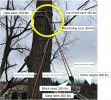
2022-02-21_18h56_56.png

Assuming a piece weight of 300 lbs, no friction, static load and neglecting angle multipliers, the static loads seen would look like this for double whip. Single whip, the top of the tree would see 600 lbs (which is what the rigging block and sling would see), rather than the 450 from a double whip. In the double whip, the porta wrap would see the 150. In single whip it would see 300.

keep in mind these are static load numbers. Dynamic load numbers can be many many times greater than these.
 
Many times I would use a double whip to do the stem of a large limb, simply becase the second block ( the one on the piece) was already there as I had rigged the brush off with it. It was the most time efficient way to get the block to the ground

Tony
 
A feature of DWT that many people don't talk about or take advantage of is how the rigging point can be positioned away from either anchor point of the system.

Put the fixed end system in one place then use a sling to set the floating anchor 'over there'. The floating block/rigging point will be off-set above a better slot for lowering.

This can be rigged so that it's retrievable too. Use a ring/ring false crotch for the floating point then either natural crotch or use another R/R FC for the fixed anchor. Run the end of the rope down to a point where it can be retrieved without going back up to fetch it all.
 
A feature of DWT that many people don't talk about or take advantage of is how the rigging point can be positioned away from either anchor point of the system.

Put the fixed end system in one place then use a sling to set the floating anchor 'over there'. The floating block/rigging point will be off-set above a better slot for lowering.

This can be rigged so that it's retrievable too. Use a ring/ring false crotch for the floating point then either natural crotch or use another R/R FC for the fixed anchor. Run the end of the rope down to a point where it can be retrieved without going back up to fetch it all.
I almost never use dwt for the purpose of reducing loads in a system. It is almost always for the purpose of span rigging like you describe.

The static anchor can be in some adjacent tree, a running bowline with a retrieval tail.
 

New threads New posts

Back
Top Bottom