double rope split tail question

MatKep

New member
Location
South West FL
Hi All! First post, so get the flame throwers ready... Have a question about split tail setup. Do I have to use climbing line for the tail? Seems like most examples are a 5-6’ piece of line blake hitched to the main line. Why not just attach your friction hitch directly to the running end? Seems faster and less complicated. Climbing on arbormaster with sterling eye to eye prusik. Practiced with a VT and prusik from the ground and everything seems to work fine. Want to make sure I’m not missing something before leaving the ground with this setup.
 
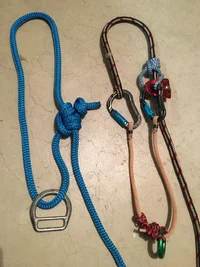
Welcome Mat, wish I hadn’t just run out of flame thrower fuel! Actually your plan has been done and is called the O Rig system, it forms a circle that the climber can rotate to move the hitch farther or closer. An additional friction hitch near where the rope passes through the harness ring is needed so the circle doesn’t rotate every time the rope is pulled. Your option on the left ? and an improvement so the climb line can be advanced easily.
9539C234-7976-4AE8-97B7-26FA19115EFB.webp
 
Thanks for the responses (and lack of flaming). Should have mentioned I’m using a rock climbing harness while saving for a tree harness.

The idea is to use a webbing runner to extend my belay loop (basket or girth hitch). From the end of the runner connect to the main line via prusik or vt.

Guess that’s where @Brocky’s suggestion shines, giving an adjustable extension rather than a fixed loop? Will deff give it a try.
 
To advance the upper hitch you only have to pull down on the left section of rope, the lower hitch isn’t life support, so it can be any size, it only keeps the circle from rotating.
With a pulley, or dog lease snap under the upper hitch, you only have to pull down on the rope and it will ascend automatically. Pull on the hitch, or the rope section it’s on, to bring it closer.
You probably wouldn’t need to extend your harness attachment point with this system.
 
Welcome Mat, wish I hadn’t just run out of flame thrower fuel! Actually your plan has been done and is called the O Rig system, it forms a circle that the climber can rotate to move the hitch farther or closer. An additional friction hitch near where the rope passes through the harness ring is needed so the circle doesn’t rotate every time the rope is pulled. Your option on the left ? and an improvement so the climb line can be advanced easily.
View attachment 66554

I don't know if you came up with this or not, but this is clever. I'd been doing the classic O-rig thing with a small accessory cord prusik advancing the hitch/pulley and the standing end just looping through biner on bridge/belay loop. But the small accessory prusik can sometimes interfere with the hitch. Moving it down to the bridge will make that a non-issue. Thanks!
 
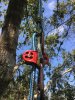
Finally did it. Upgraded to an eye to eye and added a hitch climber pulley. Much smoother climbing and easier to descend. Slightly concerned at first about the sewn eye interfering with the hitch but it does t seem to be an issue. Any pointers or suggestions there?

Installed a permanent TIP about 30’ up an old Water Oak in my yard. Will be my training and project tree for the short term.
7ABA188D-63E0-466E-99CC-E70BA4A57A4E.jpeg
 
When I was first learning to climb double-rope, I experienced the same problem, and I was puzzled about what I was doing wrong when I was sure I was following all the instructions and requirements of this industry standard setup correctly. The fact is, you're not doing anything wrong. The hitch interference you are experiencing is a common problem with that setup. You have several options. You can do leave the setup just as it is, be mindful of it and just get used to it. You can connect the end of the rope to your bridge instead thereby losing the self-tending feature, but you can restore the tending by putting a small Prusik on the rope opposite the pulley and connecting it to the pulley with an accessory carabiner. Or you can run a strap over the shoulder to tend the pulley. There are other options, but, generally, I would recommend that you get familiar and comfortable with whatever double-rope/MRS setup you like and then get a Rope Wrench and start climbing single-rope/SRS. You will be a much happier climber.

Also, I am concerned about your "permanent TIP." If you are leaving your rope setup at all times, be aware that squirrels and rats could chew on your rope where you don't see it. Instead, just install your rope each time and benefit from the practice.

 
When I was first learning to climb double-rope, I experienced the same problem, and I was puzzled about what I was doing wrong when I was sure I was following all the instructions and requirements of this industry standard setup correctly. The fact is, you're not doing anything wrong. The hitch interference you are experiencing is a common problem with that setup. You have several options. You can do leave the setup just as it is, be mindful of it and just get used to it. You can connect the end of the rope to your bridge instead thereby losing the self-tending feature, but you can restore the tending by putting a small Prusik on the rope opposite the pulley and connecting it to the pulley with an accessory carabiner. Or you can run a strap over the shoulder to tend the pulley. There are other options, but, generally, I would recommend that you get familiar and comfortable with whatever double-rope/MRS setup you like and then get a Rope Wrench and start climbing single-rope/SRS. You will be a much happier climber.

Also, I am concerned about your "permanent TIP." If you are leaving your rope setup at all times, be aware that squirrels and rats could chew on your rope where you don't see it. Instead, just install your rope each time and benefit from the practice.

I’ve tried the accessory cord-prusik-pulley for tending and find the hitch climber much easier. Better alignment, no adjusting necessary before descending, and easier to advance the main line.

Should have clarified the permanent TIP... not so much a TIP but an easy way to install my rope: I’ve left some bank line hanging over the TIP down to the ground. Makes an easy way to hoist/raise my rope. Does deprive me of valuable throw bag practice but I’ve been practicing that too. Thanks for the feedback and for looking out.
 
Misfit has some good ideas, another is to attach the rope end to the middle hole of the pulley, gets it further away from the hitch.
A foot ascender is handy on a moving rope system when you are away from the tree too much to place your feet against it. It’s twice the rope and work, but gets you up there.
 
Foot ascender is absolutely the way to go with a split tail and a moving rope system. It's night and day from body thrusting. It's a very decent way to climb. Experienced climbers have tuned their bodies up so much they may forget a little that a 2:1 moving rope system is pretty sweet getting up into a tree when you're not in a rush. You can do a footlocking half hitch on your strong side foot until you get a foot ascender. I was stubborn and climbed MRS/split tail for a couple years that way before finally giving in and buying a foot ascender. MRS is a great way to learn how to climb in the crown of a tree. SRS is beautiful but... It's about learning how to be in a tree no matter what system you use.

I've posted this many times, here you go. Works super smooth the more rope tail weight you have under you. To get off the ground feed the slack through the half hitch on your foot manually, you'll only need to do that for one or two pushes then wiggle your foot for the next couple pushes. After that it is completely self-tending, keep your toe pointed upward when you lift your foot for the next push to keep the half hitch in the best position on your foot. Tilt your foot down to lock on the rope to stand up and continue.

447315264_cacb329180_b.jpg


447314848_9eac845afe_b.jpg


447321005_ffe816a37b_b.jpg


-AJ
 
@moss do you jam your other foot on top? You like this better than traditional footlocking?

You can place your other foot on top if you want. I think of it as the same functionality as a cammed foot ascender but not as convenient. I combine it with a foot ascender to make a very decent “no additional gear” rope walker system. It is not nearly as efficient as a SAKA style bungee rope walker. I think of traditional footlocking as a completely different animal. I use all of the techniques above each has it’s place depending on the climbing circumstances.
-AJ
 

New threads New posts

Back
Top Bottom