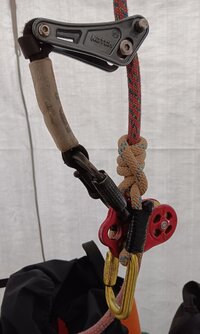
Documenting my hand-sewn eye process

I read this whole thread with interest. I have done neither splicing nor stitching and it stimulated thoughts about how all this works. One of these, impractical as it is:

A friction hitch can hold quite a lot, enough indeed to be a life support implement. Why could not the same mechanism be used for a bend or an eye: a hitch on each strand pulling against each other? A friction hitch can be expected to slip initially but is that just because it is not maximally tight? And smaller cord is known to bite harder than thicker cord closer to the rope diameter.

Suppose we start with a pattern like this from Winchman but instead of the figure-8 pattern between strands we form a short two or three wrap coil before switching sides, the hope being that each of those coils will tighten under load?

That would only give us direct friction on the mantle strands. Could one expose the kern at the bitter end and place another series of opposing wraps on it to provide additional hold? Could this be combined with limited stitching to lock everything together? Could the mantle bundles from the exposed section themselves be sewn through the other strand in a form of splice?

I mean, play around with it a couple feet off the ground and let us know what you think? I liked the idea of sewn eyes because it, like a knot, is a termination with no throat, like splices have. It is almost as clean as a handsplice too, so it is a bit of the best of both worlds. I have several hand sewn eyes that I have been using for a long time without any deformation of the stitching. I have also been sewing since I was a kid, and did embroidery, so I enjoy the challenge and artistry of it. I don't even use a speedy stitcher.
 
I will do that when I can. A hand-tight section about 1.25" long made of 550 cord on a 10mm rope makes an interesting low profile adjustable loop. Certainly not something for life support but the friction hitch effect is very apparent. Pulled far tighter while it is formed it would be impossible to slide by hand and should hold quite a bit.

I am so new at this I don't know what "a termination with no throat" means.
 
I will do that when I can. A hand-tight section about 1.25" long made of 550 cord on a 10mm rope makes an interesting low profile adjustable loop. Certainly not something for life support but the friction hitch effect is very apparent. Pulled far tighter while it is formed it would be impossible to slide by hand and should hold quite a bit.

I am so new at this I don't know what "a termination with no throat" means.
When you splice an eye, it requires putting the tail of the rope back inside of the rope and burying it down in there to a minimum depth. You taper the tail to reduce the bump this causes where it ends, but there is still a section where there is a full rope width is stuffed inside with the core. This is the throat, and it is much fatter than the rest of the rope. A sewn eye, like a knot, does not suffer this issue, and a prusik can go all the way to the termination. I have some lanyards that only cinch down to about 18" because of this.
 
I read this whole thread with interest. I have done neither splicing nor stitching and it stimulated thoughts about how all this works. One of these, impractical as it is:

A friction hitch can hold quite a lot, enough indeed to be a life support implement. Why could not the same mechanism be used for a bend or an eye: a hitch on each strand pulling against each other? A friction hitch can be expected to slip initially but is that just because it is not maximally tight? And smaller cord is known to bite harder than thicker cord closer to the rope diameter.

Suppose we start with a pattern like this from Winchman but instead of the figure-8 pattern between strands we form a short two or three wrap coil before switching sides, the hope being that each of those coils will tighten under load?

That would only give us direct friction on the mantle strands. Could one expose the kern at the bitter end and place another series of opposing wraps on it to provide additional hold? Could this be combined with limited stitching to lock everything together? Could the mantle bundles from the exposed section themselves be sewn through the other strand in a form of splice?

The hitches would hold for a while, but usually will start slipping before breaking. It would only be as strong as the cord holding the two rope ends, if it didn’t slip.
 
The hitches would hold for a while, but usually will start slipping before breaking. It would only be as strong as the cord holding the two rope ends, if it didn’t slip.
Do you think that adding mechanical interlocking to a friction hitch has promise? If the cover strands are buried either into the other side of the rope, or folded back over the top of the friction hitch and buried above it, or any other such configuration where they would have to pull out for the hitch to slip off.

What about a friction hitch on both the cover and core? Do you think that could nearly double the holding power, or do you see a reason why it would not?
 
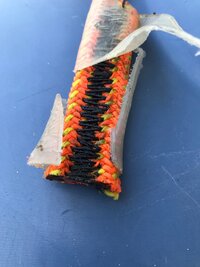
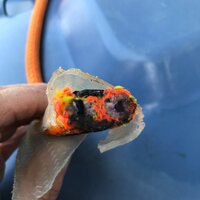
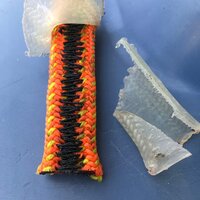
Sewn Splice Integrity Exam - my favourite Tachyon long double end lanyard got a case of Silky rash last week so ended up doing a chop job on it. Took off about three feet but in doing so had a chance to cut off and cut apart one of my "Cave of Wonders" homemade sewn spices to have a look at the condition after two or three years of use. Three sewn passes and the sewn sections had been covered with a light coating of polyurethane shoe repair goo before shrink tubing with a hot air gun. Everything had not moved or worn one iota - in fact it looked in new condition despite rope washing and sap removals over the years. So I for one have no concerns about sewn eyes on lanyards done a la Moss method with 75 lb thread, ball tip needle and taking your time (and maybe a longer sewn section to get in more thread). The shoe goo had soaked into the thread and down in between the two rope legs a bit and the whole thing was still real stiff - permanent like. Quality control dept me likes.
Another winter job for the job jar to put a new end on the still good length of Tachyon.
Cheers all.
 

Attachments

  • IMG_2669.jpg
    IMG_2669.jpg
    337.7 KB · Views: 18
  • IMG_2670.jpg
    IMG_2670.jpg
    165.1 KB · Views: 18
  • IMG_2671.jpg
    IMG_2671.jpg
    297.5 KB · Views: 17
Sewn Splice Integrity Exam - my favourite Tachyon long double end lanyard got a case of Silky rash last week so ended up doing a chop job on it. Took off about three feet but in doing so had a chance to cut off and cut apart one of my "Cave of Wonders" homemade sewn spices to have a look at the condition after two or three years of use. Three sewn passes and the sewn sections had been covered with a light coating of polyurethane shoe repair goo before shrink tubing with a hot air gun. Everything had not moved or worn one iota - in fact it looked in new condition despite rope washing and sap removals over the years. So I for one have no concerns about sewn eyes on lanyards done a la Moss method with 75 lb thread, ball tip needle and taking your time (and maybe a longer sewn section to get in more thread). The shoe goo had soaked into the thread and down in between the two rope legs a bit and the whole thing was still real stiff - permanent like. Quality control dept me likes.
Another winter job for the job jar to put a new end on the still good length of Tachyon.
Cheers all.
That looks great. Yes, when I retire my lanyards or climbing lines with hand sewn eyes, they always look amazing. The sewn parts of the eyes are not getting the kind of wear that the working parts of PPE cordage are.
-AJ
 
Last edited:
Forgot to mention in the post above that I had carried the shrink tube about a half inch longer then the 45 degree cut end of the sewn rope leg - there was absolutely no rope wear in this area so maybe the shrink tubing served a bit to slow any rope wear at the end point of the spliced area/ flex point. Didn't really cost anything and conjecture it mighta prevented/ eased up on another potential point of wear. Cheers
 
Was doing a bit of sewing today, and thought of Bonner's admonition early on here.
I always think of this skit when deadwooding spruces - "Bring me your dead, bring me your dead. He's not dead (a swift stroke with the Silky) There, yes he is . . . "
It's a lot like this (nice piano). Cheers all
 
Last edited:
I always think of this skit when deadwooding spruces - "Bring me your dead, bring me your dead. He's not dead (a swift stroke with the Silky) There, yes he is . . . "
It's a lot like this (nice piano). Cheers all
I love the way his Zubat so naturally functions like a walking stick/extension of his hand flowing its way around the tree.

Slows things down a little but a second tie-in more often please ;-)
-AJ
 
Looks like a test rig not actual PPE?
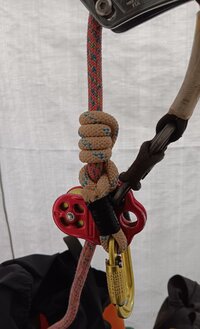
I forgot the pics before I taped it, but that had not occurred to me until now, that I could have tuned the length precisely like that. I will remember that when I go to do other sizes of cordage. This is finished and hand sewn of course, and it's a length so specific, I doubt any company would agree to try to replicate it. That half inch lets me get that last wrap, which I was shocked to find I actually prefer over how I had been running my hitches for most of the last year. With no legs, it starts eating slack with minimal effort and releases so smoothly. I finally see how a hitch can be better than any mechanical.
 

New threads New posts

Kask Stihl NORTHEASTERN Arborists Wesspur TreeStuff.com Teufelberger Westminster X-Rigging Teufelberger
Back
Top Bottom