Documenting my hand-sewn eye process

I think it was USD. Looks like they have warehouse in North Carolina. Their price is fair IMO. The 6mm Ocean Vectran just aint cheap. Ha. How much of this stuff do you have on hand? It has come up several times in this thread and this is the first source that looks legit. I will have to see if I can find an old invoice from back in the days when TS sold it.

ETA: Found old invoice. Last time I could find it was in 2015 and was $1.29/ft. Considering how the price of everything has gone up, still seems fair at $2.52/ft

StilI need order two DMM thimbles... these projects get expensive
 
Last edited:
Has anyone ever tested the breaking strength of rope that has been stitched? Seems like you could take a straight piece of rope and stitch a short (say 3 or 4 inches) piece alongside it. The short piece would only be there to support the stitching, not to carry any load. That would tell you how much, if any, the longer rope has been weakened by the stitching process.
 
I think it was USD. Looks like they have warehouse in North Carolina. Their price is fair IMO. The 6mm Ocean Vectran just aint cheap. Ha. How much of this stuff do you have on hand? It has come up several times in this thread and this is the first source that looks legit. I will have to see if I can find an old invoice from back in the days when TS sold it.

ETA: Found old invoice. Last time I could find it was in 2015 and was $1.29/ft. Considering how the price of everything has gone up, still seems fair at $2.52/ft

StilI need order two DMM thimbles... these projects get expensive
System shows a fresh 656' reel + 1 cut open reel at around 300'. Its definitely a niche item. I've been trying to get my hands on their Ocean Dyneema 7mm too. Its a little more supple and fits well inside the enclosed DMM thimbles. They don't sell it in bulk though (only as a finished loop). Probably because they know dealers will just sew it and make pulleySavers (though technically anyone who wants a fully certified ANSI/EN pulleySaver still has to buy their complete kit). If I ever get my hands on a bulk reel of Ocean Dyneema I'll post it here, I bet you guys might like it!
 
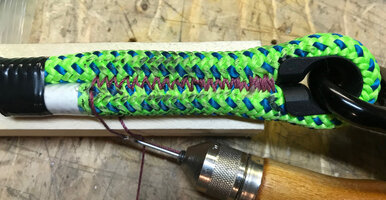
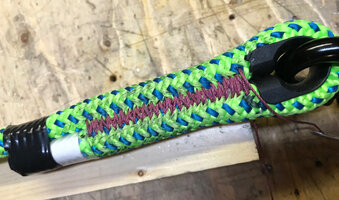
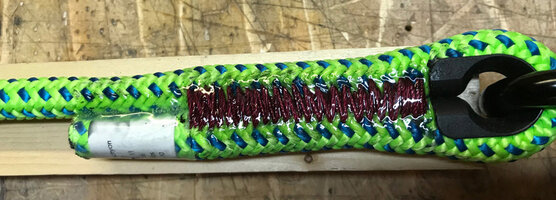
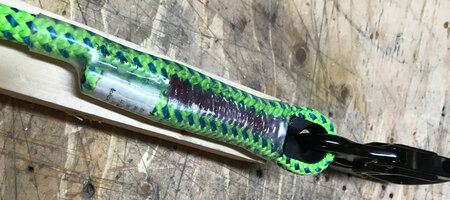
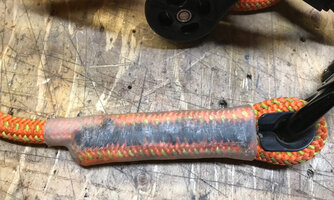
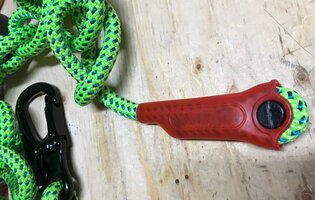
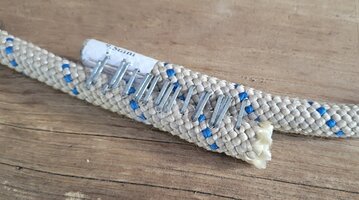
So below are pics of yet another sewn lanyard/ snap termination that was this week's project. Comments appreciated, good or bad. Used 75 lb thread as found above in this "thread" and about 145 passes in total on a chunk of Tachyon, from MLR it turns out. Couple of comments - daigentanoen has done a couple of sewn splice videos on AdTube and one thing I did this time that he showed was to put a needle and retainer knot on the end of the thread used for locking the stitch. Made it bigly easier to get the thread thru the loop by the SpeedyStitcher needle! Also, this time I didn't put the rope end on the bench or on a piece of wood/ plywood with a hole drilled into it, but rather had it on a piece of spruce 2X2 - this held the rope end up in the air a bit so the snap didn't flop around and made the first "stick" easier and straighter downwards (often stopped by the spruce), then moved the splice over a bit to allow the needle to go right the rest of the way thru. 2 X 2 gave lots of room to push the needle thru. A third thing was the use of polyurethane boot repair goo over the splice (fourth pic) to set things up a bit before the shrink tube (last pic). You can see how overnight the stuff soaked into the thread a bit (fourth pic). The thing is like rock now. Last pic is of a similar sewn splice from some time ago - it's been well used this season on a double ended lanyard and is still like a rock.
Confidence - other used rope lengths sewn this way have been subjected to the "4Runner hitch and clevis" pull test. Neither splice or rope has failed but some of the yanks were enough I feared for doing damage to the truck/ diff etc. So I for one am comfy in integrity of this method still. As long as one is meticulous in their method.
Cheers all.


SewnSpliceI.jpg

SewnSpliceII.jpg

SewnSpliceIII.jpg

SewnSpliceIV.jpg

SewnSpliceV.jpg

SewnSpliceVI.jpg

Addenda:
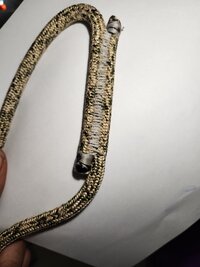
Keeping going with the hand stitcher on the other end of the lanyard, I decided to do another sewn splice and re- attach the Petzl cover and black plastic screw thingy from a Zillon lanyard - kinda over the top maybe but the winter nights up here are long . . .

SewnSpliceVII.jpg
 
Last edited:
So below are pics of yet another sewn lanyard/ snap termination that was this week's project. Comments appreciated, good or bad. Used 75 lb thread as found above in this "thread" and about 145 passes in total on a chunk of Tachyon, from MLR it turns out. Couple of comments - daigentanoen has done a couple of sewn splice videos on AdTube and one thing I did this time that he showed was to put a needle and retainer knot on the end of the thread used for locking the stitch. Made it bigly easier to get the thread thru the loop by the SpeedyStitcher needle! Also, this time I didn't put the rope end on the bench or on a piece of wood/ plywood with a hole drilled into it, but rather had it on a piece of spruce 2X2 - this held the rope end up in the air a bit so the snap didn't flop around and made the first "stick" easier and straighter downwards (often stopped by the spruce), then moved the splice over a bit to allow the needle to go right the rest of the way thru. 2 X 2 gave lots of room to push the needle thru. A third thing was the use of polyurethane boot repair goo over the splice (fourth pic) to set things up a bit before the shrink tube (last pic). You can see how overnight the stuff soaked into the thread a bit (fourth pic). The thing is like rock now. Last pic is of a similar sewn splice from some time ago - it's been well used this season on a double ended lanyard and is still like a rock.
Confidence - other used rope lengths sewn this way have been subjected to the "4Runner hitch and clevis" pull test. Neither splice or rope has failed but some of the yanks were enough I feared for doing damage to the truck/ diff etc. So I for one am comfy in integrity of this method still. As long as one is meticulous in their method.
Cheers all.


View attachment 84710

View attachment 84711

View attachment 84712

View attachment 84713

View attachment 84714

View attachment 84715

I like what I'm seeing. I was also thinking about using some polyurethane on my sewn splices, as I use it on the eyes of my beeline prusiks.
 
I was also thinking about using some polyurethane on my sewn splices, as I use it on the eyes of my beeline prusiks.
I've used Aquaseal Shoe goo for about five or six years now - first on old climbing lines/ splices used to prop up errant trees/ branches for months at a time, then on some test lines with homemade splices and finally now on climbing splices (and boots). I've mentioned elsewhere what an admirer I am of it - some of it even survived off trail wandering in Iceland one summer amongst very hot rocks (the "Stay on Trail" signs are there for reason . . . ). Cheers
 
It may be minwax, but I don't think it matters that much. I was told that they just pop down to the hardware store and grab some from the paint department. They don't care what brand, and have used behr, and varathane. Sorry to keep you in suspense @Dan Cobb , I was just curious if anyone had figured this out yet, as I have seen folks try to act like it's a secret they can't share. The key seems to be making sure it's water based, not oil, and I am betting you shouldn't use the spray cans.
 
There was a Buzz thread a while ago about glued splices (future technology the verdict it was?). I am not a polymer chemist or materials engineer but the Minwax type "polyurethane's" are not meant to be flexible, esp at low temperatures and as such I personally wouldn't use them on rope. They're wood finishes (and I do use them for that over oil based stains even once it's dried thoroughly). The urethane shoe goo above is tenacious (if the surface is free of oil and dust before application), flexible including in lower temperatures and doesn't exhibit any UV degradation that I've seen - at least over a couple of summers sun. Used it to rebuild boot soles. As such the shoe goo is more akin to the types of urethanes seen in sailboat caulkings (3M 3500 comes to mind) or other more expensive exterior caulkings being used in the window industry (at least up here). Where we are, south facing windows and doors take a huge beating from the UV and from wild temperature swings - this urethane formulation performs way better than anything I've found. More flex agent and more UV inhibitors I guess. My two cents this AM.
 
Last edited:
There was a Buzz thread a while ago about glued splices (future technology the verdict it was?). I am not a polymer chemist or materials engineer but the Minwax type "polyurethane's" are not meant to be flexible, esp at low temperatures and as such I personally wouldn't use them on rope. They're wood finishes (and I do use them for that over oil based stains even once it's dried thoroughly). The urethane shoe goo above is tenacious (if the surface is free of oil and dust before application), flexible including in lower temperatures and doesn't exhibit any UV degradation that I've seen - at least over a couple of summers sun. Used it to rebuild boot soles. As such the shoe goo is more akin to the types of urethanes seen in sailboat caulkings (3M 3500 comes to mind) or other more expensive exterior caulkings being used in the window industry (at least up here). Where we are, south facing windows and doors take a huge beating from the UV and from wild temperature swings - this urethane formulation performs way better than anything I've found. More flex agent and more UV inhibitors I guess. My two cents this AM.
I will probably switch to the aforementioned shoe goo product when I run out, but what I bought is uv resistant outdoor grade PU, but I am not really concerned about flexibility, as the sewn areas are already pretty inflexible, and I actually like the stiffness it adds to the vectran eyes on the beeline prusiks. Good to know that if I do find a situation I want to preserve some flexibility, that there's a tested option. Thanks for the feedback.
 
My only thought about this shoe goo PU (or other) originally was that it didn't harden the thread strands as much but would "toughen them" if that makes sense, knowing that if the rope termination is yanked on really hard, stuff will probably have to move around a bit (movement of the rope strands v.s. sewing stitch pattern was discussed earlier in this thread (book?)).
On boot soles (or other outdoor repairs like tents etc.) it is flexible, but I couldn't get it off boot soles with pliars once it hardened well - cantankerous stuff. I've mentioned elsewhere too that on boot soles, it survived off trail heat and traipsing around on what amounted to clinker/ hardened lava in Iceland. We couldn't believe it. It was as tough as the boot soles themselves it looked like. And it's chemistry is probably really compatible with synthetics on account of it being designed for outdoor gear repair - tents, boots and clothing, after those backcountry BC bush thrash epics.
Two approaches I guess.
Cheers and stay safe out there.
 
My only thought about this shoe goo PU (or other) originally was that it didn't harden the thread strands as much but would "toughen them" if that makes sense, knowing that if the rope termination is yanked on really hard, stuff will probably have to move around a bit (movement of the rope strands v.s. sewing stitch pattern was discussed earlier in this thread (book?)).
On boot soles (or other outdoor repairs like tents etc.) it is flexible, but I couldn't get it off boot soles with pliars once it hardened well - cantankerous stuff. I've mentioned elsewhere too that on boot soles, it survived off trail heat and traipsing around on what amounted to clinker/ hardened lava in Iceland. We couldn't believe it. It was as tough as the boot soles themselves it looked like. And it's chemistry is probably really compatible with synthetics on account of it being designed for outdoor gear repair - tents, boots and clothing, after those backcountry BC bush thrash epics.
Two approaches I guess.
Cheers and stay safe out there.
The potential benefit of the stitches having some play is part of why I have been hesitant to do anything extra at all. I want to send in a bunch of samples for testing when I have the resources to do so.
 

New threads New posts

Kask Stihl NORTHEASTERN Arborists Wesspur TreeStuff.com Teufelberger Westminster X-Rigging Teufelberger
Back
Top Bottom