Documenting my hand-sewn eye process

Plus the dyneema is harder to cut then polyester, or nylon.

Perhaps hand sewing is evolving into two distinct methods of accomplishing the same thing.
Multiply, tight, lock stitches on the interior of the two rope sections, like the machine produced ones, and the other with fewer stitches, that spiral, are spaced further apart, and using stronger thread.
perhaps, and I said before if you try to duplicate by hand what is done with the machine you will probably fail but if you try to take advantages of what can be done with the hand that can't be done with the machine then I see a win.
 
Agreed as to heat, but polyester and nylon burn just as readily.

Can polyester burn?
Synthetics (Nylon/Polyester/Acrylic): Ignites and burns quickly and can continue to burn after a flame is removed—exercise caution. Fiber may shrink from the flame,
 
I was referring to melting points. Dyneema is much lower than the other common fibers. It's like 290 degrees F where the others are 470 and higher. You could have a problem if a chainsaw muffler got close or a throw line got pulled across a dyneema eye. Shouldn't happen but it does.
 
Sorry, still not comprehending what you're trying to say.

"It's not just because it's forced through the rope harder but because it can. You just can't do that by hand."
What are the last it,and the word, that, referring to, that a machine can do but can't be done by hand.
 
This is just a general comment, not in response...

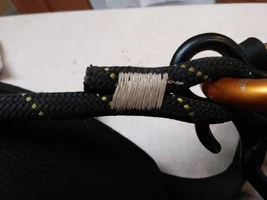
Take a bight of rope, put a rubber band around it as many times as necessary and seize the two legs together, put a carabiner through the eye, anchor the carabiner, and pull on the rope. Watch the rope and the rubber bands closely. Now imagine the rubber band is our sewing thread and the rope is a strand or group of strands within some multi-strand cordage. We need enough friction in the fibers of the bight so that the legs stay reasonably stationary until we reach a target force; AND we need enough fiber material in the rope and rubber band so that the system doesn't break until we reach that target force. But watch it closely and decide what factors are in play and by how much. I bet it looks a lot like the sewn eye on my saddle bridge (see pic). Is that a good thing or a bad thing?

Here are some factors I see : coefficient of friction between adjacent cordage fibers; coefficent of friction between rubber band and cordage; the amount of tension in the rubber band; the configuration of the locations where the rubber band applies force; the orientation or direction of the rubber band strands; the shape of the coradage fibers after seizing force has been applied; the spring constant of the rubber band; the type of multi-strand cordage and it's strand configuration; variations in any previous variable from one area to the next; strength of fibers due to fiber configuration (ie lock stitch), base fiber strength.

Here are some questions: what effect does a shift in the legs have on the system? Do you want a high or low spring constant in the rubber band? What challenge do you face with a high spring constant rubber band? Does one cordage type react differently to sewing/seizing than another type due to their configuration? etc, etc, etc

I can only guess that these might be the types things Da Vinci discussed with Columbus and his advisors as he secretly guided them in their preparations. :bananas:
 

Attachments

  • 0828181749.webp
    0828181749.webp
    123.7 KB · Views: 44
Last edited:
The stitches in your picture were either sewn slanted like that, or the stitches are loose. Maybe see if the two sections can be moved to make the stitches slant the opposite way. Is it a Petzl product?
 
The stitches in your picture were either sewn slanted like that, or the stitches are loose. Maybe see if the two sections can be moved to make the stitches slant the opposite way. Is it a Petzl product?
@Brocky Yes Petzl Sequoia bridge. No, they were straight when I got them. Another buzzer had this issue and discussed in thread about "Easthook Open". You probably remember it. If you look at the stitch pattern, it's obvious why it's doing it. There doesn't appear to be any kind of inside basting row. The one and only row of stitches has an offset pattern that goes from inside left to outside right, then outside left to inside right as you work your way down eye. This leaves nothing but large loops which are more prone to stretch and shift, albeit this ultimately leads us back to thread tension as the ultimate root cause. Theoretically, it should get stronger as it shifts because stitches stretch and puts more seizing tension on the cords as it finds equilibrium between thread tension and cord friction. I read somewhere a while back that Petzl was not concerned about this. I will call them today to discuss. I guess modern technology is only as good as the person using it, huh ... not knocking technology though.
 
Last edited:
I've taken their sewing apart, they do one pass, that alternates in width as you said. If the bridges are like the Connect Adjusts, which I took apart, the thread is dyneema, which is known to be low stretch. I thought an important part of a machine sewn connection is compression being applied to the two sections of rope. The loose Petzl sewings are depending on the combined strength of the thread only, they are lock stitches, so no cascading if some are accidentally cut.

Please let us know what Petzl says about them.
 
The loose Petzl sewings are depending on the combined strength of the thread only, they are lock stitches,
Exactly. And, because the core is probably parallel, if they don't seize tight enough to create friction in core equal to eye rating, then the core could slide right through the stitching loops in a manner of speaking. This could happen below rating without stitches ever totally failing, especially with a Class 2 core.
 
Just thinking to myself here after reading some arguments about the safety factory of "hand" sewing these.. but i wonder if some sort of needle jig could be made up to increase precision & quality control of doing these by hand.

In other words to create the same exact acceptable/ repeatable pattern every time..

I don't have a clear idea what it the jig would look like, but I'm sure some of you have a better imagination than i. This is a wildly different example but, i know when I've studded snomobile tracks I've used a jig/template out of metal to mark the suggested drilling pattern.. if the holes in the template were big enough to pass the cutter/punch i was using, I could have just layed it over track & gone to town instead of just marking the holes & drilling after... Maybe this could be done on a needle/awl size with one jig under & one jig over & you match the holes while the rope is compressed by whatever means..

Maybe these things have all been discussed already..idk..

Cool thread for sure though...

Sent from my Pixel 2 XL using Tapatalk
I’ve done some reading about stitched eyes, and there are 2 separate camps. One camp believes that variation in stitch can increase strength, the other believes that consistent patterns do. My thought is that a machine would obviously be more efficient at delivering consistent results with both tension and pattern but either can be stronger than the rope itself, especially if the coverage area and stitch density is large.
 
Maybe send a picture of the stitches slanted in the opposite direction also. Is there any gap between the two when the stitches are straight up and down?
 
Please let us know what Petzl says about them.
Okay, Petzl wants me to send in the bridge for warranty evaluation. They won't say one way or another whether this is normal or not even after I told them the rope legs were moving within the stitching. They better do me right on this.
 
I don't have specific data on this but my understanding is that Dyneema or other high modulus threads can cut polyester fibers under load. Don't know if that is true for sewn eyes but the 75 lb. strength nylon thread I've used for years pull tests very well. For the Globe 3000 bridge eyes I sewed, I used I think a 50 lb. strength polyester thread and in pull tests of the very well used bridge I think it broke at over 8000 lbs, cordage failed, eyes did not budge. I agree that irregularity of stitch placement probably creates slightly stronger eyes. Don't think anyone needs to try and make their stitching irregular, it happens.

As far as lock stitching vs. an open running stitch goes... I tighten each lock stitch pretty hard, and balance the load as I tighten. I've dissected machine stitches and in most cases it is no tighter than what I sew, some machine eyes are less tight than mine. What I like about lock stitching is that I can maintain very tight compression of the cordage as I stitch. I understand why a running stitch could be good but I have seen anything that shows that a well sewn lock-stich is not strong enough for the purpose.
-AJ
 
Okay, Petzl wants me to send in the bridge for warranty evaluation. They won't say one way or another whether this is normal or not even after I told them the rope legs were moving within the stitching. They better do me right on this.

The loose stitching on the Petzl cordage bridges is not inspiring. That's why I sewed Globe 3000, to make a replacement bridge for my Petzl harness.
-AJ
 
The loose stitching on the Petzl cordage bridges is not inspiring.
No it is not. In fact, I almost paid for the $6 priority mail label today to ship it back, then decided to tie on some 10mm OP and save myself the shipping cost. They would have sent another one of the same, as this has been seen before. I don't like the large loops and weakening thread tension on their sewn eye and would probably just be sending back again. $5 worth of OP, and I'm done and climbing again.
 
I’ve done some reading about stitched eyes, and there are 2 separate camps. One camp believes that variation in stitch can increase strength, the other believes that consistent patterns do. My thought is that a machine would obviously be more efficient at delivering consistent results with both tension and pattern but either can be stronger than the rope itself, especially if the coverage area and stitch density is large.
The end of your post makes sense to me about being stronger than the actual rope itself...

However i know very little about stiching, the methods, actual patterns or how to go about it.. The most stitching I've done is in my Levis.. or whiplocking a splice... I will say though.. the Stitch on the thimble end of my Sterling RIT loop looks very very very simplistic & rather chinsy..

Sent from my Pixel 2 XL using Tapatalk
 

New threads New posts

Kask Stihl NORTHEASTERN Arborists Wesspur TreeStuff.com Teufelberger Westminster X-Rigging Teufelberger
Back
Top Bottom