DMM throw hook.

The rollclip works great. I've used it a bunch of times with my hand ascender. Your idea is brilliant too and gets the job done. I like the rollnlock/roll clip because its so compact and efficient. The bigger problem was deciding to use my one rollnlock for a 2:1, or an adjustable rope bridge. The rope bridge lost that battle.
 
I've had some issues with hockling...I'm working on a long edit video now, a segment of which briefly shows the hockling that can occur when using a Dual-in One lanyard when setting up for a throw. I'm not sure if this is from the type of rope or from the dual end usage of the lanyard which causes twist or from the way I'm storing the hook line. It's nothing that a quick dangle can't fix but it's something that I've experienced and that others should be aware of.

Bingo! Yes, if you constrain the other end of a line hockling is guaranteed. Which is another reason I don't use 2 in 1 setups.
 
That really wasn't very bad hockling and probably would not have stopped a good throw. A stuff sack would be a better way of stowing the line as the process of coiling the rope can introduce the twist.
If you can, try a knee ascender. The HH loves being pulled up a taut line and you will not have the excessive amount of set-back at each stop on your ascent.
 
Here is a new video . . .
Fabulous footage, BobBob! Hook, lanyard, traversing, Shakespeare reel throwline, retrieval action. Looks like a fine outing. I admire how you have the angle of your GoPro fine tuned. Everything important in view most all the time. But, man, what a 2 in 1! Looked like it dangled clear back to the ground when you shook it out! When does a lanyard stop being a lanyard and become a second full-size climbing line with simply a lanyard clinging to one end?! ;-) Do we need an acronym for such a case? Perhaps H.E.L.L.? (Hook on Extra Long Lanyard)?
 
If you can afford it the Velox is a great Knee ascender but you could also cobble one of the more traditional ones together for dirt cheap. There are many threads and posts on what you need and how to put one together
 
. . . You might see that acronym in my next video description.
Well, that was quite a throw you made when you scored that limb in Part 2. I can see a future caption: 'could barely see that elm in the distance, even with binoculars, but no problemo, I whipped out the HELL and . . .'. Seriously, though, I am enjoying your vids and learning a lot from them. I think you once said you were self-taught and your progress is most inspiring to us other newbies.
 
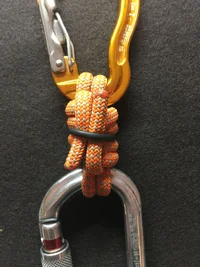
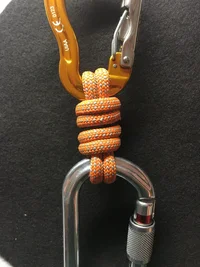
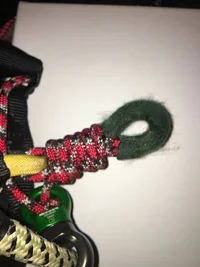
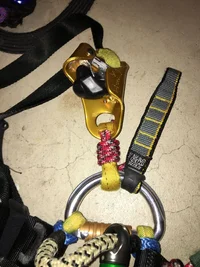
Nice videos Bob! Just wanted to show you an option for the small loops that you girth hitch.
IMG_1620.webp IMG_1621.webp IMG_1622.webp
They're double loop sliding grapevine, I guess technically they're a bend. You can get fiddlely and o ring the tails down like in the first picture. If it needs to be left open, I put some tubing in the eye so that the loop can't get pulled out.
 
To go between two carabiners it takes a minimum of 30". I use 36" for making one with the webbing cover to allow easier insertion of a carabiner. The strength is four times the break strength of the cord, minus the knot lose. For some reason I don't like to make metal to metal connections, so I've used these a lot.
IMG_1634.webp
 
@Muggs; @Brocky; Brocky, if I haven't said it before, I think you could self publish a book of your climbing hitch illustrations, and now I see that you do nice photo illustrations, also. Muggs has his educational website for climbers, and he's already selling Jerry Baranek's book there. Maybe you two should partner up. I would buy what you publish. I think others would also.

Tim
 
Thanks Tim, in the past I thought about putting out a friction hitch only book, waited until I had a significant amount, but now with the interest in mechanicals, I'm not sure there would be that much interest.
 
Thanks Tim, in the past I thought about putting out a friction hitch only book, waited until I had a significant amount, but now with the interest in mechanicals, I'm not sure there would be that much interest.
Seems like lots of guys still use hitches, and now in combo with some of the new devices, like a hitch beneath a RW for SRT. And hitches will surely always be invaluable backups. Maybe cover all the new mechanicals too? Has anyone put out something recently that covered everything that is happening? Just documenting the innovations, contributions, and advice of guys like Moss, Richard, and Gordon right here on the Buzz is enough to fill a good-sized book. I would sure buy a copy. Just my tuppence. 'Hitches and Beyond - On Rope in the Twenty-First Century' Something like that?
 
Thanks Tim, in the past I thought about putting out a friction hitch only book, waited until I had a significant amount, but now with the interest in mechanicals, I'm not sure there would be that much interest.

I had a post I was trying to write wiped out by a glitch in my handheld computer a few days ago. Basically I was trying to say I disagreed with you. Most new climbers and many veterans prefer hitches because of the sensitivity that can be achieved, but more importantly how inexpensive they are compared to the alternatives. $300 or $400 is not an amount of money that someone just starting out in climbing would care to shell out at a time when they're already paying big money for all of the other gear they need. With the ability to tie a termination knot, a new climber can buy high quality hitch cord for probably less than $15 for enough length to allow ascent & descent on a rope. The difference in price between mechanicals and hitch cord will, I think, ensure an everlasting desire on the part of climbers everywhere to continue to use hitch cords for climbing. Then I also read posts from veteran climbers like @swingdude who have the money and the experience to climb on any device, but who choose to go back to hitch cord because of its reliability and control.

I'll say again, I think you should publish, if @Muggs would be willing to do the work it takes to make it happen. If you cut Muggs in for a piece of the action for all of the work he's going to need to do, it might give a boost to his desire to help. It would help pay for the costs associated with his website. I would pay $20 for an electronic book of your hitch illustrations, along with the names of the hitches underneath. Photos would be nice, too, but I'd be happy if you just let Muggs scan whatever illustrations you currently have assembled, & let him produce it as a book in PDF format. It could bring in a steady trickle of income for you, and it would be of great help to all the new climbers out there, if they were smart enough to buy it.

Tim
 
Last edited:
Mechanicals are great...but hitches are so much fun and properly tuned just have so much control....love them both but I really gravitate to hitchcord and wrench....mechanical are so damn finiky...hey I am a runner guy so let me clarify that is what I am solid on....carry on nice thoughts above folks....
 
Thanks Tim, in the past I thought about putting out a friction hitch only book, waited until I had a significant amount, but now with the interest in mechanicals, I'm not sure there would be that much interest.
I think its a great idea. There's an old school quality to knowing good knots and rope on rope seems more friendly than mechanical cams or teeth. There are a lot of climbers who like the idea of relying less on hardware and more on the basic skill that comes with knowing how to climb this way. At the very least, your book will provide a fundamental understanding of hitch grabbing knots.
 
Bringing it back to the DMM Hook, got together with some arborist friends on a woods climb over the weekend. We gave a couple of hooks a serious workout, both climbers had zero or limited experience with the hook. We ended up traversing through several trees and really pushed the limit on high "out there" hook anchors, both climbers came away from it "Wow!". I used a Rope Runner on my 10mm hook line for the first time, very functional but not as good as the BDB for the purpose. Cinch is still damn good but you need to add a RADS for ascent at the end of a traverse. Hitch is fine but obviously binds up if you're trying to let line out with your weight on the system.Some short video with a little hook action:
 
I was just outside in the light rain practicing to throw and retrieve the hook, practice limb walks, etc. I may just use a second dedicated line for the throwing hook and keep the lanyard separate, like Moss does to mitigate the hockling issue.
 
Last edited:
Moss, I can never bring in your videos. They must not be regular youTubes somehow. What does it take to watch them? I am sure I am missing some really great stuff!

Huh. Interesting, I post on Vimeo, like it better that Youtube. They play right in the post for me, or click on them and watch on Vimeo. Here's the link, let me know if that doesn't work for you:

rec climb video
 

New threads New posts

Kask Stihl NORTHEASTERN Arborists Wesspur TreeStuff.com Teufelberger Westminster X-Rigging Teufelberger
Back
Top Bottom