
Hey Coleman. PM sent...Hey @Huskyman , the dmm hook looks really well thought out , i like the stowing idea, its really neat. Ive had the epple hook for quite a while now and it stays on my harness full time . where in stockholm are you working ? i will be up those ways in a couple of months possibly.

Navigation
Install the app
How to install the app on iOS
Follow along with the video below to see how to install our site as a web app on your home screen.
Note: This feature may not be available in some browsers.
More options
You are using an out of date browser. It may not display this or other websites correctly.
You should upgrade or use an alternative browser.
You should upgrade or use an alternative browser.
DMM throw hook.
- Thread starter Huskyman
- Start date

- Location
- Brisbane, Australia
Would anyone seriously climb on these things? I like to have something wrapped around the tree, myself. What happens if you are traversing, slip and swing too far? Wouldn't there be a decent chance the hook would come off?
Isn't there going to be movement as we move below it that could upset its positioning? What am I missing here?
Isn't there going to be movement as we move below it that could upset its positioning? What am I missing here?

colemanjessenz
Participating member
- Location
- heidelberg , Germany
Would anyone seriously climb on these things? I like to have something wrapped around the tree, myself. What happens if you are traversing, slip and swing too far? Wouldn't there be a decent chance the hook would come off?
Isn't there going to be movement as we move below it that could upset its positioning? What am I missing here?
I have an article coming out in the next month that can provide a bit of insight into the use of these hooks .
traversing is one of the many uses , as i said before the hook is always on my harness but that is down to the type of work I'm doing at the moment which is basically deadwooding and pruning a lot of trees.
I can use the hook to throw out deadwood or hangers , traverse to parts of the tree or from tree to tree, basically its an energy saver. when you get good at throwing , it turns into a time saver also.
- Location
- Brisbane, Australia
The chance of the hook coming off is very very small when weighted, its all about the hook positioning , some hook positions are bombproof and some are more susceptible to angle changes ...
Thanks for showing me what you are doing with it. So, in this still from your video, wouldn't it be quite possible for the hook to slip up the branch?
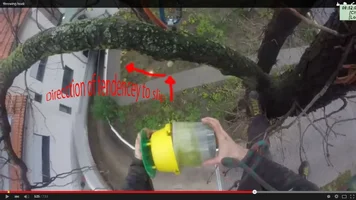
I'm not doubting your abilities or your judgement, but I do doubt the system. I'm not a new climber and as to judging vector forces, I wonder if anyone can when looking at a hook in a branch 50 feet away. Stay safe.
Oh, loved your heli felling vid, by the way.
Last edited:
colemanjessenz
Participating member
- Location
- heidelberg , Germany
Thanks for showing me what you are doing with it. So, in this still from your video, wouldn't it be quite possible for the hook to slip up the branch?View attachment 32133
in that still i am roped in with my lanyard but that aside I have found that once a hook is weighted it sets quite hard into the wood so thats whats nice about having that little wooden ball on the end (less invasive). ..... the possibility is there to slip but it would cause no problem on that particular traverse...... that limb was strong and with the friction around the above limb i was putting very little weight on that anchor point. that particular technique i have found to be one of the safest, i have never had a hook slip mid traverse.Thanks for showing me what you are doing with it. So, in this still from your video, wouldn't it be quite possible for the hook to slip up the branch?View attachment 32133
I'm not doubting your abilities or your judgement, but I do doubt the system. I'm not a new climber and as to judging vector forces, I wonder if anyone can when looking at a hook in a branch 50 feet away. Stay safe.
Oh, loved your heli felling vid, by the way.
by vector forces I'm talking angles.... at 120 degrees you have 100percent of your weight on each anchor point 135 degrees its about 130 percent of your weight so that along with your lateral forces on limbs can cause some serious numbers , its better to do traverses ranging from 90 to 120 degrees.
I know where your coming from mate , it just doesnt look right moving from one place to the other on just a hook but it can be done safely and efficiently it all depends on the style of tree work you do also , some people may never need it but i use mine nearly everyday
 .
. cheers by the way it was a pretty cool job

dogwood
New member
- Location
- Garner, NC
That is really slick. It saves the time of using a throw line to get that next anchor. I'd want to watch and study some more before attempting it though.in that still i am roped in with my lanyard but that aside I have found that once a hook is weighted it sets quite hard into the wood so thats whats nice about having that little wooden ball on the end (less invasive). ..... the possibility is there to slip but it would cause no problem on that particular traverse...... that limb was strong and with the friction around the above limb i was putting very little weight on that anchor point. that particular technique i have found to be one of the safest, i have never had a hook slip mid traverse.
by vector forces I'm talking angles.... at 120 degrees you have 100percent of your weight on each anchor point 135 degrees its about 130 percent of your weight so that along with your lateral forces on limbs can cause some serious numbers , its better to do traverses ranging from 90 to 120 degrees.
I know where your coming from mate , it just doesnt look right moving from one place to the other on just a hook but it can be done safely and efficiently it all depends on the style of tree work you do also , some people may never need it but i use mine nearly everyday
cheers by the way it was a pretty cool job

How often do you do a crappy throw where it gets snagged at an anchor point you can't use, and then you've got a hook stuck in another tree and you still have to get over there?

JTree
Participating member
- Location
- East Texas
That would happen to me at least 2/3 of the time i fear. Still haven't bought an epple hook for that very reason. I do my transfers with throw line and a grapnel.

MikePowers321
Carpal tunnel level member
- Location
- Leeds, Ny
I'm not sure the weight of these hooks, but I imagine if you use it in conjunction with a steel carabiner it will have enough weight for you to give it a good whip, lowering it enough to have another shot at retrievable. Depends on the situation I suppose.
MikePowers321
Carpal tunnel level member
- Location
- Leeds, Ny
How does this work for you? Throwline and this guy?That would happen to me at least 2/3 of the time i fear. Still haven't bought an epple hook for that very reason. I do my transfers with throw line and a grapnel.
http://www.treestuff.com/store/catalog.asp?item=1849
JTree
Participating member
- Location
- East Texas
Thats exactly what i use. Works well. Make your throw, give it enough slack to double the line in the system, tie the grapnel on midline with a good long tail, lower it further to get the grapnel to the union, wiggle the line so it hooks the line, pull it back. Easy Peesy, but it takes 3x the distance worth of throwline.
Saw it on a you tube somewhere but i don't remember where. Wish i could give the credit away, cause i never understood how to use that little guy until it was explained to me.
Perfect for pine transfers.
Saw it on a you tube somewhere but i don't remember where. Wish i could give the credit away, cause i never understood how to use that little guy until it was explained to me.
Perfect for pine transfers.
Last edited:
JTree
Participating member
- Location
- East Texas
One of these days I'll buy Mumford's magnets. Haven't thought up a good system yet and the chalk line thing just doesn't do it for me. Wish they made higher capasity bowfishing reels. Maybe someone here knows of bigger bottles that would screw on the reel in variety reels, but I'm not willing to buy them without knowing that they could work and work well....
Enough of the derail.......looking forward to those products.....Esspecially the swivel.
Enough of the derail.......looking forward to those products.....Esspecially the swivel.
colemanjessenz
Participating member
- Location
- heidelberg , Germany
It hasn't happened to me yet but I'm pretty damn careful , nothing screams professionalism like being stuck in a tree and having a workmate rescue youHow often do you do a crappy throw where it gets snagged at an anchor point you can't use, and then you've got a hook stuck in another tree and you still have to get over there?
 . as @MikePowers321 says it can usually be manipulated out of a position by flicking it , the problem would be when you get impatient and try and pull hard , inadvertently setting the hook.
low and slow as they say , it applies to the hook, you should get familiar with its qualities in controllable situations.

southsoundtree
Been here much more than a while
- Location
- Olympia, WA
Swing-back protection can sometimes be achieved with a groundie doing a trunk wrap with the climbing line tail at a tree beyond the target tree.
MikePowers321
Carpal tunnel level member
- Location
- Leeds, Ny
How is the weight on the epple hook? Do you use a steel carabiner for additional weight?It hasn't happened to me yet but I'm pretty damn careful , nothing screams professionalism like being stuck in a tree and having a workmate rescue you
low and slow as they say , it applies to the hook, you should get familiar with its qualities in controllable situations.
colemanjessenz
Participating member
- Location
- heidelberg , Germany
Just an ultra o for the crab , I find that the weight is sufficient (260grams) and adding a biner to that you can get some good distance with good throw technique and positioning , I find that positioning is honestly half the battle.How is the weight on the epple hook? Do you use a steel carabiner for additional weight?

rawtree
Participating member
- Location
- Mid Atlantic

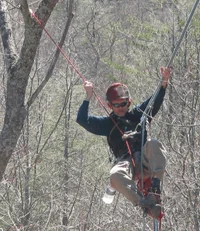
Attachment: Hooking transfer w/ ropeman cam and single line footlock assist.
I'm working on replacing the bungee cord and will post that at a later date.
Also great for:
1.) Pulling out hangers from below you.
2.) Picking up the chainsaw or polesaw you forgot to attach to the end of your line after you're 20 feet (or whatever length you have attached to the hook) into your assent.
3.) Pulling a small tree, that you need to prune, to your position and 2 hand cutting while the cam holds it in position.
4.) Hooking the crotch of a branch that you need to cut, with 2 hands (right), so that it's temporarily held until you can chuck it with precision ( I NEVER drop anything from the tree without aiming for a target, it's good practice; heads up ken! Oh yeah, we're not allowed to say "heads up", I missed that class). It's great for those heavier limbs that you don't want to take straight to hand in order to prevent the muscle strain/back strain you might experience trying to undercut with the chainsaw and top cut with the handsaw and hold directly with the free hand. Typically, I put the cam 'biner straight to my lower SportJack 'biner and tension as needed (yeah, I've climbed with the Jack for 12 years now; I'm lazy, it's embarrassing but I still get the job done). And you wonder why I had to leave ArborMasters ...
5.) The hook can be used as a temporary triangulation point and/or adjustable (to the length of rope attached to it) re-direct. With both uses it is somewhat retrievable from a distance.
6.) It can be used as an equipment station for holding chainsaw, pole or whatever else. Unlike a sling and a "biner", you can just grab the hook and move to another limb as you maneuver to your next position.
**ON A SIDE NOTE, I never did get Epple's permission to post that pic. I need to ask the manufactures out there not to steal his idea without giving him some credit/royalty (fat chance!). Prove me wrong and call the guy up and order a couple hundred of them. Ronny is a multiple time German TCC with possibly a European title in there somewhere. He's very photogenic and would be a great endorsement in someone's catalog. Anyway, I'm sure he understands how the climbers/riggers are and that, after seeing the tool, they're likely to make some version on their own (the port-a-wrap and bollard are perfect examples). That's just how we are (I should say, you are, because I'm mechanically brain-dead - but I can keep my chainsaws running). Anyway, what's done is done.
**Okay, talked with Ronny, got spanked, he's over it, moven on...
For more information please contact Ronny Epple at:
ronny@baumkletterteam.com
New contact number: 01149-171-17-420-63
Originally posted:
rawtree,Mar 17, 2010

treegongfu
Branched out member
Great post! Now I know what I've been missing.

treebing
Been here much more than a while
- Location
- Detroit, Mi.
i wonder why the DMM version did not inclued the bungee and the ball holder. Talking to fanatics of the original epple hook, that bungee is very important in keeping the hook from snagging every limb in the tree as you climb around. although the hooking danger might not be so bad if you carry it from the bottom of the J


